Utah Divorce Papers: How to File Correctly in 2026
Written and reviewed by the divvi team. How we research and check this.

How to quickly get and file Utah divorce papers
Utah divorce papers are prepared through MyPaperwork, the official Utah Judiciary form preparation tool, then filed manually with your county court clerk. The court’s divorce filing instructions list email, mail, and in-person submission for self-represented filers.
Here is what you need to file:
- Petition for Divorce (the primary document stating your grounds and requests)
- Summons (notifies your spouse of the case)
- Domestic Relations Injunction (automatic restraining order on assets)
- Financial affidavits (required when children or alimony — spousal support — are involved)
- Certificate of Divorce from the Utah Department of Health (filed alongside the Petition; frequently overlooked, causing delays)
Submission methods accepted by the court:
- In person: Bring printed documents to the courthouse clerk's office
- Email: Send PDFs to your court's designated email address; write "New filing for [your name]" in the subject line; documents must be in English, completely filled out, black and white, PDF format only
- Mail: Slowest option; your case is not filed until the court physically receives the papers
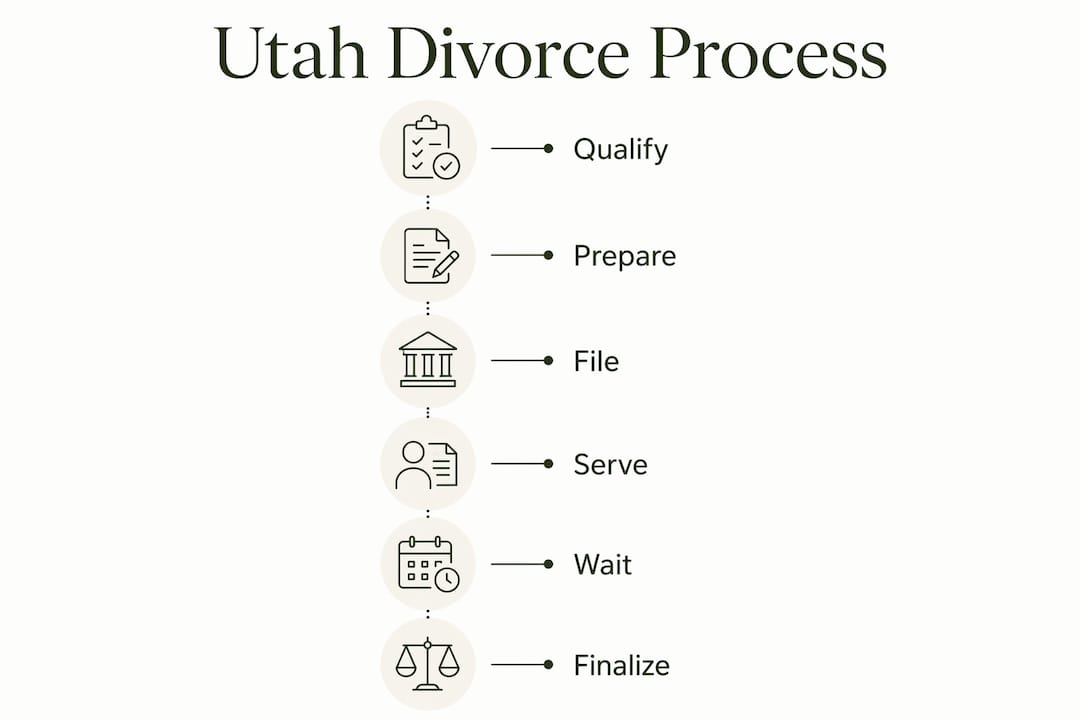
Your spouse must be served within a specific window after filing. Residency must be established before you file. And if you have minor children, mandatory education courses apply before the court will finalize anything.
Scam warning: Utah courts never request payment through unsolicited texts or QR codes. Use only official Utah Judiciary websites ending in .gov for any payment or filing action.
Do you qualify to file for divorce in Utah?
Residency is the first gate. Miss it, and your case gets dismissed before it starts.
- 3-month county residency: Either you or your spouse must have lived in the same Utah county for at least 3 months immediately before filing
- Military exception: Active-duty service members stationed in Utah under orders may qualify even without meeting the standard 3-month window
- Grounds for divorce: Utah accepts irreconcilable differences as sufficient grounds; you do not need to prove fault. Additional grounds exist under Utah Code 81-4-405 if applicable
- Parents: If minor children are involved, the court will also consider where the children have lived, which can affect jurisdiction over custody matters
Check the Utah divorce laws in 2026 guide for a full breakdown of qualifying criteria before you file.
What does MyPaperwork actually do for your divorce forms?
MyPaperwork is the official Utah court form preparation system. It asks you a series of questions and builds your paperwork based on your answers, so you are not staring at a blank legal form trying to guess what goes where.
- Supports both petitioners (the spouse filing) and respondents (the spouse responding)
- Covers divorce, parentage, protective orders, name changes, and more
- Generates forms specific to your situation: children or no children, contested or uncontested
One thing to understand clearly: MyPaperwork prepares your documents but does not file them. Download the finished divorce forms and follow the court’s instructions for submitting them by email, mail, or in person.
Choosing a preparation tool? Compare divvi and MyPaperwork for Utah divorce, including guided preparation, shared review, and filing responsibilities.
After you complete the interview and click "Sign and Download," processing takes at least 15 minutes and can run up to an hour during busy periods. Watch for a confirmation email from MyCase.
Pro Tip: Download your completed forms within 7 days of generation. After that, MyPaperwork deletes them and you have to restart the entire download process.
Filing fees, waiting periods, and mandatory parent education
The filing fee for a Utah divorce applies. If you cannot afford it, a fee waiver application can be submitted alongside your initial paperwork. Do not let cost stop you from filing; the waiver process exists specifically for this.
- 30-day waiting period: Utah generally requires 30 days between filing and finalizing a divorce. You can ask the court to waive the wait for extraordinary circumstances; an agreement alone does not waive it.
- Parent education courses: If you have minor children, both parties must complete required education courses before the court will finalize the divorce
- Service deadlines: After filing, you must serve your spouse. Once served, your spouse has 21 days to respond if served in Utah, or 30 days if served outside the state
Filing cost snapshot: $358 court filing fee + ~$65 parent education (if applicable) + service fees. You may be able to ask the court to waive the fee.
Pro Tip: Serve your spouse promptly after filing. Delays in service can delay the case, but the 30-day waiting period starts when the petition is filed, not when your spouse is served.
Use the divorce cost estimator to get a clearer picture of your total expected costs before you file.
Who can access your Utah divorce records?
Divorce case filings are public records in Utah. That means anyone can request them unless a judge specifically orders them sealed.
- Sealing: A court can seal specific documents or the entire file, but only by judicial order and only for compelling reasons
- Both spouses always have access to their own case documents regardless of sealing status
- Certified copies of your final divorce decree are available from the court clerk that handled your case. Fees typically run $5–$15 per certified copy
- To find the right court, use the Utah Courts directory to locate contact information for the specific courthouse
If you need your decree for a name change, refinancing, or remarriage, order a certified copy directly from the clerk rather than relying on a printout.
How to spot and avoid Utah court payment scams
Utah courts do not send unsolicited texts asking for payment. They do not use QR codes to collect filing fees. If you receive a message like that, it is a scam.
- Legitimate payments for divorce filing fees are made in person at the courthouse, by check or money order through the mail, or through official portals on Utah Judiciary websites ending in .gov
- Never pay through a link sent via text, email from an unofficial address, or any third-party payment app
- Verify every URL before entering payment information; the official Utah court system lives at utcourts.gov
Scammers specifically target people in active legal proceedings because they know those individuals are anxious and less likely to question an urgent-sounding payment request. When in doubt, call the courthouse directly using the number listed on utcourts.gov.
How Divvi simplifies Utah divorce paperwork beyond official tools
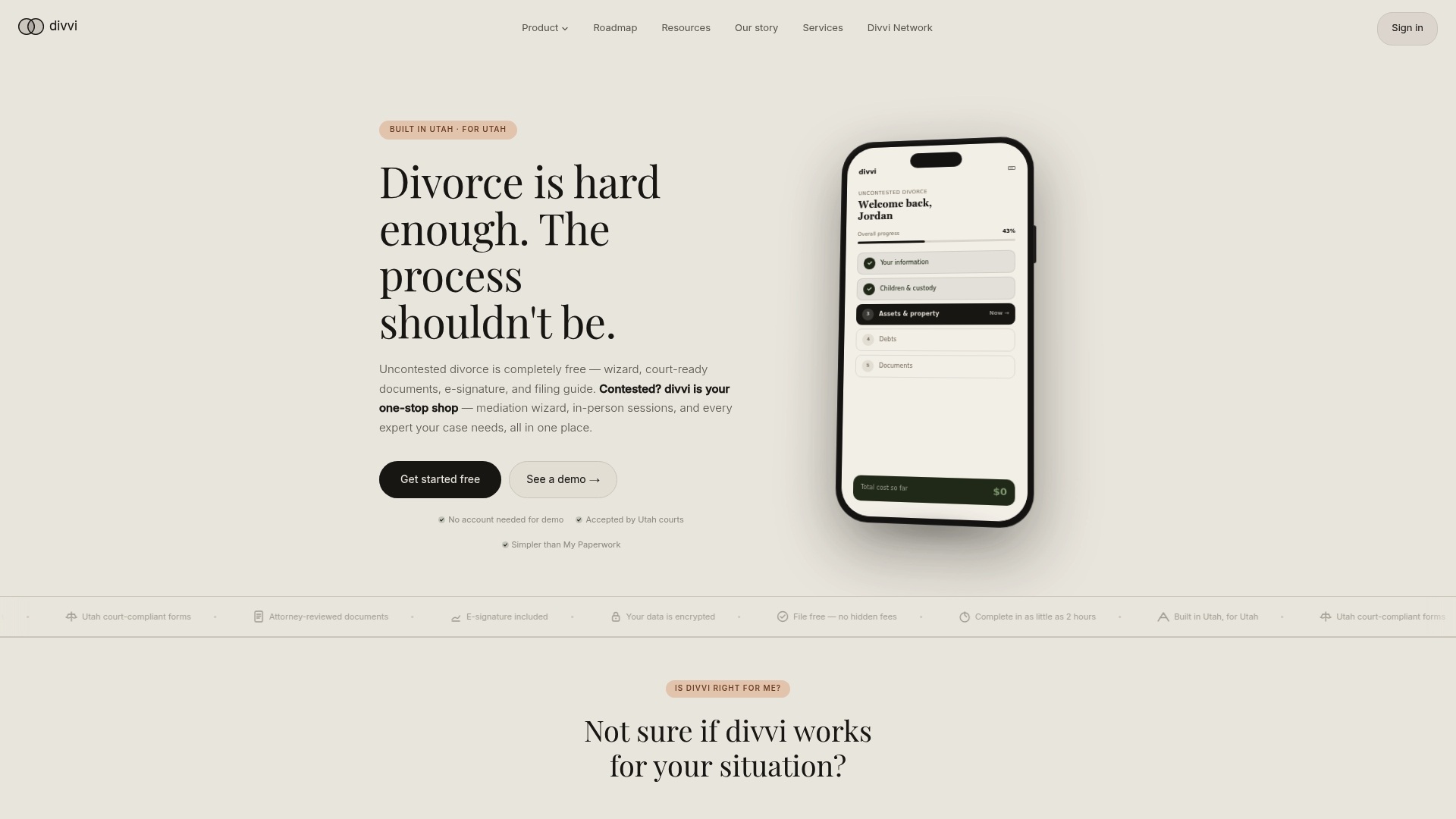
Official tools like MyPaperwork handle form generation, but they don't walk you through each question in plain language, flag errors before you file, or help when your spouse stops cooperating. That is where Divvi fills the gap.
- documents designed for filing in about 40 minutes via a guided step-by-step wizard. About 40 minutes is the paperwork, not how long the divorce takes. Timing varies by court and by case. Utah law generally doesn't let a judge enter a decree until 30 days after the petition is filed, and the court can waive that wait only in extraordinary circumstances. Many uncontested divorces typically finish in about 6 weeks to 4 months from filing, but that isn't a promise.
- Uncontested and contested divorce support, including AI-assisted and human mediation options
- Post-divorce tools: child support calculators, alimony estimators, co-parenting resources, and decree modification support
- Professional network: connections to qualified mediators and independent real estate agents and financial advisors when your situation requires more than documents. divvi is not a law firm and can't give legal advice.
- Freemium model: the base platform is free; you pay only for the specific services you actually need
Pro Tip: Before submitting anything to the court, run your documents through Divvi's document audit tool to catch gaps or errors that could delay your case.
How to fill out Utah divorce forms correctly
Every field on a Utah divorce form matters. Incomplete or incorrect forms get rejected, which restarts your timeline.
Start with the Verified Petition for Divorce. This document states your name, your spouse's name, the date and place of marriage, grounds for divorce, and what you are asking the court to order (property division, custody, support). Write clearly and completely. Courts require forms in English, filled out in full, submitted as PDFs.

For financial disclosures, form 1052FAJ covers income verification and child support compliance. Form 1004FA lets either party report what they know about the other's income. If you are disputing a proposed order, form 1113FA is the objection form. Log into MyPaperwork to confirm which specific forms apply to your case type.
Do not leave any field blank unless the form explicitly says "if applicable." Courts treat blank fields as incomplete, not as "not applicable."
How to serve divorce papers on your spouse
Serving your spouse is a legal requirement, not a courtesy. The case cannot move forward until proper service is completed and documented.
- Do not serve the papers yourself. Utah requires service by an authorized third party, such as a process server, sheriff's deputy, or another adult who is not a party to the case.
- Deliver the correct documents: the Petition for Divorce, the Summons, and the Domestic Relations Injunction.
- File Proof of Service with the court after service is completed. This document confirms when, where, and how your spouse was served.
- Alternative service: If your spouse cannot be located, you can request court permission to serve by publication or another approved method. This requires a separate motion.
Improper service is one of the most common reasons self-represented divorces stall or get dismissed. Get it right the first time.

Uncontested vs. contested divorce in Utah: what changes
The paperwork starts the same. What diverges is the process after filing.
Uncontested divorce means both spouses agree on all terms: property, debt, custody, support, and everything else. After the 30-day waiting period, you submit final decree documents and the judge signs without a hearing in most cases. It is faster, cheaper, and far less stressful. Read the full uncontested divorce guide for step-by-step instructions.
Contested divorce means at least one issue is unresolved. The court schedules hearings, may order mediation, and both parties may need to submit additional financial disclosures and parenting plans. Timelines stretch from months to over a year depending on complexity. Divvi's contested divorce support covers mediation and document preparation for these cases.
The single biggest factor in cost and timeline is whether you and your spouse can reach agreement before the court has to decide for you.
Supporting documents you need to file with the divorce papers
Beyond the core petition and summons, Utah courts require several additional documents depending on your situation.
- Certificate of Divorce (Utah Department of Health form): required with every initial filing; missing this is a common delay
- Financial affidavit (form 1052FAJ): required if you have children under 18 or are requesting alimony
- Income disclosure (form 1004FA): used by either party to report the other's known income
- Parenting plan: required if minor children are involved; outlines custody and visitation arrangements
- Child support worksheet: courts need this to calculate the appropriate support amount
- Proposed divorce decree: a draft of what you want the final order to say; MyPaperwork generates this based on your answers
Log into MyPaperwork after completing your interview to see the complete list of forms generated for your specific case.
How to amend or correct filed divorce papers
Mistakes happen. Filing an incorrect form does not end your case, but you need to act quickly.
If you catch an error before the court processes your filing, contact the clerk's office immediately. In some cases, you can retrieve and replace the document before it enters the record.
If the case is already open, you file an amended petition or a motion to correct depending on what needs to change. Minor clerical errors (a misspelled name, a wrong date) are typically corrected through a simple stipulation signed by both parties. Substantive changes to what you are requesting require a formal amended filing and may require your spouse's response.
For errors in a final divorce decree, you file a motion to modify or a motion to correct clerical error under Utah Rules of Civil Procedure Rule 60. This is a separate legal action and has its own deadlines. Act fast; some corrections must be filed within a specific number of days of the decree being signed.
What happens after you file: hearings and finalization
Filing starts the clock. Here is what follows.
The 30-day waiting period runs from the date you file the petition, not from service. During this time, the court generally will not finalize the divorce. Use this window to complete parent education courses if required, gather any remaining financial documents, and confirm your spouse has responded or defaulted.
If your divorce is uncontested, you return to MyPaperwork after the waiting period to generate final decree documents. You then file those with the court. In straightforward cases, a judge may sign without scheduling a hearing.
If your divorce is contested, the court will schedule hearings to address unresolved issues. These can include temporary orders hearings (covering custody or support while the case is pending), mediation sessions, and a final trial if no settlement is reached. The judge issues the divorce decree at the conclusion of the process.
You are not legally divorced until the judge signs the decree. Once signed, contact the court clerk to obtain your certified copy for your records.
Key Takeaways
Filing Utah divorce papers correctly from the start saves weeks of delays and avoids costly refiling.
| Point | Details |
|---|---|
| Use MyPaperwork for forms | Utah's official tool generates the divorce documents; you must download and file them yourself. |
| $358 filing fee | You may be able to ask the court to waive the filing fee. |
| 30-day mandatory wait | No divorce decree can be issued until 30 days after filing, even in fully uncontested cases. |
| Serve papers properly | An authorized third party must serve your spouse; improper service halts the entire case. |
| Contested vs. uncontested | Agreement on all terms keeps the process short; unresolved issues trigger hearings and extend timelines significantly. |