Mediation with a Narcissist: A Safety-First Guide
Written and reviewed by the divvi team. How we research and check this.

Yes, mediation with narcissist dynamics can work, but only with real safeguards in place. If there's domestic violence or coercive control involved, the answer flips to no. That distinction matters more than anything else in this guide.
Family-law policy has caught up to this reality. England and Wales rejected compulsory mediation in 2024 specifically to protect domestic abuse survivors from being forced into a room with someone who could use the process against them. That's the backdrop for everything below: methods like the BIFF technique from the High Conflict Institute, and court-recognized apps like OurFamilyWizard, exist because standard mediation assumptions don't hold when one party is manipulating rather than negotiating.
Here's the short version before we get into the details:
- Mediation can work when there's no active safety threat, both parties have legal representation, and the mediator uses caucus or shuttle sessions.
- Non-negotiable safeguards include a written-only communication channel, documented behavior patterns, and a pre-set walk-away point.
- Stop and escalate to court the moment you see coercive control, safety threats, or a pattern of the process being used to punish rather than resolve.
Key Takeaways
Mediating with a high-conflict or narcissistic co-parent works only when documentation, a written channel, and mediator safeguards replace trust as the foundation of the process.
| Point | Details |
|---|---|
| Screen for safety first | Domestic violence or coercive control makes mediation inappropriate without special protections like caucus sessions. |
| Document, don't diagnose | Courts act on timestamped records and behavior patterns, not on personality labels. |
| Use BIFF and grey-rock | Brief, Informative, Friendly, Firm replies and low-reaction responses limit what the other party can escalate. |
| Vet your mediator | Ask directly about high-conflict experience, DV screening, and caucus policy before committing. |
| Get platform-level support | Divvi offers mediation support, optional attorney referrals, and modification tools for Utah families navigating this exact situation. |
Table of Contents
- What narcissistic behavior actually looks like in mediation
- When mediation is unsafe or likely to fail
- How to prepare before you ever sit down at the table
- Communication tactics that hold up under pressure
- What a mediator should do when neutrality isn't enough
- When to walk away from mediation entirely
- Tools that create a record courts actually trust
- Scripts you can use without overthinking them
- Getting professional support when mediation gets complicated
- Frequently asked questions
- Sources
What narcissistic behavior actually looks like in mediation
Courts don't rule on personality labels. They rule on documented behavior. That's why recognizing the patterns matters more than diagnosing the person.
Watch for these in the room:
- DARVO (Deny, Attack, Reverse Victim and Offender): they flip the narrative so you look like the aggressor.
- Charm offensive toward the mediator: cooperative and reasonable in front of the neutral party, then rigid or hostile the moment it's just the two of you.
- Gaslighting: denying things they said minutes earlier, sometimes in the same session.
- Document dumping: burying you in paperwork to exhaust your attention before the real issues get discussed.
- Interrupting and dominating: talking over you until the mediator starts treating their version as the default.
- Unreasonable anchoring: opening with an absurd custody split or asset demand to make a merely unfair offer look like a compromise.
Picture this: a co-parent agrees calmly to a holiday schedule in the joint session, then texts an hour later claiming they "never agreed to that" and demanding a redo. That's not a misunderstanding. It's a pattern, and a timestamped record is what stops it from becoming your word against theirs.
When mediation is unsafe or likely to fail
Some situations call for skipping mediation altogether, or at least demanding heavy modifications before you agree to sit down.
Red flags that should make you pause:
- Any history of domestic violence or physical intimidation.
- Coercive control: financial restriction, isolation from family and friends, surveillance of your phone or movements.
- Ongoing fear for your physical safety or your children's safety.
- Repeated threats, even veiled ones, tied to custody or money.
- A pattern of using the kids as leverage or messengers.
- Chronic no-shows or last-minute cancellations at exchanges, designed to create instability.
If you check any of these boxes, request a formal domestic violence screening before mediation starts, insist on caucus (shuttle) sessions so you're never in the same room, and bring an advocate or attorney with you. If the other party or the mediator resists these accommodations, that's your signal to pause the process and move toward court instead. Policy shifts like the one in England and Wales exist precisely because mandatory mediation isn't appropriate when coercive control is in play.
How to prepare before you ever sit down at the table
Preparation is where most of your leverage gets built, long before the mediator says a word.
- Choose your mediator carefully. Look for someone with specific experience in high-conflict cases, not just general family mediation. A directory of vetted Utah mediators can save you from learning this the hard way.
- Bring counsel, even briefly. An attorney doesn't need to sit through every session, but a pre-mediation consult sets your walk-away point.
- Define your bottom line in writing before you arrive. Know exactly what you'll accept and what triggers you leaving the room.
- Lock down a single communication channel. Stop replying to texts, calls, or emails outside of it.
- Gather your evidence now, not the night before. A structured discovery checklist helps you organize bank statements, missed-exchange logs, screenshots, and school or medical records into something a mediator or judge can actually use.
- Request caucus or shuttle mediation in advance, in writing, so it's not a surprise negotiation on the day.
Pro Tip: When you get your private caucus time with the mediator, don't vent. Hand them a one-page written summary: dates, incidents, and what you need addressed. Say, "Here's the pattern I need you to be aware of," and let the paper do the talking. Mediators remember documents far better than emotional accounts.
Communication tactics that hold up under pressure
The goal in-session isn't to win an argument. It's to stay boring, factual, and unbaited.

The BIFF method (Brief, Informative, Friendly, Firm) from the High Conflict Institute works because it gives you a template instead of forcing you to improvise under stress. A BIFF reply to a provocative claim might sound like: "I have the pickup schedule from March 3rd showing a different time. I'll follow what's in the agreement." No apology, no lecture, no bait taken.
Grey-rocking pairs well with BIFF when someone is fishing for a reaction: you go flat and uninteresting, offering nothing for them to escalate against.
Other tools to keep in your pocket:
- Broken record technique: repeat your position in the same words, calmly, as many times as needed.
- Reality-testing asks: "Do you have documentation for that?" This single question deflates a lot of unsupported claims fast.
- A rehearsed exit line: "I'm ending this conversation now. We can continue in writing."
Pro Tip: Journal immediately after every session while details are fresh, even a few bullet points on your phone. That record becomes invaluable if the same disputed claim resurfaces three months later.
What a mediator should do when neutrality isn't enough
Standard mediation assumes both people are negotiating in good faith. When that assumption breaks down, the process needs to change, not just your attitude toward it.
Look for a mediator willing to offer:
- Caucus/shuttle sessions, so you're never negotiating face-to-face.
- Trauma-informed screening at intake, not just a generic questionnaire.
- Room for an advocate or attorney to sit in, even silently.
- Evaluative input when needed, rather than staying purely facilitative if one party is dominating.
- Written, enforceable drafts after every session, closing the door on "I never agreed to that."
Before you commit to anyone, ask directly about their experience with high-conflict personalities, their DV screening process, and their policy on caucus requests. A mediator who bristles at these questions is telling you something important. These adaptations do slow down straightforward negotiation, but that tradeoff buys safety and a fairer outcome.
When to walk away from mediation entirely
Mediation isn't a moral obligation. If it keeps failing, the right move is often structural, not more patience.
Parallel parenting replaces cooperative co-parenting when repair attempts keep getting weaponized instead of returned. It separates major legal decisions from day-to-day logistics, which reduces the surface area for conflict. Compare your options:
- Parallel parenting: minimal direct contact, decisions divided by category, best when cooperation itself is being exploited.
- Supervised exchanges: a neutral third party or location handles handoffs, useful when safety at exchanges is the core issue.
- Arbitration or court: a binding decision from someone with authority, appropriate once mediation has clearly stalled or safety is compromised.
A rough escalation path looks like: immediate safety steps first, then a documentation phase, then a request for supervised exchanges or a guardian ad litem, then filing for modified or temporary orders if needed.
Whatever path you take, never use your kids as messengers, and keep their routines as predictable as you can. Children absorb instability faster than they absorb conflict itself.
Tools that create a record courts actually trust
Courts don't take your word for it, and they don't take theirs either. They look at timestamped, tamper-resistant records.
OurFamilyWizard and TalkingParents both log every message with a timestamp that neither party can quietly edit later. Move every conversation onto one of these platforms and stop responding anywhere else, including texts and phone calls.
A few habits make this system work:
- Back up your records periodically outside the app itself.
- Register with school and medical portals directly so you're not relying on the other parent to relay information.
- Screenshot and timestamp anything that happens outside the app, like an in-person comment at a handoff.
Judges consistently respond to documented patterns, not accusations. A log of missed exchanges beats a paragraph describing how frustrating someone is, every time.
Scripts you can use without overthinking them
Having language ready in advance means you're not composing a response while your heart rate is spiking.
- Caucus briefing: "Here's a one-page summary of the pattern I've documented. I need the process to account for this."
- BIFF reply to a false claim: "The agreement states pickup is at 5:00 PM. I'll follow that unless we update it in writing."
- Exit line at a handoff: "I'm not discussing this here. Anything further goes through the app."
- Request for evidence: "Do you have documentation for that? I can review it once it's in writing."
Avoid long emotional explanations, apologizing for having boundaries, or re-litigating old arguments. Each of those hands over material to work with. A single BIFF sentence deflates most bait attempts because there's nothing left to argue with.
A practical note on why this approach works
In these cases, the people who do best are not the ones who win the argument. They're the ones who stopped trying to be believed and started building a paper trail instead. This guide leans on documented behavior, child safety, and realistic expectations, not on convincing anyone that the other parent is a narcissist. That fight is unwinnable and unnecessary.
Getting professional support when mediation gets complicated
Mediation with a difficult co-parent often needs more than good scripts. It needs someone reviewing the paperwork, matching you with the right professionals, and making sure whatever gets agreed to actually holds up in court.
Divvi's mediation support connects Utah users with mediators experienced in high-conflict cases, converts mediated agreements into documents designed for filing, and provides attorney referrals when a case turns contested. If you're already past mediation and need to change an existing custody or support order, mediated modification support handles that without starting from zero. And if the other side won't cooperate at all, Divvi's contested case tools connect you directly with an attorney rather than leaving you to figure it out solo. If safety is a concern at any point, a resource like understanding protective orders is worth reading before your next exchange. Start by visiting the mediation page and see which level of support fits your situation.
Frequently asked questions
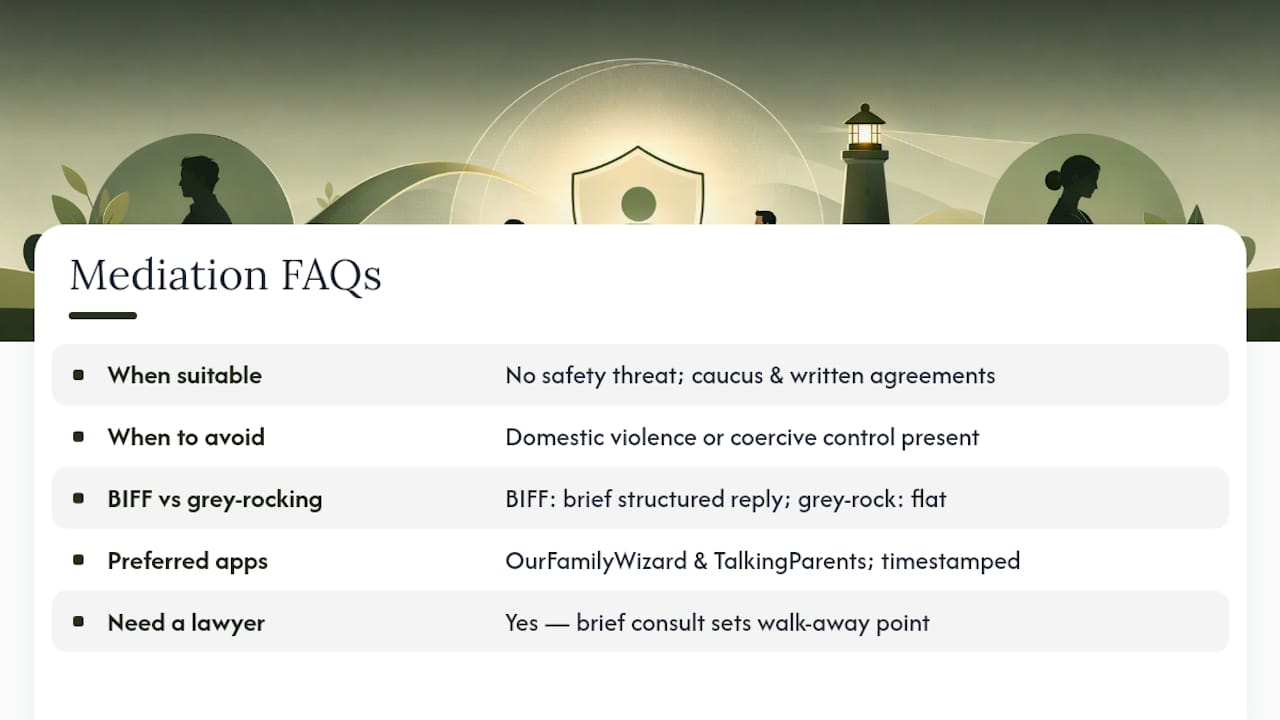
Is mediation with a narcissist ever a good idea? It can work when there's no active safety threat and the mediator uses process adaptations like caucus sessions and written agreements. It's not advisable when domestic violence or coercive control is present.
What's the difference between BIFF and grey-rocking? BIFF is a reply structure for written communication: Brief, Informative, Friendly, Firm. Grey-rocking is a broader posture of giving flat, uninteresting responses to avoid feeding a reaction-seeking pattern.
Which co-parenting app do courts prefer? OurFamilyWizard and TalkingParents are both widely accepted because they timestamp messages and prevent either party from editing history after the fact.
When should I stop mediating and go to court? Stop when you see safety threats, coercive control, repeated bad-faith proposals, or a pattern where agreements get denied shortly after being made. At that point, parallel parenting or a formal court filing is usually the safer path.
Do I need a lawyer if I'm already using a mediator? Legal representation, even for a brief consult before sessions, helps you set a realistic walk-away point and understand what's enforceable in your jurisdiction.
This article is general information, not a substitute for advice from a qualified lawyer. Consult a qualified legal professional about your own circumstances before acting on anything here.
Sources
- Professional mediation guidance and policy changes on mediation safety
- The Narcissistic Co-Parent: Boundaries & Protecting Kids - Co-Parenting Guide
- Mediation with a Narcissist | Expert Guide | Mediate UK
If you're in immediate danger, contact a domestic violence hotline or local law enforcement before considering any mediation process.