Can You Seal Divorce Records in Utah? Here's the Real Answer
Written and reviewed by the divvi team. How we research and check this.
If you're wondering whether you can seal divorce records in Utah, the short answer is: not usually, and probably not the way you're imagining. Since April 1, 2012, Utah has classified divorce records as private by default, which already blocks casual public access. True sealing, where even the parties themselves need a court order to look at a document, is reserved for a narrow slice of cases and requires a specific motion.
Here's what that means for you right now:
- If you haven't filed yet: mark your sensitive documents "private" at the time of filing rather than waiting to fix it later.
- If your case is already open or closed: contact the court clerk who handled your divorce to ask what classification currently applies and whether you need to file a motion to change it.
- If you're worried about safety or identity theft: talk to an attorney or a service like Divvi about filing a motion to classify or seal specific documents under Rule 4-202.04, and consider whether the situation calls for a protective order instead.
- If you need a copy of your decree: find the court that handled the case through the Utah Courts directory, or contact Vital Records for certain certificate requests.
Most people asking about sealing actually want privacy, not invisibility. Those are different goals, and Utah's court rules treat them differently.
Key Takeaways
Utah treats divorce records as private by default, but true sealing requires a specific court order and applies to a narrower category of documents than most people expect.
| Point | Details |
|---|---|
| Private is automatic | Divorce cases filed since April 1, 2012 are private by default, with no motion required. |
| Sealed is rare and specific | Sealing requires a court order under Rule 4-202.04 and applies to limited document categories. |
| Some documents stay visible | Final decrees and certain motion orders often remain accessible even in private cases. |
| Classify early, not later | Marking documents private at filing is easier than petitioning to seal them afterward. |
| Copies come from two places | Contact the court clerk for certified decrees and Vital Records for certificate authentication. |
Table of Contents
- What "Private," "Protected," and "Sealed" Mean Under Utah Court Rules
- Who Can View Divorce Records in Utah, and What the Exceptions Look Like
- Which Divorce Documents Stay Public Even When Your Case Is Private
- How to Petition to Seal Divorce Records or Classify Documents as Private
- Filing Best Practices That Keep Your Divorce Records Private From Day One
- How a Third Party Can Request Access to Sealed Divorce Records
- If Your Privacy Was Exposed: What to Do in the First 72 Hours
- Where to Get Copies of Divorce Decrees and Sealed Records
- How Divvi Helps Utah Users Protect Privacy During Divorce
- Frequently Asked Questions
- Sources
What "Private," "Protected," and "Sealed" Mean Under Utah Court Rules
Utah's Code of Judicial Administration sorts court records into a handful of access tiers, and mixing them up is the single most common mistake people make when they search for how to protect a divorce file.
Private records are the default status for divorce cases filed after April 1, 2012. The parties, their attorneys, and court staff can see them, but the general public cannot pull them up on request. This is automatic. You don't need to ask a judge for it.
Protected records sit in a middle tier. They're not fully public, but they're also not locked down as tightly as sealed records. Access typically depends on the type of information involved, such as certain financial disclosures or juvenile-related material, and who is requesting it.
Sealed records are the strictest category, and Utah Courts explains that accessing a sealed record requires a court order, full stop. Even the parties to the divorce may need to petition the court to view a sealed document if the seal was written broadly. This is why sealing is rare. Judges don't hand it out for embarrassment or convenience. UCJA Rule 4-202.02 spells out exactly which categories of records fall into sealed versus private status, and the list is narrower than most people expect.
| Classification | Who can view it | How to get access |
|---|---|---|
| Private | Parties, attorneys, court staff | Automatic for divorce cases since 2012 |
| Protected | Limited parties, sometimes specific agencies | Depends on record type and rule provision |
| Sealed | Court order required, even for parties in some cases | File a motion under Rule 4-202.04 |
Pro Tip: Don't assume "private" and "sealed" are interchangeable when you're filling out forms or talking to court staff. Ask the clerk which classification applies to your specific document, not your case as a whole, since classification can vary document by document.
Who Can View Divorce Records in Utah, and What the Exceptions Look Like
Even under the private classification, more people can see your divorce file than you might think.
- The parties themselves and their attorneys always retain access to their own case file.
- Court staff and judges need full access to manage and rule on the case.
- Certain government agencies may have statutory access for enforcement purposes, such as child support agencies.
- Opposing counsel in related litigation may petition for limited access if the divorce record is relevant to another case.
Sealed records work differently. Nobody outside the court, not even a party, gets to open a sealed document without asking a judge first. That's the practical distinction that trips people up: private records are hidden from the public but open to the people inside the case, while sealed records can be hidden from everyone until a judge says otherwise.
Exceptions exist on both sides. A final decree of divorce is generally treated as a public-facing document even though the surrounding case file is private, largely because the decree itself often needs to be presented to third parties like banks, employers, or the Social Security Administration. Certain motions and rulings, especially ones that don't touch financial or custody detail, can also remain visible on the docket even in an otherwise private case.
Which Divorce Documents Stay Public Even When Your Case Is Private
This is the part that catches people off guard. You mark your case private, breathe a sigh of relief, and then discover that a handful of documents are still sitting in plain view.
- The final decree of divorce (or portions of it) often remains accessible, since it functions as proof of the legal change in marital status.
- Orders ruling on motions, like an order waiving the standard waiting period, frequently stay on the public docket even in private cases.
- Parts of parenting plans tied to enforcement or modification proceedings can surface again later if either party goes back to court.
- Docket entries themselves (the case number, filing dates, party names) are often visible even when the substantive documents inside are not.
The risk here isn't abstract. If you attach a full financial disclosure or a detailed account of a custody dispute to a motion that ends up on the public docket, that sensitive information can leak out through the back door even though your overall case is technically private.
Pro Tip: Redaction and classification solve different problems. If a document has a paragraph or two of sensitive material, redact that specific text before filing. If the whole document is sensitive from top to bottom, don't bother redacting line by line, ask the court to classify the entire document as private or protected instead.
How to Petition to Seal Divorce Records or Classify Documents as Private
If your case already exists and something in it needs stronger protection than the default private status, you'll need to file a motion. Here's the general flow.
- Identify the exact case and document. You need the case number and a clear list of which documents or portions you want reclassified, not a vague request to "seal my divorce."
- Confirm the court still has jurisdiction. If your case is closed, you may still be able to petition, but the process and standard can differ from an active case.
- Prepare a motion or petition under Rule 4-202.04. This is the rule that governs requests to classify or access a record, and it lays out the factors a judge weighs when deciding whether to grant your request.
- Include a proposed order and, where possible, a redacted public version. Giving the judge a ready-to-sign order and showing what the public-facing version would look like makes approval far more likely.
- Serve the other party unless the court excuses service for genuine safety reasons.
- Attend the hearing, if one is scheduled, prepared to explain why your privacy interest outweighs the public's general right to access court records.
What actually persuades a judge? Safety concerns, documented risk of identity theft, and statutory privacy interests carry real weight. Vague discomfort about an ex-spouse or the public knowing about the divorce generally does not. The court can also land somewhere in between what you asked for and full denial, ordering partial sealing or targeted redaction instead of sealing the whole file.
Rather than trying to draft precise legal language yourself, describe the harm you're trying to prevent and let the specifics of your situation, minor children involved, a documented safety threat, financial exposure, shape the argument.
Pro Tip: Classifying a document as private the moment you file it is dramatically easier than trying to seal it after the fact. Retroactive sealing means convincing a judge to undo something that's already been accessible; classification at filing means it was never exposed in the first place. If you're still preparing your paperwork, call the clerk's office before you file, not after.
Filing Best Practices That Keep Your Divorce Records Private From Day One
Most privacy problems in divorce cases aren't the result of a hostile third party digging through court files. They're the result of a document getting filed without the right classification attached. A few habits prevent most of that.
- Mark documents "private" at the point of filing, not after the fact. Ask the clerk's office directly which cover sheet or classification option applies if you're filing on paper or through the court's e-filing system.
- Use initials or case-specific identifiers for minor children instead of full names in any document likely to remain visible on the docket.
- Prepare a redacted public copy alongside the full private version when you know a document contains a mix of sensitive and non-sensitive information, following the substitution guidance under Rule 4-202.09(9).
- Check the current classification forms and instructions on utcourts.gov before filing, since procedural details occasionally change.
- Work with the clerk's office or a platform like Divvi to confirm classification is applied correctly the first time, rather than discovering a gap after the document is already on file.
Pro Tip: Check the metadata on any PDF you upload to the court's e-filing portal. Track-changes comments, hidden spreadsheet tabs in financial disclosures, and author names buried in document properties have all leaked private information in cases where the visible text looked perfectly clean.
If you're building out your paperwork from scratch, our step-by-step guide to filing an uncontested divorce in Utah walks through where classification decisions come up during the process.
How a Third Party Can Request Access to Sealed Divorce Records
Sometimes the person asking about sealed records isn't a party to the divorce at all. Maybe it's a researcher, a journalist, or someone with a genuine legal interest in what's inside the file. Here's what that process looks like.
- File a motion to unseal with the court that issued the original seal, identifying the specific record and the reason access is being sought.
- Serve the parties to the original case, giving them the opportunity to object.
- Expect a possible in-camera review, where the judge examines the record privately before deciding whether any or all of it should be released.
- Attend a hearing, where the judge weighs the public interest in access against the privacy interest that justified sealing in the first place.
What tends to work: a documented legal interest, like needing the record for a related court proceeding, or a genuine public interest tied to matters of real public concern. What tends to fail: general curiosity, commercial interest in the information, or a desire to use the record for leverage in an unrelated dispute.
- Decisions on motions to unseal can typically be challenged on appeal, though the standard of review favors the trial court's original judgment.
- Hearing schedules and filing procedures for these motions are available through the same Utah Courts self-help resources that cover classification generally.
If Your Privacy Was Exposed: What to Do in the First 72 Hours
If you discover that private or sealed information from your divorce has become publicly accessible, or worse, has been used against you, speed matters.
- Call the court clerk's office immediately to flag the exposed document and ask what emergency options exist.
- File an emergency motion to reclassify or redact the exposed material if the case is still active or can be reopened for this purpose.
- Contact local law enforcement if the exposure involves a genuine safety threat, particularly in cases involving domestic violence.
- Reach out to legal aid or domestic violence advocacy organizations if cost is a barrier to getting a lawyer involved quickly; several operate statewide in Utah.
- Consider whether a protective order is the right tool, since a protective order and a motion to seal records solve different problems and are often confused. A protective order addresses immediate safety and contact, while sealing addresses document access. You may need both.
Remedies vary depending on how the exposure happened. If a court employee mishandled classification, an emergency motion to correct the record is usually the fastest fix. If your ex-spouse deliberately shared sealed material, a contempt motion may apply on top of any privacy-related relief. Civil claims are possible in more serious cases, but they take time and won't undo an immediate exposure, which is why the emergency motion route usually comes first.
Where to Get Copies of Divorce Decrees and Sealed Records
Once your case is resolved, you'll likely need an actual copy of the decree at some point, for a name change, a mortgage application, or remarriage. Where you get that copy depends on what kind you need.
Certified copies come from the court clerk that handled your original case. You'll need your case number and a valid ID, and the Utah Courts self-help page confirms this is the first stop for most people needing a decree. Fees apply and vary by county, so check with the specific clerk's office.
Exemplified copies go a step further, adding authentication from the judge and clerk that certifies the document is a true copy. These are typically required when you need the decree recognized in another state or country. Vital Records explains the ordering and authentication process, including that the Lieutenant Governor's office handles apostille authentication for documents headed overseas.
Vital Records, part of the Utah Department of Health, handles certain certificate requests separately from the court system, so it's worth checking both if you're not sure which office has what you need. If you're not sure which court handled your original filing, our divorce cost estimator tool includes guidance on locating the right court and estimating associated fees.
How Divvi Helps Utah Users Protect Privacy During Divorce
Getting document classification right at the moment of filing is one of the most overlooked parts of the divorce process, and it's exactly where Divvi spends a lot of its engineering effort. Our platform walks you through the classification decision as you build your paperwork instead of leaving it as an afterthought you discover too late.
That includes:
- Document classification guidance built into the filing wizard, so private and sensitive material gets flagged correctly the first time.
- An attorney referral for users who want a professional set of eyes on a motion to seal or classify before it's filed.
- Filing support: a free step-by-step guide to getting documents to the right court, with divviFile filing assistance included in divvi Mediate Pro.
- Mediation tools for contested situations where privacy concerns are tangled up with disputes over custody or assets.
None of this replaces an attorney, and it shouldn't. If you're pursuing a contested motion to seal, especially one involving safety concerns or a dispute the other party is likely to fight, talk to a lawyer directly. What Divvi can do is make sure the paperwork you generate along the way is built correctly from the start, so you're not stuck filing a retroactive motion to fix a classification mistake six months later. Start with our Utah divorce platform if you want to see how the classification workflow fits into the rest of the filing process.
Frequently Asked Questions
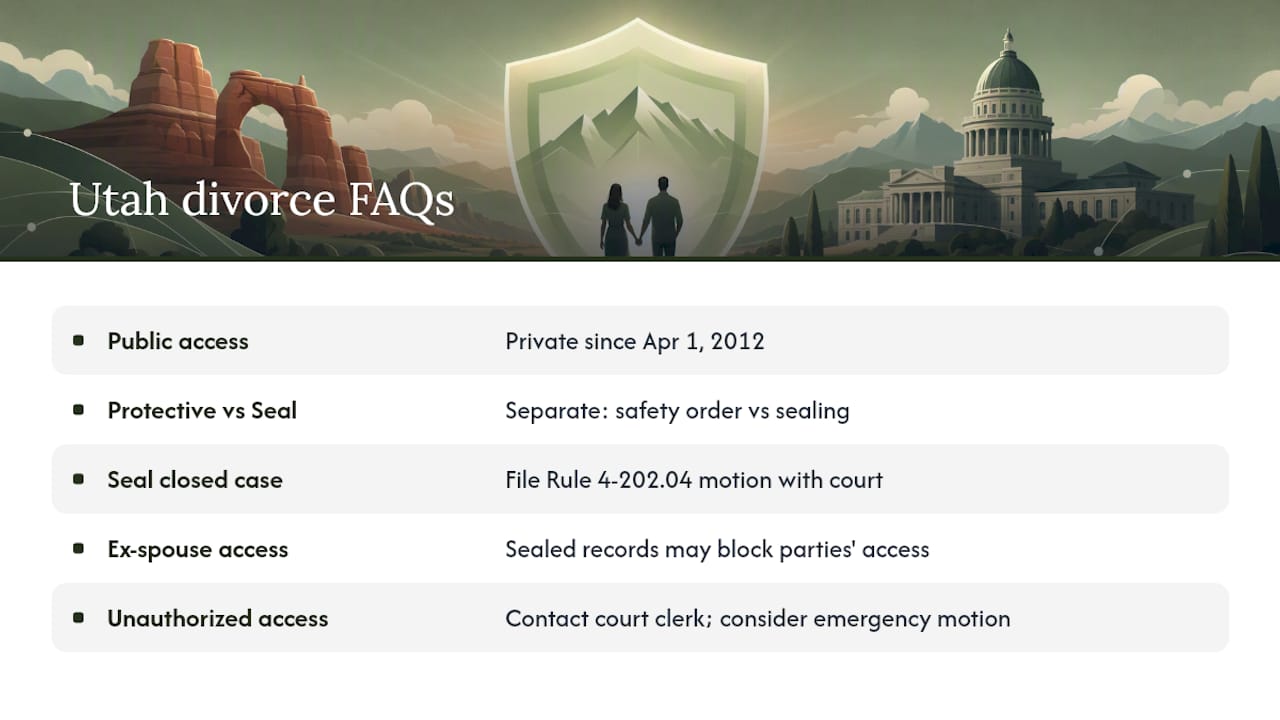
Are divorce records public in Utah? No, not by default. Since April 1, 2012, Utah classifies divorce case records as private, meaning the general public cannot access them on request. Certain documents, like the final decree, may still be visible.
What's the difference between a protective order and sealing divorce records in Utah? They're separate legal tools. A protective order addresses safety and contact restrictions between individuals, while sealing controls who can view specific court documents. You can pursue either one independently, or both, depending on your situation.
How do I seal divorce records in Utah if my case is already closed? You'll generally need to file a motion or petition under Rule 4-202.04 with the court that handled your case, identifying the specific documents and the reason they need stronger protection than the default private classification.
Can my ex-spouse see my sealed divorce records? Not automatically. If a document is genuinely sealed rather than just private, even the parties to the case may need to petition the court for access, depending on how the seal was written.
Where do I get a certified copy of my Utah divorce decree? Contact the court clerk that handled your original case for a certified copy. If you need an exemplified copy for use in another state or country, Vital Records explains the additional authentication steps required.
What should I do if someone accesses my private divorce records without authorization? Contact the court clerk immediately and consider filing an emergency motion. If safety is a concern, contact local law enforcement as well. This is general information, not legal advice, so confirm your specific options with a licensed attorney or the court directly.
This article is general information, not a substitute for advice from a qualified lawyer. Consult a qualified legal professional about your own circumstances before acting on anything here.
Sources
- Divorce — Utah Courts (Self-Help)
- UCJA Rule 4-202.02 — Utah Courts (Code of Judicial Administration)
- Order a vital record certificate — Vital Records, Utah Department of Health
Start with the Utah Courts self-help page for your specific case category, then check the relevant Rule 4-202 subsection if you need the exact legal standard a judge will apply. For older cases where you're not sure whether records still exist or were transferred to archives, the State Archives research guide is the right next stop.