Same-Sex Divorce in Utah: Same Forms, Same Process
Written and reviewed by the divvi team. How we research and check this.

Yes, same-sex spouses can get divorced in Utah. The courts apply the same family-law statutes, forms, and procedures to every married couple, regardless of gender. That foundation comes from Obergefell v. Hodges (2015) and is reinforced by the federal Respect for Marriage Act. Your first move: confirm you meet the 90-day county residency requirement, then download the petition packet from Utah Courts self-help or your county clerk.
Before you file, pull these together:
- Marriage certificate (certified copy)
- Proof of county residency (driver's license, lease, or utility bills showing 90+ days in the county)
- Basic financial records (bank statements, tax returns, mortgage or lease documents, retirement account statements)
- Parenting records if children are involved (birth certificates, adoption decrees, school and medical records)
Key Takeaways
Same-sex couples in Utah have full access to the divorce process under the same statutes and court procedures that apply to every married couple, with parentage documentation and pre-2015 cohabitation history being the two issues most likely to require extra attention.
| Point | Details |
|---|---|
| Full legal access | Same-sex spouses use the same Utah divorce statutes, forms, and courts as any married couple. |
| Residency and waiting period | You need 90 days of county residency; courts cannot enter a final decree until 30 days after service. |
| Parentage is not automatic | Secure a court order, adoption decree, or parentage action before the case is contested. |
| QDROs protect retirement assets | Without a properly drafted QDRO, plan administrators have no obligation to pay the non-employee spouse. |
| Divvi | Offers a free-to-start guided document wizard, optional attorney referrals, and mediation support for Utah couples. |
Table of Contents
- How same-sex divorce in Utah is legally grounded
- How Utah family courts treat same-sex divorce
- Step-by-step: how to file for divorce in Utah
- Parentage, custody, and child support for same-sex couples
- Money matters: property division, alimony, and retirement accounts
- Special situations that change the standard process
- Common mistakes to avoid
- Forms, fees, timelines, and official Utah resources
- When to hire an attorney, use mediation, or try a guided service
- What this process actually looks like
- Divvi makes the paperwork side manageable
- Sources
How same-sex divorce in Utah is legally grounded
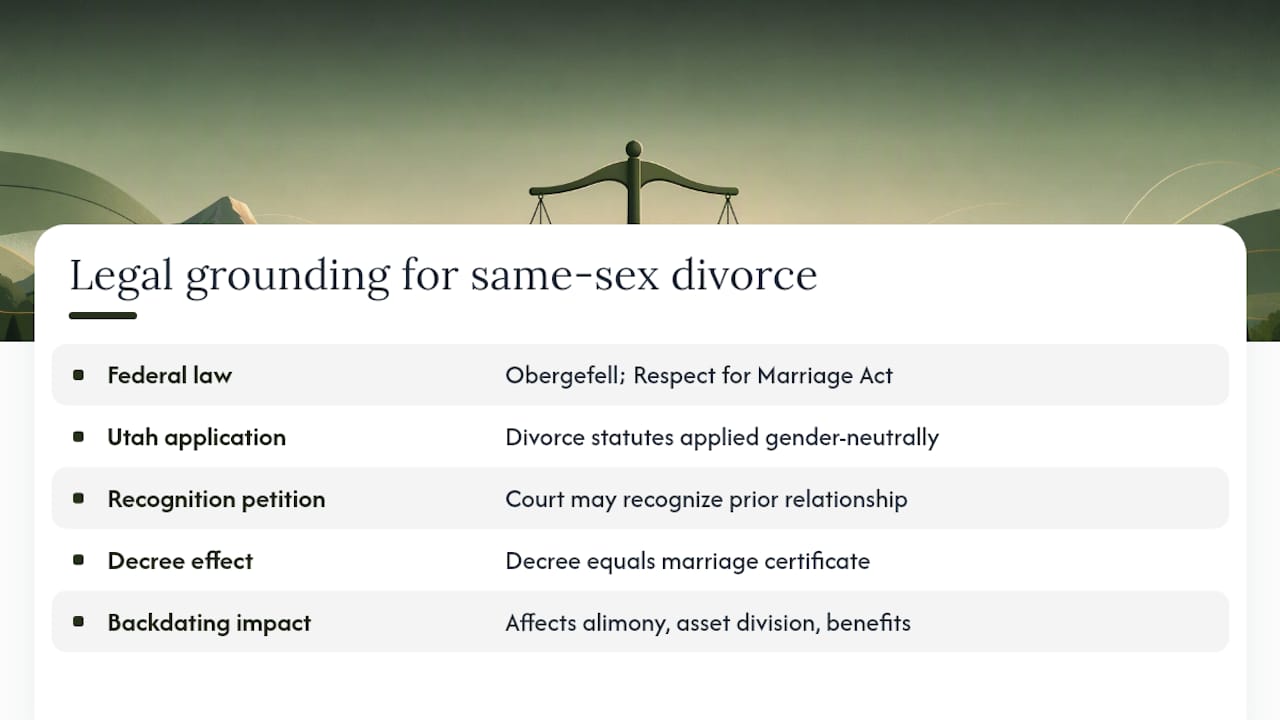
The right to marry and to dissolve that marriage is federally protected. Obergefell established nationwide recognition of same-sex marriage; the Respect for Marriage Act added a statutory floor requiring full faith-and-credit treatment of out-of-state marriages. Utah's courts apply its divorce statutes gender-neutrally, so the same rules that govern any dissolution govern yours.
One wrinkle matters for couples who lived together before same-sex marriage was legally available in Utah (before October 2014 under federal order, or June 2015 under Obergefell): you may need a separate petition to have that prior relationship formally recognized as a marriage. Utah Courts allow petitioners to ask a court to recognize a past relationship as a marriage, and a recognition decree carries the same legal weight as a marriage certificate. This matters most when you need property division, spousal support, or a formal decree for benefits or probate purposes.
Pro Tip: If your cohabitation predates your legal marriage, consider filing a recognition petition alongside your divorce petition. Courts can backdate the marriage to the start of the qualifying relationship, which can affect alimony duration, asset division, and Social Security eligibility.
How Utah family courts treat same-sex divorce
Utah processes same-sex dissolution under the same family-law framework as any other divorce: same petition forms, same jurisdiction rules, same temporary-order procedures, same path to a final decree. The procedural parity is complete. What differs in practice are a handful of recurring issues that require extra attention.
What commonly needs more work:
- Legal parentage for non-biological or non-adoptive parents, especially when children were conceived through assisted reproduction before the marriage was formalized
- Pre-2015 cohabitation that may not count as years of legal marriage for property division or spousal support calculations
- Retirement and Social Security impacts, where the length of the legal marriage (not the relationship) controls eligibility for divorced-spouse benefits
- QDROs (Qualified Domestic Relations Orders) to divide employer retirement accounts, which require separate court orders and plan-administrator approval
Step-by-step: how to file for divorce in Utah
Utah Code Title 81, Chapter 4 governs the filing path. The statutory waiting period is 30 days after the respondent is served before a court can enter a final decree; most uncontested cases resolve in 60–90 days total, while contested cases routinely take six months to a year or more.
- Confirm county residency. You must have lived in the filing county for at least 90 days. Your driver's license, a signed lease, or two months of utility bills in your name all work as proof.
- Prepare your petition and financial declarations. The Petition for Divorce (form 1100FA or the applicable county variant) and a Financial Declaration are the core documents. Utah Courts self-help pages list current form numbers.
- File and pay the fee. The typical filing fee is around $358, though it varies by county. If that's a hardship, ask the clerk for a fee-waiver application (form 1016GE or 1015GE).
- Serve the respondent. Deliver the filed documents to your spouse by personal service or an approved alternative. Keep the proof-of-service form the process server signs.
- Wait for a response. The respondent has 21 days (in-state) or 30 days (out-of-state) to file an Answer.
- Request temporary orders if needed. If custody, support, or use of the marital home is contested during the case, either party can ask for temporary orders at any point after filing.
- Exchange financial disclosures. Both parties must provide complete financial declarations. A divorce discovery checklist can help you gather what the court requires.
- Attempt mediation or settlement. Many Utah counties require mediation before a contested trial. Even when it's not mandatory, settling saves time and money.
- Attend trial or submit a stipulated decree. If you reach agreement, submit a Stipulated Decree of Divorce. If not, the judge decides at trial.
- Receive the final decree. The court enters the decree no sooner than 30 days after service. The marriage is legally dissolved at that point.
Pro Tip: County clerks can tell you the exact fee and whether your county requires a local cover sheet. Call before you drive down — some counties accept e-filing, which saves a trip.
Parentage, custody, and child support for same-sex couples
Custody decisions follow Utah's best-interest-of-the-child standard. But who can ask for custody or child support is controlled by legal parentage, not by caregiving history alone. The Utah Uniform Parentage Act (Title 78B, Chapter 15) governs how parentage is established, including the marital presumption: a child born during a marriage is presumed to be the legal child of both spouses.
For same-sex couples, that presumption applies, but it can be challenged. If your child was born before the marriage was formalized, or through assisted reproduction with a donor, the non-biological parent's legal status may not be automatic. Early action protects everyone.
Evidence that supports parentage or caretaking history:
- Birth certificate listing both parents
- Adoption decree or second-parent adoption order
- Court parentage order under the Utah Uniform Parentage Act
- School enrollment records, medical authorizations, and insurance records showing both parents
- Shared parenting communications (texts, emails, co-parenting app records)
If parentage is unclear, second-parent adoption or a parentage action substantially increases the likelihood of getting custody and parent-time orders that reflect caregiving reality. Don't wait until the divorce is filed to address this. The Social Security Administration requires 10 years of marriage for a divorced spouse to claim retirement benefits on a former spouse's record, which is one more reason the length of the legal marriage matters beyond the divorce itself.
When custody is shared, the question of who claims the children as dependents on federal taxes has real financial consequences. A tax professional familiar with custody arrangements can walk you through the IRS rules; this breakdown of child custody and taxes covers the basics.
Money matters: property division, alimony, and retirement accounts
Utah uses equitable distribution, not community property. Courts divide marital assets and debts fairly, weighing the length of the marriage, each spouse's financial contributions, and future earning capacity. Utah is not a community property state, so a 50/50 split is not guaranteed.
The pre-2015 gap creates a real problem for long-term couples. If you lived together for ten years before your legal marriage was possible, those years may not count toward the marriage duration for property division or alimony calculations. Courts sometimes consider pre-marriage cohabitation when awarding alimony or dividing property, particularly when one partner sacrificed career opportunities or made economic contributions during that period, but this requires solid documentation and is not guaranteed.
Steps to protect your financial interests:
- Gather joint bank statements, tax returns, and mortgage records going back as far as possible
- Get professional appraisals for real estate, businesses, or significant personal property
- Identify every retirement account and confirm whether a QDRO is needed
- Ask the court to include specific Findings of Fact about the length of the relationship, not just the legal marriage, to support future Social Security or benefit claims
On retirement accounts: a properly drafted QDRO is the only mechanism that obligates a plan administrator to pay the non-employee spouse. Without one, the plan simply pays the account holder. This is not a step to skip or handle informally.
Pro Tip: Ask your attorney or document service to include a request for Findings of Fact that document the full length of your relationship. Those findings can support Social Security claims and alimony arguments that depend on relationship duration.
Special situations that change the standard process
Special rules apply when the marriage was performed in another state, when a spouse dies or becomes incapacitated before the divorce is final, or when earlier legal relationships remain active.
- Married elsewhere, now living in Utah: Utah will recognize the marriage under the Respect for Marriage Act. File in your Utah county of residence once you meet the 90-day threshold.
- Death before the decree is final: The divorce case typically abates (ends) at death. Estate law, not divorce law, then governs asset distribution.
- Incapacity of a spouse: A guardian ad litem or conservator may need to be appointed before the case can proceed.
- Existing domestic partnerships or civil unions: A divorce decree dissolves the marriage only. If you also hold an active domestic partnership or civil union from another jurisdiction, that separate legal relationship must be explicitly terminated during the case, or it may create lingering obligations.
- Recognition petitions: When you need a court to recognize a prior cohabiting relationship as a marriage, Utah Courts provide specific procedures and forms (including form 1600FA) that can be filed alongside the divorce petition.
Common mistakes to avoid
The most damaging errors in same-sex divorces tend to cluster around parentage assumptions, undocumented financial history, and missed deadlines.
- Assuming parental rights exist without legal proof. Biological connection or years of caregiving does not automatically create legal parentage under Utah law. Secure a court order.
- Ignoring pre-marriage assets and contributions. Document what each spouse brought into the relationship and what was built together, even before the legal marriage date.
- Skipping the QDRO. Verbal agreements about retirement accounts are unenforceable against plan administrators. Get the order.
- Failing to address prior domestic partnerships or civil unions. A divorce alone may not terminate them.
- Missing response deadlines. A default judgment can be entered if the respondent fails to answer within the statutory window.
- Informal agreements without written orders. Parenting plans, support amounts, and property transfers need to be in the decree or a separate court order to be enforceable.
- Not filing a recognition petition when cohabitation predates the marriage. This is the single most common missed opportunity for long-term couples.
Forms, fees, timelines, and official Utah resources
The key filing facts: 90-day county residency requirement, 30-day statutory waiting period after service, and a typical filing fee of around $358.
| Item | Detail |
|---|---|
| County residency requirement | 90 days in the filing county before you can petition |
| Statutory waiting period | 30 days after service before a final decree can be entered |
| Typical filing fee | ~$358 (varies by county; fee waivers available via forms 1015GE/1016GE) |
| Common petition form | 1100FA (Petition for Divorce) or county equivalent |
| Recognition petition form | 1600FA (Petition to Recognize Relationship as Marriage) |
| Fee waiver forms | 1015GE / 1016GE |
| Governing statute | Utah Code Title 81, Chapter 4 |
Official resources to bookmark:
- Utah Courts self-help center for forms, instructions, and county-specific guidance
- Utah Code Title 81 for the full statutory text on divorce, residency, and equitable distribution
- Utah Uniform Parentage Act, Title 78B, Chapter 15 for parentage rules
- Your county district court clerk for local cover sheets, current fees, and e-filing availability
Always verify fees and form numbers with your county clerk before filing. Courts update forms periodically, and a rejected filing resets your timeline.
When to hire an attorney, use mediation, or try a guided service
Hire an attorney when custody is contested, parentage is disputed, significant assets or retirement accounts are at stake, or Social Security and benefit claims depend on the marriage length. These are the scenarios where a mistake in the paperwork costs more than the attorney's fee.
Quick decision guide:
- DIY or guided filing: Both spouses agree on all terms, no minor children with disputed parentage, straightforward asset split, no complex retirement accounts.
- Mediation: You disagree on some terms but want to avoid a trial. Mediation is faster and cheaper than litigation, and Utah courts often require it before a contested hearing.
- Attorney representation: Disputed custody, unclear parentage, business valuations, QDROs, recognition petitions, or any case where one spouse has significantly more legal knowledge or financial resources than the other.
A guided service like Divvi fits the middle ground well: couples who want documents designed for filing without paying full attorney rates, or who need a document audit before filing. For contested parentage or complex finances, attorney involvement is worth the cost.
What this process actually looks like
Divorce is hard regardless of the legal framework. For same-sex couples in Utah, the procedural path is genuinely equal to what any other married couple faces, and that is worth saying plainly. The complications that do exist, parentage gaps, pre-2015 cohabitation, retirement account division, are solvable with the right documentation and, when needed, the right professional support.
The two most important immediate actions: confirm your county residency and secure any documentation of legal parentage before the case gets contested. Everything else in this process has a form, a deadline, and a procedure. Those two items are the ones that catch people off guard.
Utah Courts self-help pages and Utah Code Title 81 are the authoritative sources for current forms and timelines. When in doubt, call your county clerk.
Divvi makes the paperwork side manageable
For Utah same-sex couples with an agreed divorce, the biggest friction point is usually the paperwork, not the law. Divvi's free-to-start platform generates documents designed for filing through a guided wizard. AI negotiation (Divvi Resolve) is included free with contested divorce. divvi is not a law firm and doesn't give legal advice.
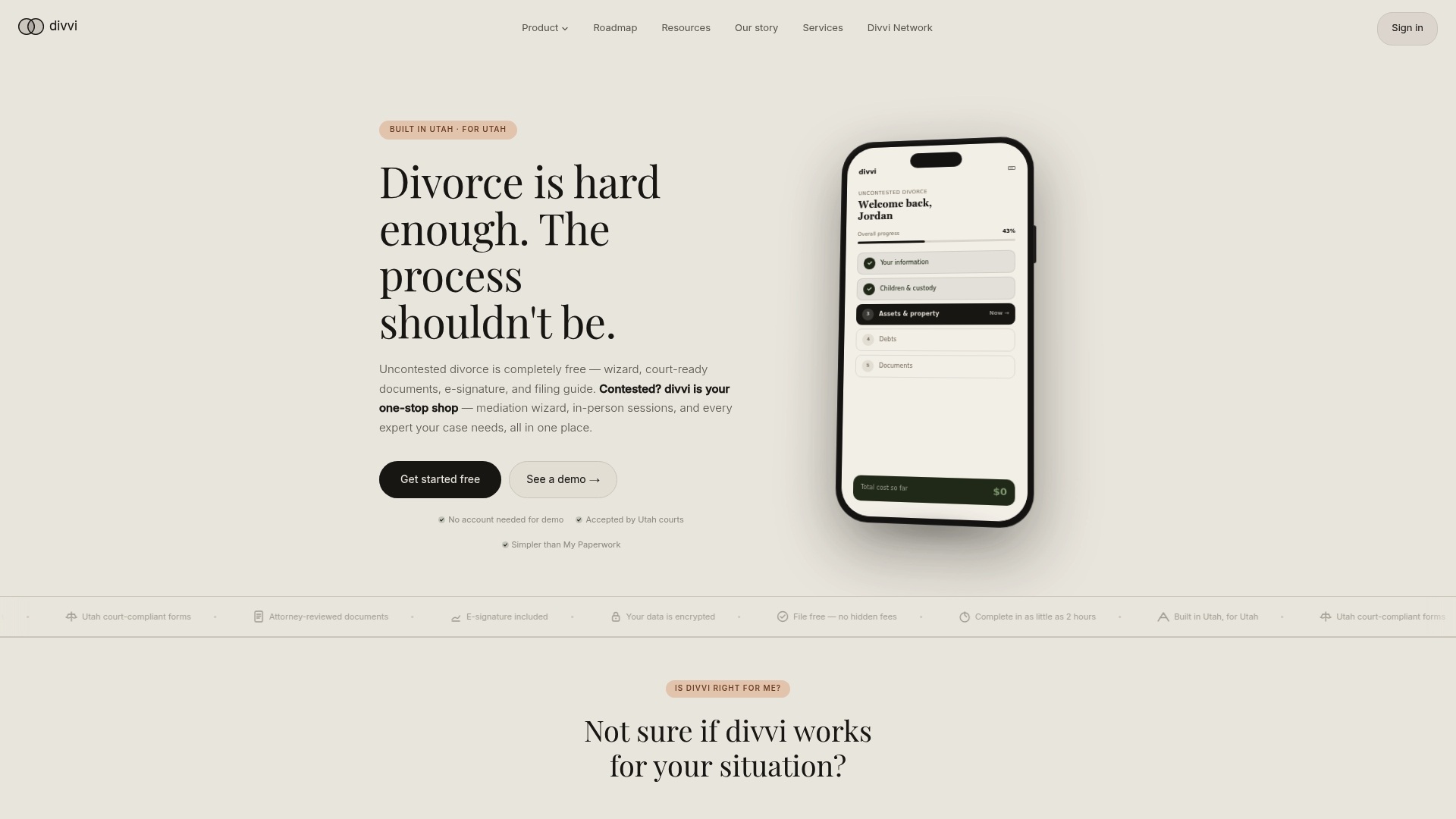
Specific services that map to the issues covered here: the document audit tool flags errors before you file; mediation support helps couples reach agreement without a trial; and the guided wizard walks you through financial declarations, parenting plans, and decree language step by step. The base model is free. You pay only for the services you actually need.
Start with Divvi's divorce tools to see what your case requires and get an estimate of costs before you commit to anything.
Sources
- Utah Code (Title 81, Chapter 4) — Divorce statutes (official PDF)
- Utah Courts — Recognize a relationship as a marriage (common-law guidance)
- Divorce
- Utah Uniform Parentage Act — Title 78B, Chapter 15 (Justia)
- LGBT Divorce Laws: Custody, Property, and Support - LegalClarity
Call your county district court clerk to verify current filing fees and confirm which forms your county requires before submitting anything. Form numbers and fees do change, and the clerk's office is the authoritative source for your specific courthouse.
This article is general information, not a substitute for advice from a qualified lawyer. Consult a qualified legal professional about your own circumstances before acting on anything here.