How to Respond to Divorce Papers in Utah: 21-Day Deadline
Written and reviewed by the divvi team. How we research and check this.

You have 21 days to respond to divorce papers if you were served inside Utah, or 30 days if you were served outside the state. That clock starts the moment you are served. Miss it, and your spouse can ask the court for everything they requested in the petition, often without you having any say.
The single most important thing you can do right now: file an Answer with the court before that deadline, or ask the court for more time. Filing even a short Answer preserves your right to contest any part of the divorce, from property division to child custody. Doing nothing is the one move that costs you everything.
Your 48-hour checklist:
- Locate your copy of the divorce petition and the summons you were served with
- Write down the exact date you were served and calculate your deadline (21 or 30 days from that date)
- Gather key documents: government-issued ID, recent tax returns, bank statements, pay stubs, mortgage or lease documents, and any existing custody or parenting agreements
- Download the Answer form (1008FA) from Utah Courts
- Do not reply to any message asking you to pay a fee via text link or QR code — that is a scam, not a court notice
- Note whether you want to request your own relief (custody, support, property) — if so, you will file a counterpetition alongside your Answer
Immediate actions in order:
- Confirm the service date and calculate your response deadline
- Read the petition paragraph by paragraph and mark what you agree and disagree with
- Complete form 1008FA (Answer) or contact the court's self-help center
- File the Answer with the district court clerk and serve a copy on your spouse (or their attorney)
- Complete the proof of service form and file it with the court
URCP Rule 55 governs what happens when you miss the deadline. Rule 60 gives you a path to undo a default, but it requires showing good cause and acting quickly. Neither is a comfortable position. Filing on time is far easier than fighting a default after the fact.
Key Takeaways
Filing your Answer on time is the single most important step to preserve your rights in a Utah divorce, and the deadline is 21 days if served in Utah or 30 days if served outside the state.
| Point | Details |
|---|---|
| Response deadline | 21 days if served in Utah; 30 days if served outside Utah. Calculate from the date of personal service. |
| Answer structure | Respond to each numbered paragraph (agree/disagree); include requests and affirmative defenses as needed. |
| Default consequences | Missing the deadline lets the petitioner request a default judgment under Rule 55; Rule 60 allows a court to set it aside for good cause. |
| Counterpetition timing | File your counterpetition with your Answer to preserve custody, support, and property requests in the same case track. |
| Divvi | Divvi's free Answer wizard generates documents designed for filing and connects you to mediation when you need it. |
Table of Contents
- How do you respond to a divorce petition in Utah?
- How your service method affects your response deadline
- What happens if you don't respond to a divorce petition?
- How to file and serve your Answer in Utah
- How to raise your own requests: counterpetitions and temporary orders
- What to expect after you file your Answer
- Common mistakes respondents make and how to avoid them
- Divvi makes filing your Answer faster and less stressful
- Sources
How do you respond to a divorce petition in Utah?
The Answer is a formal court document, not a letter or a personal statement. Utah Courts' guidance on answering a complaint or petition instructs you to go through the petition paragraph by paragraph and mark each one as either agreed or disagreed. That structure matters more than most people realize.
The structure of a Utah Answer
The petition is numbered. Your Answer mirrors those numbers. For each paragraph, you mark one of three positions:
- Agree (you admit the statement is true)
- Disagree (you deny it)
- Disagree because I don't know (you lack enough information to admit or deny)
That third option is underused and often the right call for financial claims or dates you cannot independently verify. Never agree to a paragraph you are not certain about. An admission in your Answer carries real legal weight.
After the paragraph-by-paragraph responses, the Answer form includes optional sections:
- Explanation of responses: a short note clarifying why you disagreed with specific paragraphs
- Affirmative defenses: legal grounds that could limit or defeat the petitioner's claims even if the facts are true
- Requests: what you want the court to order (property, custody, support, attorney fees)
Sample language
For a paragraph you agree with: "Paragraph 4: Agreed."
For a paragraph you disagree with: "Paragraph 7: Disagreed. The parties did not separate on the date stated. The actual separation date was [date]."
For a request: "Respondent requests that the court award joint legal custody of the minor children and order child support pursuant to Utah guidelines."
Keep explanations short and factual. Courts are not looking for a narrative of the marriage. They are looking for clear positions on specific claims.
Pro Tip: Number your responses to match the petition exactly. If the petition has 14 numbered paragraphs and you skip paragraph 9, the court may treat it as admitted. Go line by line, even for paragraphs that seem trivial.
Counterpetition basics
If you want the court to grant you relief (not just respond to what your spouse asked for), you need a counterpetition filed at the same time as your Answer. The Answer alone says what you disagree with. The counterpetition says what you want. More on that in the counterpetition section below.
How your service method affects your response deadline
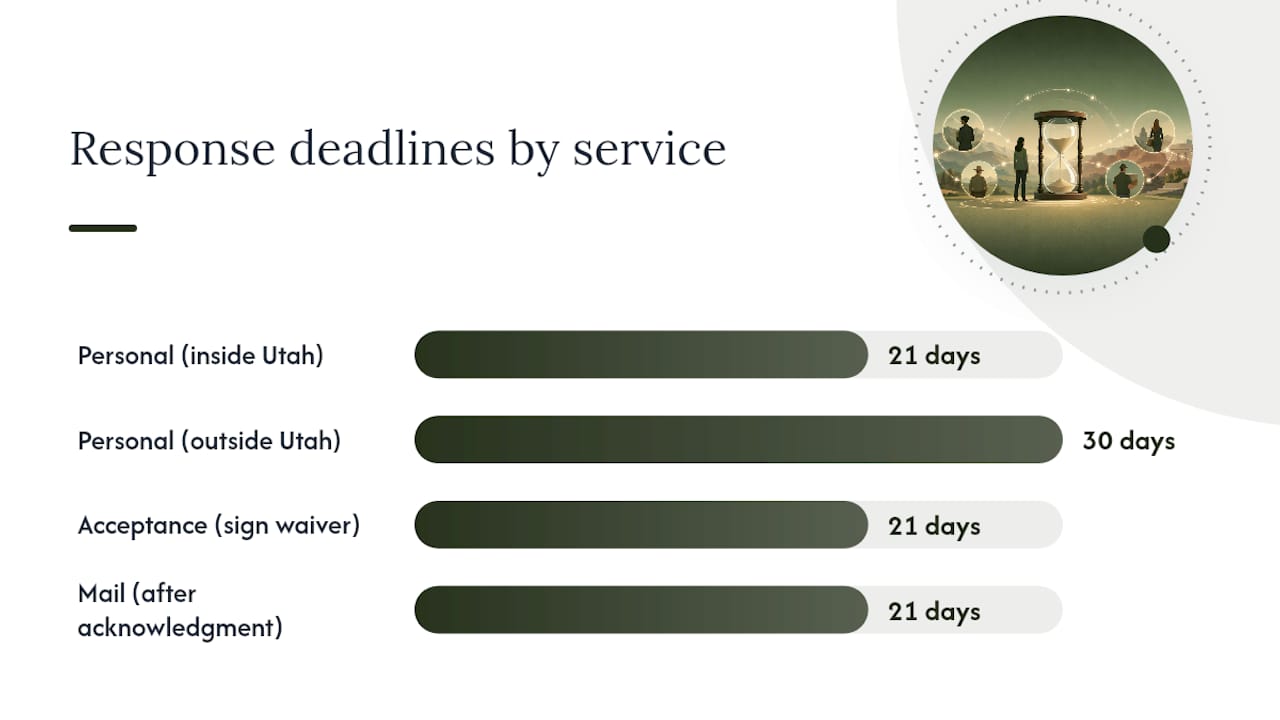
The deadline to respond to divorce papers in Utah depends on how and where you were served. The rule is straightforward: 21 days if served inside Utah, 30 days if served outside Utah. But the clock does not always start the same way.
Service methods and their timing rules
| Service method | Where served | Response window | When clock starts |
|---|---|---|---|
| Personal service (process server or sheriff) | Inside Utah | 21 days | Date of personal delivery |
| Personal service | Outside Utah | 30 days | Date of personal delivery |
| Acceptance of service (you sign a waiver) | Either | 21 days | Date you sign the acceptance |
| Service by mail (with acknowledgment) | Either | 21 days after acknowledgment | Date you return the acknowledgment form |
| Service by publication | Utah | Set by court order | Per the court's publication order |
Two example deadline calculations
Example 1: You are handed the papers by a process server at your Salt Lake City home on March 3. Your deadline is March 24 (21 days later). If March 24 falls on a weekend or court holiday, the deadline moves to the next business day.
Example 2: You are served at your sister's home in Nevada on March 3. Your deadline is April 2 (30 days later).
Proof of service matters here. The petitioner must file an affidavit or proof of service with the court before they can request a default judgment. If you believe the service was improper (wrong address, wrong person, no signature), document that immediately. Improper service can block a default request entirely.
Requesting an extension
If you need more time, you can ask the court for an extension before your deadline expires. File a motion requesting additional time and state your reason. Courts are more receptive when the request comes before the deadline, not after. Once the deadline passes without a filing, the petitioner can move for default.
What happens if you don't respond to a divorce petition?
Missing the deadline does not just delay things. It can hand your spouse a court order granting everything they asked for, without a hearing where you get to speak.
How default works in Utah
When a respondent fails to file an Answer by the deadline, the petitioner can request that the court enter a "default." Under URCP Rule 55, the process has two stages:
- Entry of default by the clerk (an administrative step confirming you did not respond)
- Default judgment entered by the clerk or the court, depending on the type of relief requested
The clerk can enter a default judgment on a sum-certain claim (a fixed, calculable amount) without a court hearing. For everything else in a divorce, including custody, property division, and alimony, the court must enter the judgment. That usually requires the petitioner to submit supporting documents and, in some cases, attend a brief hearing.
Proper service is a prerequisite. The petitioner must prove you were served before the clerk will enter default. If service was defective, that is your first line of defense.
If you are already past the deadline
Act immediately. Your options narrow fast, but they do not disappear:
- Confirm whether default has been entered. Check the court docket online or call the clerk's office.
- File a late Answer plus a motion to set aside default. Under Rule 60, courts can vacate a default for good cause: excusable neglect, improper service, fraud, or newly discovered evidence.
- Gather supporting facts. A Rule 60 motion needs specifics. "I didn't know" is weaker than "I was hospitalized" or "the papers were left at the wrong address."
- Request a hearing. A judge decides Rule 60 motions. You will need to appear and explain your situation.
The longer you wait after a default is entered, the harder the motion becomes. Courts look at whether you acted promptly once you learned of the default. Days matter.
How to file and serve your Answer in Utah
Filing the Answer is a two-step process: you file with the court clerk, and then you serve a copy on your spouse (or their attorney). Both steps are required.
Forms and where to get them
All of these are available at no cost from the Utah Courts self-help center.
Filing options
- In person: Bring two copies of your completed Answer to the district court clerk's office in the county where the case was filed. The clerk stamps both, keeps one, and returns the other to you.
- By mail: Send the original plus a self-addressed stamped envelope for the clerk to return your file-stamped copy. Allow enough time for mail delivery before your deadline.
- E-filing: Available in many Utah counties through the Utah Courts e-filing portal. Check whether your county participates before relying on this option.
The filing fee for an Answer varies by county. If you cannot afford the fee, submit a fee waiver application (also called an Application to Proceed Without Paying Filing Fees) at the same time. The court reviews your income and expenses and may waive the fee entirely or reduce it.
Serving the petitioner
After filing, you must serve a copy of your Answer on your spouse or their attorney. Service on a represented party goes to the attorney, not directly to your spouse. Acceptable methods include personal delivery, first-class mail, or electronic service if the attorney has consented.
Complete the proof of service form, sign it, and file it with the court. This step is often skipped by self-represented respondents and creates problems later. No proof of service on file means the court has no record that the other side received your Answer.
Pro Tip: If you are protecting yourself financially during this process, review practical financial preparation guidance before your first court appearance. Knowing what accounts and assets to document early can affect support and property outcomes significantly.

How to raise your own requests: counterpetitions and temporary orders
Filing an Answer tells the court what you disagree with. Filing a counterpetition tells the court what you want. These are different documents with different purposes, and you typically file them together.
What a counterpetition does
A counterpetition is your formal request for relief in the same case. Without one, you are limited to responding to your spouse's requests. With one, you can ask the court to award you custody, divide property in a specific way, order support, or address any other issue the court has authority over in a divorce.
Filing it with your Answer is the standard approach. Waiting creates procedural complications and can put you on a different scheduling track than the main case.
Temporary orders
While the divorce is pending, you can ask the court for temporary orders to govern the situation until a final decree is entered. Common requests include:
- Temporary physical and legal custody of minor children
- Temporary child support or alimony
- Exclusive use of the family home
- Temporary restraining orders (if there is a safety concern)
- Freeze on marital assets to prevent dissipation
Temporary orders require a motion and supporting declaration. The court schedules a hearing, and both parties can present their positions. These orders stay in place until the final decree unless modified.
Emergency (ex parte) relief
If there is an immediate safety risk to you or your children, or a credible threat that assets will be hidden or destroyed, you can request emergency relief without prior notice to your spouse. Ex parte orders are granted sparingly and require a strong factual showing. Expect the court to schedule a follow-up hearing quickly so your spouse can respond.
Pro Tip: Filing a counterpetition at the same time as your Answer preserves your ability to request custody or support in the same case track. Waiting can force you into separate motions or different scheduling tracks, which adds time and cost to an already complicated process.
Counterpetition preparation checklist:
- List every form of relief you are requesting (custody, support, property, attorney fees)
- Gather evidence supporting each request (financial records, parenting history, communications)
- Complete the counterpetition form (1008FA-CP) and attach it to your Answer filing
- Serve the counterpetition on the petitioner along with your Answer
- File proof of service for both documents
What to expect after you file your Answer
Filing the Answer is not the end of the process. It is the beginning of the contested phase. Utah Courts describe a structured sequence that follows, and knowing what comes next helps you stay ahead of deadlines.
Case Management Conference
Shortly after the Answer is filed, the court schedules a Case Management Conference (CMC). This is a brief hearing where the judge or commissioner sets the schedule for the case: discovery deadlines, mediation timing, and the trial date if the case does not settle. Come prepared with your calendar and a general sense of how complex your case is.
Mandatory mediation
Utah requires mediation before trial in most family law cases. Both parties share the cost unless the court orders otherwise. Utah Legal Services confirms that mediation is commonly required, with the court retaining authority to waive it for good cause. Domestic violence is the most common basis for a waiver. If you have safety concerns, raise them with the court in writing before mediation is scheduled. Divvi's mediator-matching service can connect you with vetted Utah mediators when mediation is required.
Mandatory parenting and divorce education course
When minor children are involved, Utah Code § 81-4-402 requires both parties to complete a mandatory education course. As the respondent, your deadline is within 30 days of being served. Missing this deadline can affect your scheduling and, in some courts, your standing in custody proceedings. The court can waive the requirement in limited circumstances, but the default rule is attendance.
Discovery
After the CMC, both parties exchange financial disclosures and can request documents, interrogatories, and depositions. For custody and support, the documents you gathered in your first 48 hours (tax returns, bank statements, pay stubs) become the foundation of your case. A divorce discovery checklist can help you organize what to gather and what to expect from the other side.
Common mistakes respondents make and how to avoid them
Most procedural errors in divorce responses are avoidable. They tend to cluster around the same handful of mistakes.
Mistakes that cost respondents their rights:
- Missing the 21-day (or 30-day) deadline entirely, triggering the default process
- Sending an email or text to the petitioner's attorney saying "I disagree" and assuming that counts as a legal response (it does not)
- Skipping paragraph numbers in the Answer and inadvertently admitting claims
- Forgetting to file proof of service after serving the Answer on the other party
- Responding to a scam message that impersonates the court and demands payment via a text link or QR code
- Assuming you were not properly served without verifying the service method and documentation
Practical corrections:
- File a basic Answer even if you plan to negotiate everything later. Filing preserves your rights; negotiating can happen in parallel.
- Keep copies of every document you file and every document you receive.
- Use neutral, factual language in your Answer. Emotional language does not help your case and can be used against you.
- Verify service before concluding it was improper. Check the affidavit of service the petitioner filed with the court.
Utah Courts will never ask you to pay a fee or fine through a text message link or QR code. If you receive a message like that, do not click the link, do not provide personal or financial information, and report it. Legitimate court notices arrive by mail or through the official e-filing portal. — Utah Courts scam warning
Handling an uncooperative petitioner
If your spouse is difficult to serve with your Answer or counterpetition, document every attempt. Use a process server and get a signed affidavit of service. If communication is hostile, keep it in writing and stay factual. Guidance on what not to say during a divorce can help you avoid statements that create problems in court later.
A note on helping respondents protect their rights
Helping people respond to divorce papers quickly and correctly is one of the most practical things anyone can do in this space. The legal system gives respondents real tools: a structured Answer form, a counterpetition, temporary orders, and mediation. The problem is that most people served with divorce papers do not know these tools exist until after the deadline has passed.
Filing a short, accurate Answer is often all it takes to keep every option open. You do not need to have your entire case figured out. You need to file on time, match the paragraph numbers, and preserve your right to be heard. Divvi's platform is built specifically for this: documents designed for filing, attorney referrals, and mediation access, all in one place for Utah families navigating exactly this situation.
Divvi makes filing your Answer faster and less stressful
When you have 21 days and no attorney on speed dial, the paperwork alone can feel like the obstacle. Divvi is built for exactly this situation: a Utah-specific platform that walks you through your Answer step by step, generates documents designed for filing, and connects you to the professional support you actually need, without paying for services you do not.
Start with the free Answer wizard. It guides you through each petition paragraph, flags where you need to make a decision, and produces a properly formatted 1008FA ready to file. If your case is more complex, you can access mediation services; divvi Mediate Pro also includes divviFile filing assistance. You pay only for what you need.
What Divvi offers respondents:
- Free Answer wizard (form 1008FA)
- Counterpetition templates and filing guidance
- Optional attorney referral
- Mediation matching with vetted Utah mediators
- Fee-waiver guidance and filing instructions
- Post-divorce tools: parenting plans, support calculators, decree modifications
If your spouse won't cooperate or the case is contested, Divvi handles that too. Start your Answer at Divvi and know exactly where you stand before your deadline arrives.
Sources
The resources below are the primary references for filing your Answer and understanding Utah divorce procedures.
Additional Divvi resources:
This article provides general legal information about Utah divorce procedures, not legal advice. Confirm current rules and deadlines with Utah Courts or a licensed Utah family law attorney before filing.
This article is general information, not a substitute for advice from a qualified lawyer. Consult a qualified legal professional about your own circumstances before acting on anything here.