Pet Custody in Utah: Why Pets Are Divided as Property
Written and reviewed by the divvi team. How we research and check this.

In Utah divorce cases, pets are treated as personal property and divided through the same equitable-distribution rules that apply to furniture, vehicles, and bank accounts. There is no "pet custody" statute in Utah, no best-interest-of-the-animal standard, and no judicial mechanism for splitting time with a dog the way a court splits parenting time with a child.
That said, the outcome is far from arbitrary. Three practical realities shape almost every pet dispute:
- Written agreements win. A settlement clause incorporated into your Decree of Divorce is enforceable as a court order. Judges almost always adopt what both spouses agree to in writing, including visitation schedules and shared vet costs.
- Documentation drives negotiation. Adoption records, vet receipts, and caregiving logs are the currency of a pet dispute, whether you're at the kitchen table, in mediation, or in front of a judge.
- Mediation is faster and cheaper than trial. Pet disputes resolved through mediation give both parties more control over the outcome than leaving the decision to a judge who may simply award the animal to one spouse and move on.
Key Takeaways
Utah treats pets as marital property in divorce, which means a written, decree-incorporated agreement is the single most reliable way to protect your arrangement and make it enforceable.
| Point | Details |
|---|---|
| Legal status of pets | Utah classifies pets as personal property divided under equitable-distribution rules, not custody law. |
| Strongest preventive step | A prenuptial or postnuptial agreement designating pet ownership is the most reliable protection before a dispute arises. |
| Evidence that matters most | Adoption records, microchip registration, vet receipts, and caregiving logs are the core of any pet ownership claim. |
| Mediation over litigation | Mediation allows shared-care schedules and cost-splitting a judge would not impose; it is faster and cheaper than trial. |
| Divvi's role | Divvi converts agreed pet terms into decree language designed for filing. AI negotiation (Divvi Resolve) is included free with contested divorce. divvi is not a law firm and doesn't give legal advice. |
Table of Contents
- How does Utah law treat pets in a divorce?
- What factors does a Utah court or mediator weigh?
- What can you negotiate or ask the court to order?
- What documents should you gather before negotiation or court?
- Is mediation a better option than going to court?
- What happens if the dispute goes to court?
- Sample settlement language and templates
- A note from the Divvi team
- Divvi can turn your pet agreement into a court order
- Sources
How does Utah law treat pets in a divorce?
Utah classifies companion animals as personal property. When a pet is acquired during the marriage, it is typically a marital asset subject to equitable distribution under Utah Code § 81-4-406(4). Utah has since recodified much of its domestic relations law into Title 81; the modern parallel provisions appear in Utah Code § 81-9-205, which governs property disposition in divorce proceedings today.
What this means in practice: A judge resolving a pet dispute is not asking "who loves the dog more?" The court is asking "who has the stronger property claim, and what is the equitable outcome?" Practical caregiving facts matter, but they matter as evidence within a property framework, not as a parallel custody analysis.
A pet brought into the marriage by one spouse, purchased before the wedding, or received as a gift or inheritance may qualify as separate property and stay with that spouse. The line blurs quickly when marital funds paid for vet care or both spouses shared daily feeding and walking duties. Utah's approach to property classification is equitable distribution, not community property. The court has discretion to weigh the full picture rather than split everything 50/50.
One common misunderstanding: courts will not impose a shared-custody arrangement over one spouse's objection. If you want a visitation schedule or cost-sharing agreement, both parties must agree to it, or the judge will simply award the pet to one spouse outright.
What factors does a Utah court or mediator weigh?
Whether the dispute goes to a judge or a mediator, the same core factors shape the outcome. Utah family law practice guidance identifies these as the most commonly considered:
- Date and method of acquisition. A pet purchased before the marriage, or received as a gift to one spouse, starts with a strong separate-property argument. A dog adopted together during the marriage is presumptively marital property.
- Who paid for the pet. Adoption fees, purchase price, and initial vet costs paid from one spouse's separate account strengthen that spouse's claim. Joint credit card charges complicate it.
- Primary caregiver role. Who scheduled and attended vet appointments? Who fed, walked, and trained the animal daily? Text messages, calendar entries, and vet records showing one spouse's name consistently carry real weight.
- Veterinary and ongoing expense history. Receipts, insurance policies, and credit card statements showing who absorbed the cost of care over time are among the most persuasive documents in a pet dispute.
- Post-divorce housing suitability. A spouse moving into a no-pets apartment has a weaker claim than one keeping the family home with a yard. Lease terms and HOA rules matter.
- Impact on minor children. If the family dog is closely bonded with the children, a judge may factor that into the overall parenting and property arrangement, even without a formal pet-custody order.
- Special value. Show dogs, breeding stock, and service animals are treated differently. Courts may order a formal appraisal for high-value animals and factor the monetary value into the overall property division. Service animals are often awarded to the spouse who depends on them medically.
Pro Tip: If you and your spouse shared vet expenses from a joint account, that commingling can convert what started as one spouse's separate-property pet into a marital asset. Document any separate-property contributions early, before filing, and keep those records distinct from joint finances.
What can you negotiate or ask the court to order?
The good news about Utah treating pets as property is that it gives spouses broad freedom to negotiate whatever arrangement actually works for their lives. Documented agreements incorporated into the decree are the most predictable path to an enforceable outcome. Common options include:
- Sole ownership award. One spouse receives the pet outright. Simple, clean, and the default if you cannot agree on anything else.
- Transfer with compensation. One spouse keeps the pet; the other receives an offset in another asset (cash, equity, personal property) to reflect the pet's value.
- Written shared-care schedule. Both spouses agree to a visitation calendar specifying who has the pet on which days, where transfers happen, and who covers costs during each period. This only works if both parties sign it.
- Expense-sharing agreement. Routine vet costs, food, and grooming split by percentage; emergency care decisions assigned to one spouse or requiring mutual consent above a dollar threshold.
- Temporary care orders. While the divorce is pending, a stipulated temporary order can specify who keeps the pet, who pays for care, and where the animal lives. This prevents one spouse from relocating the pet or refusing access during a long divorce process.
Pro Tip: Vague language kills enforcement. Add a clause requiring mediation before either party can seek court enforcement, which keeps future disputes out of litigation.
What documents should you gather before negotiation or court?
Strong documentation is the difference between a confident negotiating position and a coin flip. Gather these before your first mediation session or attorney meeting:
- Adoption or purchase records. The original contract, shelter paperwork, or breeder receipt showing who signed and what account paid.
- Microchip and license registration. Whose name appears on the microchip database and the county license? This is often the clearest single-document proof of ownership.
- Veterinary records and receipts. Pull the complete file from your vet, including the account name, appointment history, and payment records. A consistent pattern of one spouse scheduling and paying is powerful evidence.
- Grooming, training, and boarding receipts. These show ongoing caregiving investment and often carry the paying spouse's name or card.
- Photos and calendar logs. Timestamped photos of daily care routines, walks, and vet visits. A shared calendar showing who took the pet to appointments adds credibility.
- Witness statements. Neighbors, dog walkers, trainers, or family members who observed the primary caregiver relationship can provide short written statements.
- Housing documentation. Your lease, HOA rules, or mortgage showing the property is pet-friendly and suitable for the animal's needs.
- Financial records. Bank and credit card statements showing who paid for food, insurance, and medical care over the marriage.
Practice guidance from Utah family law attorneys recommends organizing these as an indexed exhibit packet with a one-page timeline summary. For high-value animals, a written appraisal from a licensed veterinarian or breed specialist establishes the monetary figure you'll need for property-division calculations.
Is mediation a better option than going to court?
For most pet disputes, yes. Mediation lets both spouses design an arrangement a judge would never impose, including shared-care schedules, rotating holidays, and split vet costs. A judge resolving a contested pet dispute will almost certainly award the animal to one party and move on. Mediation frequently produces more durable outcomes because both parties had a hand in building the agreement.
In Utah, mediation can happen at several points:
- During settlement negotiations, before any court hearing
- As part of a temporary-orders process while the divorce is pending
- After a judge orders the parties to attempt mediation before trial
Bring your evidence packet to mediation, a draft of your preferred settlement clause, and a clear sense of your priorities. If keeping the pet is non-negotiable, know in advance what you're willing to trade elsewhere in the property division.
Collaborative law is another option. Both spouses retain attorneys who commit to resolving everything outside court. It costs more than mediation but less than a contested trial, and it keeps the process private.
The main limitation of both paths: if one spouse refuses to negotiate in good faith, you will end up in front of a judge. Courts will not force a shared-care arrangement over objection.
What happens if the dispute goes to court?
If you cannot reach an agreement, the pet dispute becomes part of the contested property division. The general sequence in Utah:
- Pleadings. Both spouses file their initial divorce paperwork, listing the pet as a marital asset (or claiming it as separate property).
- Temporary orders. Either party can request a temporary order specifying who keeps the pet during the divorce. These are heard relatively quickly and remain in place until the final decree.
- Discovery. Both sides exchange financial records, vet records, and other evidence. This is where your indexed exhibit packet earns its preparation time.
- Settlement attempts. Most cases settle before trial. Mediation is often court-ordered at this stage.
- Trial or stipulated decree. If no settlement is reached, a judge hears evidence and decides. The judge's order becomes part of the final Decree of Divorce.
| Utah divorce filing fee | varies by county | source | PRIMARY | Mandatory waiting period | 30 days | source | PRIMARY | Mediation session cost | Roughly $100–$300 per hour per party | | Average annual pet care cost (dog) | Not specified due to lack of primary source |
Figures sourced from Utah divorce procedural guidance. Filing fees vary by county; confirm current amounts with your local district court clerk.
A contested trial adds attorney fees that can run several thousand dollars for a single-issue property dispute. For most pets, the cost of litigation exceeds the animal's monetary value by a wide margin, which is the strongest practical argument for settling.
Sample settlement language and templates
These clauses are starting points. Have an attorney or Divvi's document review service check the final language before you file.
Sample ownership and expense clause:
Sample visitation transfer protocol:
Printable evidence checklist (bring to mediation):
- Adoption/purchase contract with payment method noted
- Microchip registration printout
- County license in your name
- Complete vet file with account holder name
- Grooming and boarding receipts (last 24 months)
- Photos with timestamps showing daily care
- Witness contact list with brief written statements
- Lease or HOA rules confirming pet is permitted at your residence
- Bank/credit card statements showing expense history
Pro Tip: Add a single sentence designating who has authority to approve emergency veterinary care when the other spouse cannot be reached. Without it, a $4,000 emergency surgery can become a dispute about consent and reimbursement on top of everything else.
A note from the Divvi team
Pet disputes come up in a surprising share of Utah divorces, and they often carry more emotional weight than assets worth far more on paper. What we see consistently is that the couples who resolve pet issues quickly are the ones who came prepared: a clear ownership document, a draft clause, and a willingness to negotiate in mediation rather than litigate. Divvi's platform can convert an agreed pet arrangement into decree-ready language, and our mediation support connects you with a neutral third party when direct negotiation stalls. For cases involving service animals, high-value breeding stock, or a spouse who refuses to engage, a Utah family law attorney is the right call. The legal complexity in those situations goes beyond what any document platform should handle alone.
Divvi can turn your pet agreement into a court order
Reaching an agreement on your pet is the hard part. Turning it into enforceable paperwork shouldn't add weeks or thousands of dollars to the process.
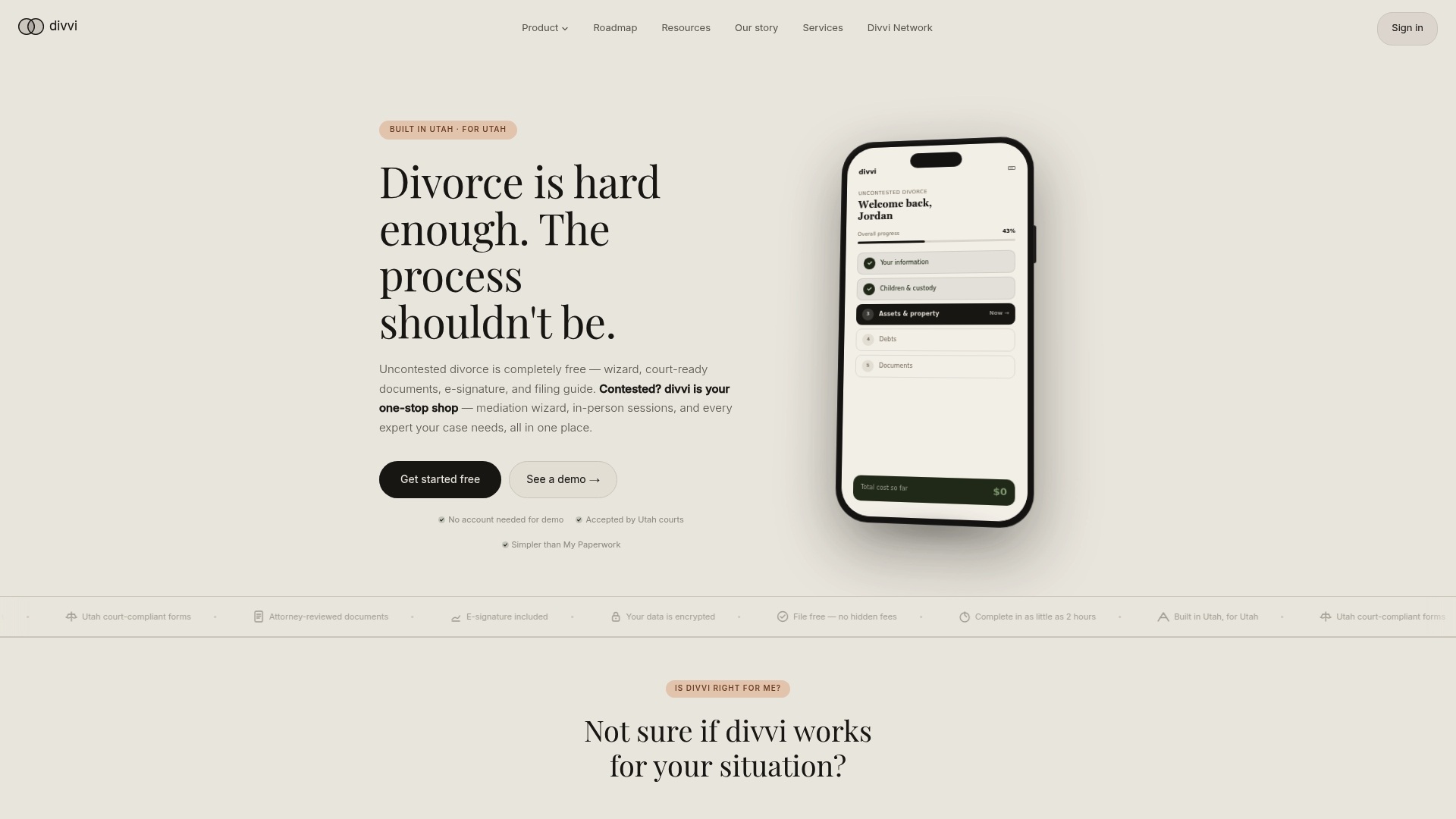
Divvi's divorce document wizard generates decree language designed for filing from your agreed terms, including pet ownership clauses, visitation schedules, and expense-sharing provisions. If you need a neutral third party to help you and your spouse reach that agreement first, Divvi's mediation service connects you with a mediator experienced in Utah property disputes. For contested cases or high-value animals where you want a licensed attorney to review the final language before filing, the document review option adds that layer without the cost of full legal representation.
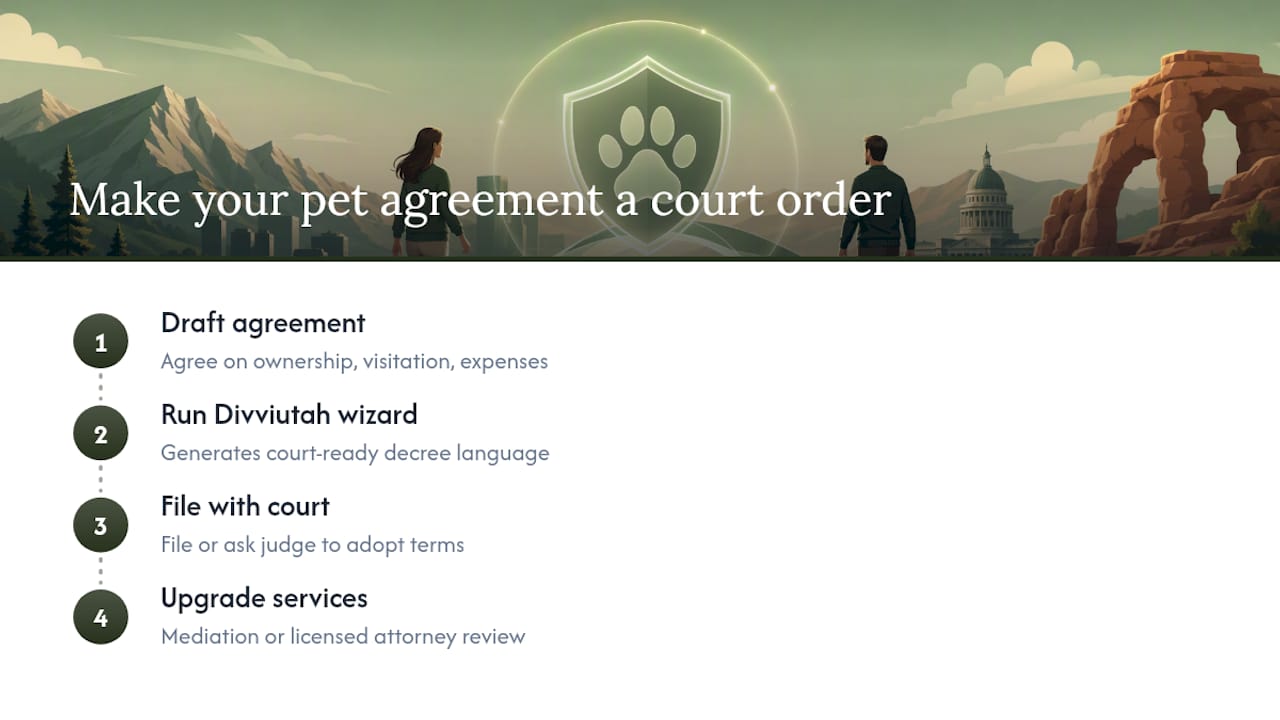
The typical path: draft your agreement, run it through Divvi's wizard to generate paperwork designed for filing, then file with the court or ask the judge to adopt your agreed terms. Start your free divorce draft today, and upgrade only for the services your situation actually requires.
Sources
The following Utah-specific resources provide statute text, procedural guidance, and practice-focused checklists for pet disputes in divorce.
- Utah Code § 81-4-406 (property division; formerly § 30-3-5)
- Divorce
This article provides general legal information about Utah divorce law and is not a substitute for advice from a licensed Utah family law attorney. Confirm current statutes, filing fees, and procedural requirements with the Utah State Courts or a qualified legal professional before making decisions about your case.