Notarize Divorce Documents in Utah: Where and How
Written and reviewed by the divvi team. How we research and check this.

Yes, you can notarize divorce documents in Utah, and state law also authorizes remote online notarization (RON), so you don't have to sit across a desk from anyone if you don't want to. You have three practical paths:
- In-person: a bank, UPS Store, or law office with a notary on staff.
- Mobile notary: someone drives to you, usually for an added travel fee.
- RON: an approved online platform verifies your ID and notarizes over live video, available anytime under Utah Code Ann. §§ 46-1-2 et seq.
The bigger question isn't whether you can notarize your paperwork. It's whether your specific forms actually need it.
Key Takeaways
Utah allows notarization of divorce-related documents in person, through a mobile notary, or online via RON, but only certain forms, like settlement agreements and financial affidavits, actually require it.
| Point | Details |
|---|---|
| RON is legal in Utah | State law authorizes remote online notarization, and courts recognize properly performed remote sessions. |
| Not every form needs a notary | The petition, summons, and decree don't require notarization; the judge signs the decree directly. |
| Match the certificate language | Jurats require signing in the notary's presence; acknowledgments don't, so read the form first. |
| Certified copies come from the court | Only the district court clerk issues certified decree copies, separate from any notary's work. |
| Divvi builds notarization-ready forms | Divvi's document wizard and optional attorney referral help ensure your settlement agreements and affidavits are complete before you see a notary. |
Table of Contents
- Which Divorce Documents in Utah Actually Need Notarization?
- How Do You Get a Divorce Document Notarized in Utah?
- Does Utah Recognize Remote Online Notarization for Divorce Papers?
- What Does Notarization Cost, and What ID Do You Need?
- How Do Certified Copies and Court Filing Work After Notarization?
- How Divvi Makes Notarization-Ready Divorce Documents Easier
- Frequently Asked Questions
- Sources
Which Divorce Documents in Utah Actually Need Notarization?
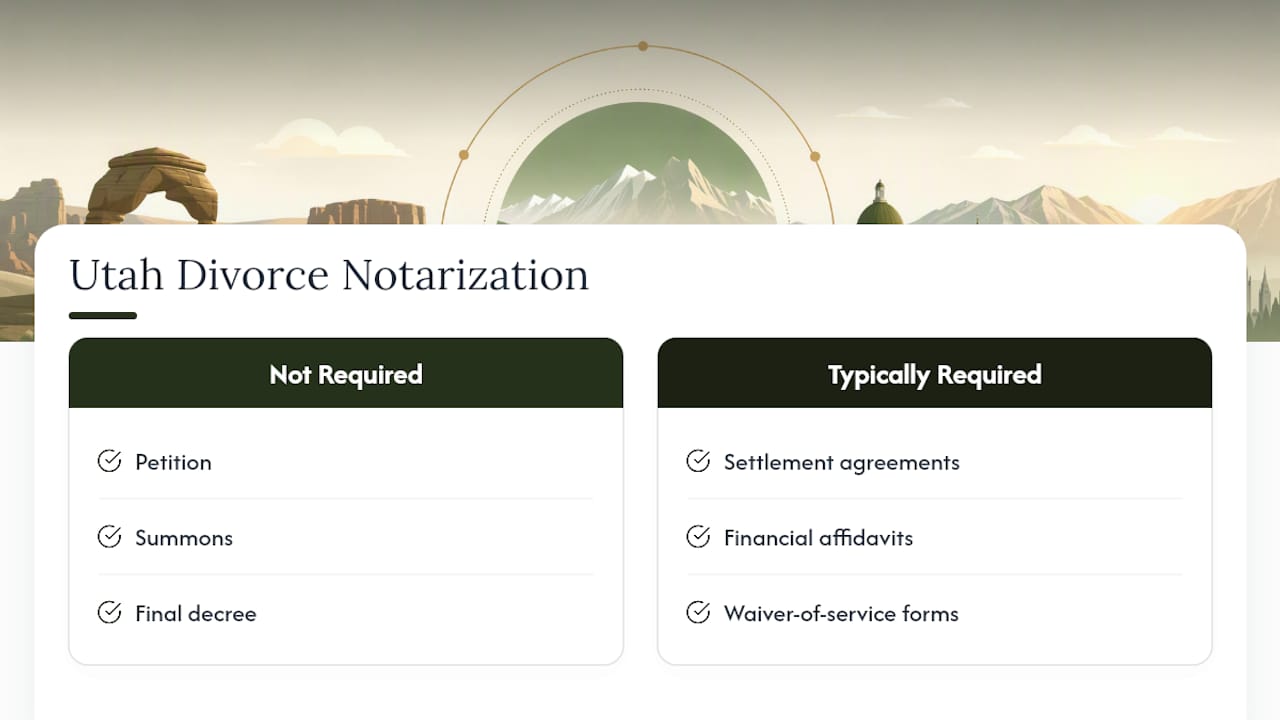
Not every page in your divorce packet needs a notary stamp. The petition, the summons, and the final decree itself don't require one. A judge signs the decree, and the court issues it directly.
Notarization typically applies to documents where you're swearing to something under oath or waiving a right, including:
- Marital settlement agreements
- Financial affidavits (these use "jurat" language, meaning you swear the contents are true in front of the notary)
- Acceptance of service or waiver-of-service forms
- Powers of attorney tied to dividing retirement accounts or other financial matters
Read the certificate language at the bottom of each form before you schedule anything. A jurat requires you to sign in the notary's presence, while an acknowledgment just confirms you're the person who signed it, sometimes even if you signed earlier. Confusing the two is the single most common reason why notarizations get rejected.
Some forms also require a witness in addition to a notary, so check that box before you show up somewhere with just your ID in hand. Utah Courts' divorce guidance separates court-issued documents from party-signed ones, and that distinction determines who signs, who notarizes, and who never touches a notary stamp at all.
How Do You Get a Divorce Document Notarized in Utah?
Start with the document itself. Fill in every blank; a notary generally will not stamp a form with obvious gaps, since an unfilled line can be altered after the fact. Bring a valid, unexpired government ID, your Utah driver's license, a passport, or a state ID card all work.
Then match your method to your situation:
- In-person. Locate a notary at a bank branch, shipping store, or attorney's office. Bring your unsigned document (don't sign it beforehand if it's a jurat), your ID, and any witnesses the form requires.
- Mobile notary. Book ahead, usually by a day or two. The notary travels to your home or office and charges a travel fee on top of the standard notarization fee. This works well if you're juggling work, kids, or limited mobility.
- Remote online notarization (RON). Create an account with an approved platform, upload your document, verify your identity through a knowledge-based quiz or ID scan, and complete a live audio-video session where the notary watches you sign. You receive an electronic seal and a tamper-evident certificate.
Pro Tip: Keep a copy of everything, the signed document, the notary's certificate, and any confirmation email. If a form gets rejected later, you'll want proof of exactly when and how it was notarized.
Before you leave (or log off), confirm: your ID matches the name on the document, every required signature line is filled, any required witnesses are present, and you have the case number handy if the court asks for it.
Does Utah Recognize Remote Online Notarization for Divorce Papers?
Yes. Utah's notary statute authorizes RON statewide, and courts recognize a properly performed remote notarization the same as one done in person, according to Utah Code Ann. §§ 46-1-2 et seq. That's a meaningful convenience if you've moved out of state mid-divorce or just can't take time off during business hours.
A typical RON session runs through:
- Identity verification (ID scan plus a knowledge-based identity quiz)
- Credential analysis, where the platform checks your ID for signs of tampering
- A live audio-video session with the notary
- Delivery of an e-seal and a digital certificate you can download and print
The nuance worth knowing: some documents carry witness requirements or real-property language that complicates RON, particularly if a settlement agreement transfers a house or other real estate. When that's the case, check with your court clerk before assuming an online notarization will satisfy the filing.
Pro Tip: Save the notary's commission number and the state where they're commissioned. If your document ever needs to be used outside Utah, that information speeds up any interstate recognition questions.
What Does Notarization Cost, and What ID Do You Need?
Utah accepts a driver's license, U.S. passport, or state-issued ID card for standard notarizations. RON platforms sometimes ask for a secondary form of verification, like a knowledge-based quiz pulling from your credit history, since there's no notary physically checking your face against a photo.
Fees vary by provider and method:
- A standard in-person notarization at a bank or shipping store often runs a modest per-stamp fee, sometimes free for existing bank customers.
- Mobile notaries add a travel charge on top of the base fee, which increases with distance and after-hours scheduling.
- Online RON platforms typically charge a flat per-document rate that covers the entire remote session.
Court filing fees are separate from anything you pay a notary. Utah's notary resource pages list current rules and fee caps, but always confirm pricing with your chosen notary or platform before you schedule, since rates aren't standardized across providers.
How Do Certified Copies and Court Filing Work After Notarization?
Notarization and certification are two different things. A notary verifies that you signed a document; a certified copy of your final decree comes only from the district court clerk after a judge signs it. Utah's authentication guidance draws that line clearly: the court issues and certifies the decree, while you and your notary handle the settlement agreement, affidavit, or waiver.
Once your relevant documents are notarized, you submit them to the court, in person, by mail, or electronically through tools like MyPaperwork, though you'll need to download and file the final papers yourself. A judge can't sign a final decree until 30 days have passed since the case was filed, so time your notarization appointment to land well before that window closes, not after.
Practical perspective: privacy vs. speed
RON wins on speed and geography. Mobile notaries win on convenience without sacrificing an in-person ID check. In-office notarization still makes sense when a court or a real estate transaction expects wet ink. Pick the method that matches what your document, and your court, actually require.

How Divvi Makes Notarization-Ready Divorce Documents Easier
Divvi is built for exactly the gap this article just walked through: knowing which forms need a notary and getting them filled out correctly the first time. Instead of guessing whether your settlement agreement needs a jurat or an acknowledgment, Divvi's step-by-step wizard generates documents designed for filing built for your specific situation, including custody and asset division, so nothing shows up blank when you sit down with a notary.
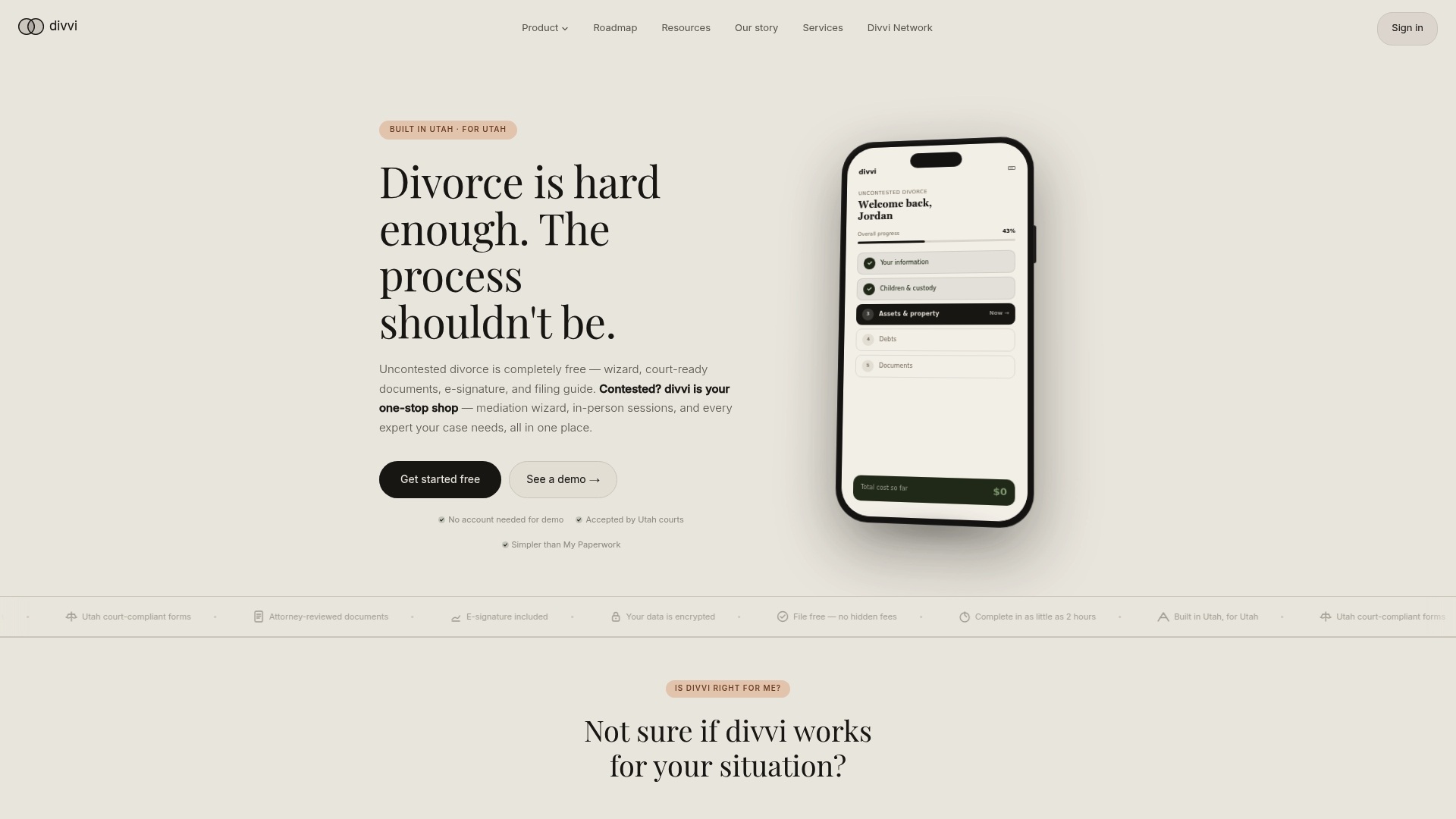
You can have an attorney check your documents before you ever schedule a signing appointment, which catches the kind of formatting errors that get filings bounced back. Divvi also connects you with mediators and financial advisors when a settlement agreement needs more than a template, and its filing guidance walks you through what happens after notarization, including the 30-day waiting period Utah courts require.
If you're ready to prepare documents that are actually notarization-ready, start with Divvi's Utah divorce platform and generate your paperwork before your next notary appointment.
Frequently Asked Questions
Does every divorce document in Utah need to be notarized? No. The petition, summons, and final decree don't require notarization. Settlement agreements, financial affidavits, and waiver-of-service forms typically do.
Can I use remote online notarization for divorce paperwork in Utah? Yes, Utah law authorizes RON statewide, though documents with witness requirements or real-property language sometimes still need extra steps.
Where do I get a certified copy of my Utah divorce decree? Certified copies come from the district court clerk where your case was filed, not from a notary, since the decree is a court-issued document.
What happens if a notarized divorce document gets rejected by the court? Check the certificate language first; a jurat signed before meeting the notary is a common rejection reason. Re-sign in front of a notary using the correct certificate wording and refile.
How do I verify a Utah notary is licensed and in good standing? Utah's notary resource pages let you confirm an active commission before you schedule an appointment, whether in person, mobile, or online.
This article is general information, not a substitute for advice from a qualified lawyer. Consult a qualified legal professional about your own circumstances before acting on anything here.
Sources
- Utah Code Ann. §§ 46-1-2 et seq.
- Utah Courts — Divorce
- Utah Notary resources and forms
- Types of Documents | Authentications Website - Utah.gov