What Counts as a High Asset Divorce in Utah?
Written and reviewed by the divvi team. How we research and check this.

A Utah divorce becomes "high-asset" when the marital estate includes complex property that's hard to value or divide cleanly, not just when the numbers are large. Business ownership, private equity stakes, multiple properties, sizable retirement accounts, or trust interests all push a case into this category. If that sounds like your situation, do two things today: gather your financial documents (tax returns, bank and brokerage statements, business records) and schedule consultations with a divorce attorney and a forensic accountant who handle complex Utah cases.
Timing matters more than most people realize. Utah requires a 30-day waiting period after filing before a decree can be entered, but assets can move fast during that window. Accounts get drained, business interests get restructured, and property gets quietly retitled before either spouse has a chance to object.
- Secure copies of financial records before discussions turn adversarial
- Book a consultation with a high-asset divorce attorney within the first two weeks
- Ask about temporary orders if you suspect your spouse might transfer or hide assets
Pro Tip: Don't wait until you file to talk to a forensic accountant. The earlier they see your financial picture, the harder it is for anyone to quietly move money before litigation starts.
Key Takeaways
Protecting substantial assets in a Utah divorce depends on early documentation, prompt expert engagement, and understanding that equitable distribution rewards preparation over reaction.
| Point | Details |
|---|---|
| Complexity defines high-asset status | Business ownership, trusts, and multiple properties matter more than a raw dollar figure. |
| Residency and timing rules apply | Utah requires 90-day county residency and a 30-day waiting period before a decree. |
| Equitable distribution isn't 50/50 | Judges weigh marriage length, contributions, and tax consequences when dividing property. |
| Valuation timing affects cost | Starting business and asset valuation early prevents disputes over stale numbers. |
| Divvi supports document and expert coordination | Divvi offers free filing tools, attorney referrals, mediation, and expert connections for Utah cases. |
Table of Contents
- What Is a High Asset Divorce in Utah?
- How Do Utah's Divorce Laws Handle Filing and Timing?
- How Does Utah Divide Marital Property?
- How Are Business Interests Valued and Protected in Divorce?
- What Steps Protect Assets During a Utah Divorce?
- Who Should You Hire for Valuation and Forensic Accounting?
- How Do Alimony and Custody Interact with Asset Division?
- Mediation, Collaborative Divorce, or Litigation: Which Path Fits?
- What Does a High Asset Divorce Cost in Utah?
- What Documents Should You Gather Before Filing?
- How Divvi Supports Utah High-Asset Divorce Cases
- Mistakes We See Most Often in Utah High-Asset Cases
- Get Started on Your Utah High-Asset Divorce with Divvi
- Sources
What Is a High Asset Divorce in Utah?
There's no statutory dollar line that makes a Utah divorce "high-asset." In practice, attorneys and financial professionals tend to use $1 million or more in net marital assets as a rough marker, but that number is a guideline, not a legal test. A couple with $600,000 tied up in a closely held business, a rental portfolio, and a deferred compensation plan can face more complexity than a couple with $3 million sitting in a joint brokerage account.
Complexity is the real driver. Consider a business owner whose company represents most of the marital estate, a couple with four properties spread across two states, or a spouse who inherited a trust interest during the marriage and later commingled trust distributions into a joint account. Each of these scenarios demands more than a simple spreadsheet split.
Watch for these red flags that turn an ordinary divorce into a high-asset matter:
- A business or professional practice owned by one or both spouses
- Multiple real estate holdings, including out-of-state or vacation properties
- Retirement accounts, pensions, or deferred compensation exceeding six figures
- Trust interests, inheritances, or gifts that got mixed with marital funds
- Investment portfolios with illiquid holdings like private equity or restricted stock
How Do Utah's Divorce Laws Handle Filing and Timing?
Utah requires bona fide residency in the county where you file for at least 90 days before the petition goes in, and the court generally cannot enter a decree until 30 days after filing, barring extraordinary circumstances. That waiting period isn't just a formality. It's a window where temporary orders often get requested to freeze accounts, set interim support, or preserve business operations while the case proceeds.
Utah is an equitable distribution state, not a community property state. Courts don't split assets 50/50 by default. Instead, judges weigh factors like the length of the marriage, each spouse's financial situation, contributions to the marriage (including homemaking and childrearing), and tax consequences of different division scenarios.
- Residency: a minimum period of residence in the filing county is required before you can submit a petition
- Waiting period: 30 days minimum between filing and decree, per Utah Code Title 81, Chapter 4
- Mediation: often required or strongly encouraged before trial in contested cases
- Temporary orders: available early to address support, asset control, and parenting time
Utah courts routinely address alimony, child support, custody, and property division within a single decree, which means the strategy you build around asset division has to account for how it interacts with support obligations from day one.
How Does Utah Divide Marital Property?
Courts start by separating marital property (acquired during the marriage) from separate property (owned before marriage or received individually as a gift or inheritance). The line blurs fast when separate funds get deposited into joint accounts, used to renovate a jointly owned home, or reinvested into a business both spouses work in. That blurring is called commingling, and once it happens, tracing the original separate contribution becomes a forensic accounting problem rather than a simple legal one.
Retirement accounts follow their own rules. Dividing a 401(k) or pension typically requires a Qualified Domestic Relations Order (QDRO), a separate court order that tells the plan administrator how to split the account without triggering early withdrawal penalties. IRAs are handled differently and don't require a QDRO, but they still need careful drafting to avoid unexpected tax consequences.
Real estate adds another layer. A primary residence, a rental property, and a mountain cabin each carry different valuation and liability questions, especially when mortgages or home equity loans are involved.
Common mistakes that cost high-net-worth spouses real money:
- Failing to document premarital contributions before they get commingled
- Making informal transfers of property or cash without written records
- Undervaluing illiquid assets like private business interests or restricted stock
- Assuming an IRA and a 401(k) get divided the same way
Divvi's guide on whether Utah is a community property state walks through these distinctions in more detail if you want the fuller picture before your consultation.
How Are Business Interests Valued and Protected in Divorce?
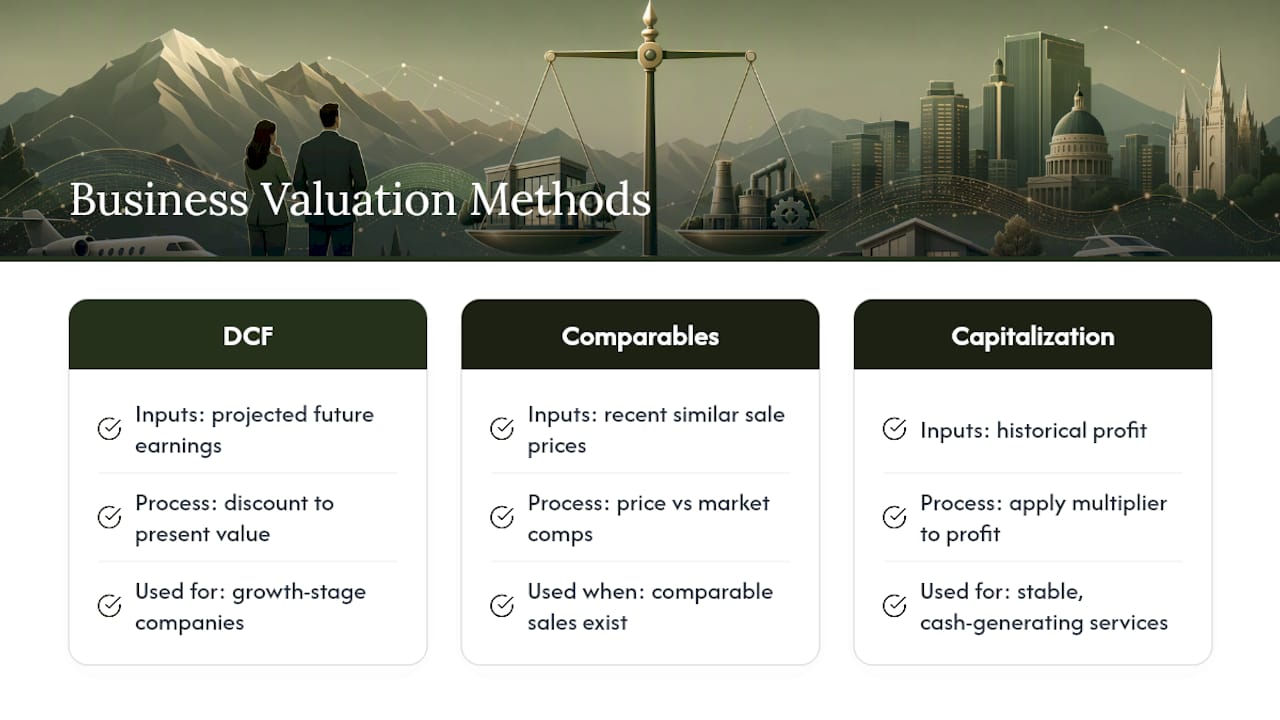
When one or both spouses own a business, valuation becomes the central battleground. Three methods dominate Utah high-asset cases: discounted cash flow (projecting future earnings and discounting them to present value), market comparables (pricing the business against similar recent sales), and capitalization of earnings (applying a multiplier to historical profit). Which method applies depends on the business type. A stable, cash-generating service company often gets valued through capitalization of earnings, while a growth-stage company might warrant a discounted cash flow analysis.
Temporary orders can restrict what an owner-spouse does with the business mid-case, from limiting large transactions to requiring detailed financial reporting to the other side. Courts take a dim view of an owner who suddenly starts making unusual withdrawals or restructuring ownership right after filing.

If you own the business, protect yourself by maintaining strict corporate formalities, keeping personal and business accounts separate, and avoiding any transfers of ownership interest until the valuation process runs its course.
Pro Tip: Start valuation work the moment divorce becomes likely, not after you file. Financial records get harder to reconstruct the longer you wait, and a valuation based on stale numbers invites a fight over accuracy.
What Steps Protect Assets During a Utah Divorce?
The first weeks after deciding to divorce are the highest-risk window for asset dissipation. Copy your bank, brokerage, and business financial statements before anything else happens. Don't move large sums between accounts without documenting the reason, and don't close joint accounts unilaterally.
If you have specific reason to believe your spouse might drain accounts, transfer property, or hide business assets, ask your attorney about a temporary restraining order or injunction. Utah courts can freeze specific assets while the case proceeds, which is often faster and cheaper than trying to claw back money after it's gone.
- Photograph or screenshot account balances and cap table snapshots before filing
- Avoid large, unexplained transfers once divorce becomes a real possibility
- Keep a written log of any joint decisions about shared property or business assets
- Ask your attorney about temporary orders if dissipation seems likely
Utah courts treat dissipation (spending or hiding marital assets in anticipation of divorce) seriously, and a documented pattern of unusual transfers can shift the final property division in the other spouse's favor.
Who Should You Hire for Valuation and Forensic Accounting?
Complex cases often need more than one type of expert. A business valuation specialist values ownership interests. A forensic accountant traces commingled funds, reconstructs historical income, and identifies hidden or undisclosed assets. Real estate appraisers handle property valuation disputes. In cases involving digital assets or hidden financial activity, a forensic IT specialist may need to recover deleted records or trace cryptocurrency transactions.

Costs vary widely depending on how many entities need review and how far back the reconstruction has to go. A single-business valuation with clean books costs far less than untangling a decade of commingled accounts across multiple entities.
Before hiring anyone, ask these questions:
- Have they testified as an expert witness in Utah family court before?
- Can they provide a sample report so you understand their methodology?
- What are their credentials (CPA, CVA, ASA) and do they specialize in divorce work?
- How do they estimate fees, and what triggers additional cost?
Divvi's divorce discovery checklist helps you organize the records these experts will need before you even sit down with them.
How Do Alimony and Custody Interact with Asset Division?
High-income cases complicate alimony (spousal support) because Utah courts look at ability to pay, the marital standard of living, and the receiving spouse's needs rather than applying a flat formula. Longer marriages and larger income gaps tend to produce longer support durations. Divvi's alimony calculator can give you a starting estimate before your attorney refines it.
Child support in high-asset cases often requires reconciling guideline calculations with irregular income sources like business distributions, bonuses, or investment gains. Custody and parent-time arrangements also carry financial weight. A parent seeking primary custody sometimes trades flexibility on property division to secure that outcome, so these issues rarely get negotiated in isolation.
Mediation, Collaborative Divorce, or Litigation: Which Path Fits?
An uncontested high-asset divorce can wrap up in one to three months once both spouses agree on terms, constrained mainly by the mandatory 30-day waiting period. Contested cases with disputed valuations or custody fights routinely stretch from six months to two years.
| Factor | Mediation / Collaborative | Litigation |
|---|---|---|
| Approach | Negotiated resolution outside court | Court decides disputed issues |
| Cost | Generally lower, fewer billable hours | Higher, driven by discovery and hearings |
| Timeline | Weeks to a few months | Six months to two-plus years |
| Privacy/control | High, spouses shape the outcome | Lower, judge issues binding rulings |
| When to hire experts | Often limited, agreed-upon valuations | Frequently required for disputed claims |
Emergency relief makes sense when a business faces imminent operational disruption or assets are at real risk of disappearing before a hearing date.
What Does a High Asset Divorce Cost in Utah?
Cost tracks complexity. Attorney hourly rates and total hours billed usually dominate the bill, followed by expert fees for valuation and forensic work. Depositions and broad discovery requests add significant expense fast.
Negotiating early and narrowing disputed issues cuts costs meaningfully. Targeted discovery requests, limited-scope expert engagements, and mediation for issues that don't require a judge all reduce the final bill. Divvi's divorce cost estimator gives you a starting figure based on your case type before you commit to a full retainer.
What Documents Should You Gather Before Filing?
Getting organized early saves time and money once discovery starts. Prioritize these in order:
- Bank, brokerage, and retirement account statements from the last three to five years
- Federal and state tax returns, including business returns if applicable
- Business financial statements: profit and loss, balance sheets, cap table
- Property deeds, mortgage statements, and any appraisals already on file
- Trust documents and records of any inheritance or gift
- Prenuptial or postnuptial agreements, if one exists
Store copies somewhere your spouse can't access or delete, and limit who sees this material to your attorney until you're ready to disclose it formally.
Pro Tip: Create a single secure, cloud-based folder organized by category before you file. When discovery requests come in, you'll spend hours instead of weeks pulling records together.
How Divvi Supports Utah High-Asset Divorce Cases
Divvi's platform handles the document automation and the preparation behind your filing, whether that means an uncontested filing or preparing paperwork for a contested one. Attorney referrals, mediation options, and connections to valuation experts and financial advisors mean you're not managing every specialist relationship on your own.
A user preparing for discovery, coordinating a QDRO, or trying to move a straightforward uncontested filing through quickly is a good fit for starting with Divvi's tools. Complex contested disputes still need dedicated legal counsel, but the platform gets your documentation and expert connections moving faster than starting from scratch.
- Document automation for both uncontested and contested filings
- An optional attorney referral before anything goes to court
- Mediation options, including AI-assisted and human mediators
- Direct connections to valuation experts, real estate agents, and financial advisors
Mistakes We See Most Often in Utah High-Asset Cases
Late valuation is the most expensive mistake. Waiting until months into litigation to value a business means working with stale numbers that invite disputes. Get it done early.
Informal asset transfers rank second. A spouse who moves money "temporarily" without documentation almost always regrets it when dissipation becomes an issue at trial.
Poor document preservation rounds out the list. Losing access to financial records because an account got closed or a login changed turns a manageable case into an expensive forensic reconstruction.
Get Started on Your Utah High-Asset Divorce with Divvi
Divvi gets you moving faster than the traditional path of shopping for a divorce attorney, waiting weeks for an initial consultation, and paying a retainer before any paperwork exists. You can start building your case documentation today, at no cost, through the free wizard, then add attorney review, mediation, or expert connections exactly where your case needs them.
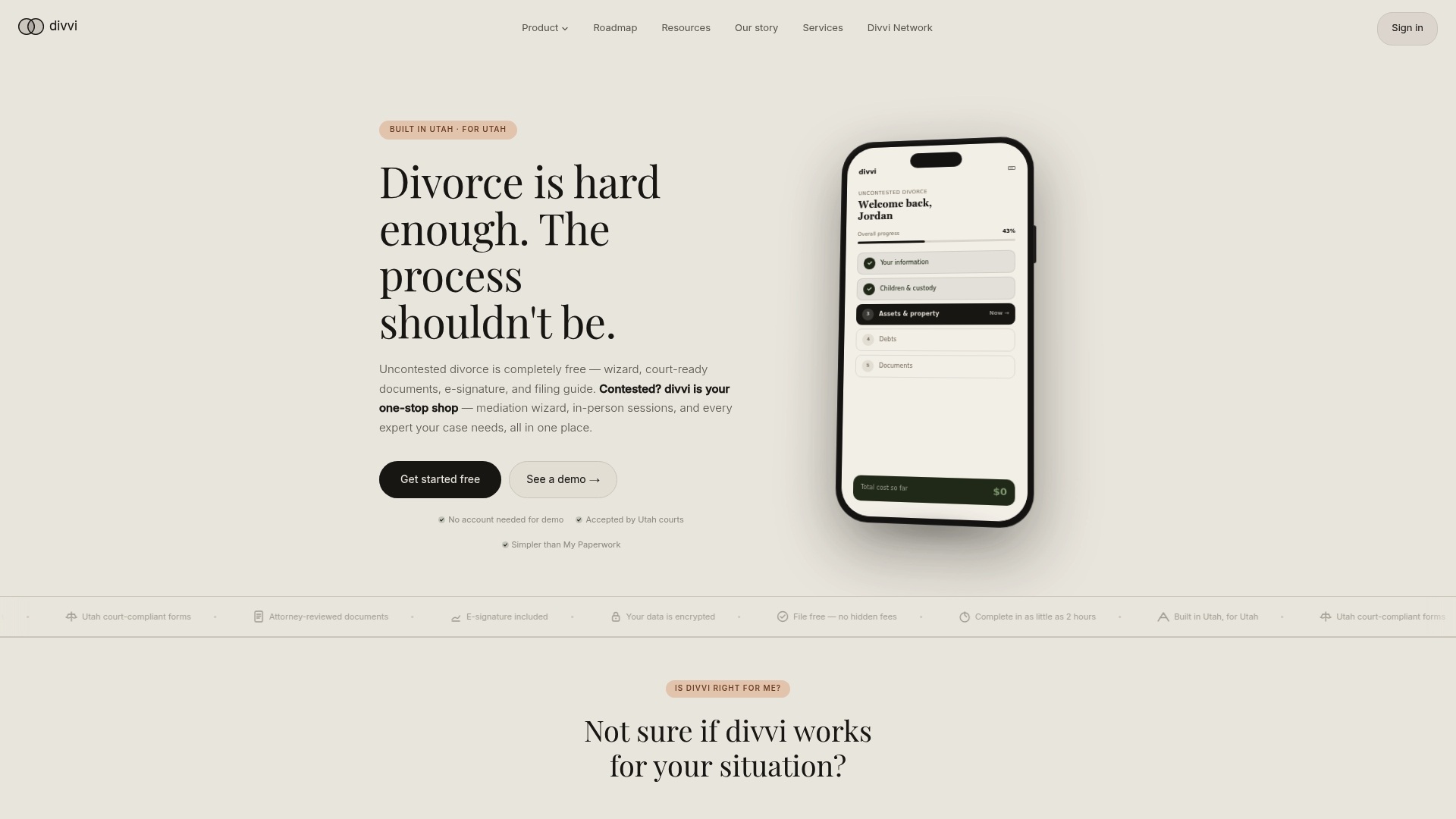
For high-asset cases specifically, Divvi's relevant services include document preparation for contested and uncontested filings, attorney referrals, mediation through the mediation platform, and QDRO assistance for splitting retirement accounts correctly. If your case involves active litigation over business valuation or a highly contentious custody dispute, you'll still want a retained specialist attorney handling court appearances. Divvi's platform works alongside that representation rather than replacing it in those situations.
Start by visiting the Utah divorce services page to see which entry point fits your situation, whether that's the free filing wizard or a paid review of documents you already have.
Sources
These sources back the legal and procedural claims in this guide:
- Divorce - Utah Courts self-help
- Utah Code Title 81. Utah Domestic Relations Code § 81-4-402. Petition for divorce--Divorce proceedings--Temporary orders
- 2024 Utah Code Title 81 - Utah Domestic Relations Code Chapter 4 - Dissolution of Marriage Part 4 - Divorce
This article is general information, not a substitute for advice from a qualified lawyer. Consult a qualified legal professional about your own circumstances before acting on anything here.