DIY Divorce in Utah: Your Complete Self-Filing Guide
Written and reviewed by the divvi team. How we research and check this.

Yes, you can handle your own divorce in Utah. The state allows self-representation for uncontested cases, and Utah Courts provides the tools to do it without an attorney. The official starting point is MyPaperwork, a guided online interview that generates forms designed for filing specific to your situation.
Before you open that system, do three things:
- Verify residency. You must have lived in the county where you plan to file for at least 90 days.
- Collect your documents. Financial records, property titles, account statements, and any existing custody arrangements.
- Check your county's filing options and fee schedule. Some counties accept filings by email or mail; others require in-person submission. Fee waivers are available if you qualify.
If both spouses agree on all terms, a DIY uncontested divorce in Utah is genuinely manageable. If there is any real disagreement on assets, custody, or support, read the contested-case section before you start.
Key Takeaways
A DIY uncontested divorce in Utah is achievable for most couples who agree on all terms, meet the 90-day county residency requirement, and follow the official filing steps through Utah Courts.
| Point | Details |
|---|---|
| Residency requirement | You must live in your filing county for 90 days before you can file. |
| Service rules | You cannot serve your own papers; use a process server or Acceptance of Service. |
| 30-day waiting period | Utah law requires 30 days after filing before a judge can sign the final decree. |
| Parenting course deadline | With a minor child, the petitioner has 60 days from filing and the respondent has 30 days from service. |
| Divvi free wizard | Divvi's free uncontested tool generates Utah forms designed for filing, with an attorney referral available. |
Table of Contents
- Do you qualify for a DIY divorce in Utah?
- Step-by-step checklist for filing a DIY uncontested divorce in Utah
- What forms and tools does Utah Courts provide?
- How do you properly serve divorce papers in Utah?
- What do you need to know if you have children?
- What happens if your spouse contests the divorce?
- How much does a DIY divorce in Utah cost?
- What mistakes do DIY filers make most often in Utah?
- An honest perspective on DIY divorce in Utah
- Divvi makes the process clearer, not harder
- Sources
Do you qualify for a DIY divorce in Utah?
Utah's self-filing path works best for uncontested cases, but you still need to meet specific jurisdictional requirements before you can file anything.
Residency
You must have lived in the county where you file for a qualifying period before filing. That is a county residency requirement, not just a state one. If you moved to Salt Lake County three months ago from another Utah county, you file in Salt Lake County. If you just relocated from out of state, you may need to wait. Utah Code § 81-4-405 governs residency and grounds requirements.
Active-duty military members stationed in Utah may qualify under different rules. If that applies to you, contact the court clerk before filing.
Grounds for divorce
Utah recognizes both fault and no-fault grounds. For a DIY uncontested divorce, nearly everyone uses irreconcilable differences, which requires no proof of wrongdoing. Both spouses simply need to agree that the marriage is over and that they can settle all terms between themselves. Fault-based grounds (adultery, cruelty, abandonment) are rarely worth pursuing in a DIY context because they complicate the process and rarely change the financial outcome.
When children are involved
If you have minor children, Utah courts apply the Uniform Child Custody Jurisdiction and Enforcement Act (UCCJEA). For a Utah court to have jurisdiction over custody, the children generally must have lived in Utah with a parent for a qualifying period before you file. If your children recently moved from another state, the court may lack jurisdiction over custody, and you may need to coordinate with the other state's courts. This is one situation where a brief attorney consultation pays for itself.
Step-by-step checklist for filing a DIY uncontested divorce in Utah
Work through these steps in order. Skipping one typically means going back to redo earlier work.
- Confirm eligibility. Verify 90-day county residency and that your case is genuinely uncontested (full agreement on property, debt, custody, and support).
- Gather documents. Collect financial statements, tax returns, mortgage or lease documents, vehicle titles, retirement account statements, and your marriage certificate.
- Complete the MyPaperwork interview. Log in at utcourts.gov, answer the guided questions, and let the system generate your forms. Download everything within the available window.
- File with the correct district court. Take or send your completed forms to the district court in your county. Pay the filing fee or submit a fee waiver request at the same time.
- Serve the respondent. You cannot serve your own papers. Arrange for a sheriff, process server, or any non-party adult to deliver the Summons and Petition. You have a specified period from filing to complete service.
- Wait for a response. The respondent has 21 days to file an answer if served in Utah, or 30 days if served out of state. If no answer is filed, you can request a default.
- Complete parenting requirements (if applicable). Both parents must finish court-mandated education courses within a set time after filing when minor children are involved.
- Observe the 30-day waiting period. Utah law requires a minimum 30-day wait after filing before a judge can sign the final Decree of Divorce. Log back into MyPaperwork after this period to generate your final decree documents.
- Submit final documents and obtain the decree. File the Stipulation and Decree (and Parenting Plan if children are involved) with the court. A judge reviews and signs. In straightforward uncontested cases, no hearing is required.
Cost snapshot: Filing fees run approximately $358 as a base, with total uncontested DIY costs commonly landing between $358 and $600 when you factor in service fees and parenting course costs. Check your specific county's fee schedule, since amounts vary.
A realistic minimum timeline for an uncontested case without children is about 30–45 days. Add children, and 60–90 days is more typical, mostly because of the parenting course requirement and the time it takes both parties to complete them.
What forms and tools does Utah Courts provide?
MyPaperwork is Utah Courts' primary self-help tool. You answer a series of guided questions about your marriage, assets, children, and agreements, and the system generates a complete, court-formatted packet. It does not file for you. Divorce case initiation in Utah is not available online, so you must download your forms and submit them to the court yourself.
Forms MyPaperwork typically generates
- Petition for Divorce (with or without minor children)
- Summons
- Certificate of Divorce (vital statistics form)
- Financial Declaration
- Stipulation and Decree of Divorce
- Parenting Plan and Child Support Worksheet (when children are involved)
- Motion to Waive Fees (if you request it)
Once your case is filed, you can track its status through MyCourtCase (also called MyCase), Utah Courts' case portal. This is where you will see filed documents, hearing dates, and case updates.
A few practical notes: courts require PDF format, and some counties print in black and white only, so avoid colored text or shading in your documents. Save copies of everything you submit. After the 30-day waiting period, you must log back into MyPaperwork to generate the final decree forms. The system does not alert you when the waiting period ends, and there is a download window, so set a calendar reminder.
Pro Tip: Keep a dedicated folder, physical or digital, for every document you generate, every receipt, and every confirmation. Courts occasionally lose filings, and having your own timestamped copies has saved more than a few cases from unnecessary delays.
That said, document tools like MyPaperwork help you fill out forms correctly but cannot evaluate whether your agreements are strategically sound. A custody arrangement that looks fair on paper can create real problems three years later. Use the tool for what it is: form generation, not legal strategy.
How do you properly serve divorce papers in Utah?
Service is where many DIY divorces stall. Get it wrong and the court clock does not start.
Who can serve the papers
Utah rules are clear on this: the petitioner cannot serve their own papers. Authorized servers include:
- A county sheriff or constable
- A licensed professional process server
- Any adult who is not a party to the case
A friend or adult family member who is not named in the divorce can legally serve papers. Just make sure they are willing to sign the Proof of Service form afterward.
Acceptance of Service: the easier option
If your spouse is cooperative, Acceptance of Service is the simplest and cheapest route. Your spouse signs a form acknowledging they received the documents, that form gets notarized, and you file it with the court. No process server needed, no sheriff's fee. This works well in genuinely amicable splits and is widely used in Utah uncontested cases.
Deadlines and proof of service
You have a specified number of days from the date you file the Petition to complete service and file Proof of Service with the court. Missing this window can result in dismissal. Once served, the respondent's response clock starts: 21 days for in-state service, 30 days for out-of-state.
- File the original Proof of Service with the court promptly after service is completed.
- Keep a copy for your records.
- If using certified mail (allowed in some circumstances), retain the signed return receipt.
Pro Tip: If your spouse is avoiding service, do not wait until day 100 to escalate. Courts can authorize alternative service methods, but the process takes time. Start the conversation with the clerk's office well before the 120-day deadline.
Common rejection reasons: unsigned server affidavit, petitioner listed as the server, or the wrong form used for the service method. Double-check before you file.
What do you need to know if you have children?
Cases with minor children carry additional legal requirements that the court enforces strictly. A decree that skips these steps will not be signed.
Custody and parenting plans
Utah distinguishes between legal custody (decision-making authority over education, healthcare, religion) and physical custody (where the child lives). Even when both parents agree completely, a judge reviews the parenting plan to confirm it serves the child's best interests. You cannot simply write "we'll figure it out" in the decree.
Key items your parenting plan must address:
- Primary physical custody and parent-time schedule (Utah has a statutory minimum parent-time schedule as a baseline)
- Legal custody designation (joint or sole)
- Holiday and vacation schedules
- Decision-making procedures for disputes
- Transportation arrangements
Mandatory parent education courses
Both parents must complete two court-mandated courses when minor children are involved:
- Divorce Orientation ($30 per person online)
- Divorce Education for Parents ($35 per parent)
The petitioner completes them within 60 days after the petition is filed; the respondent within 30 days after being served (Utah Code § 81-4-402(4)). Several providers offer these online, which makes scheduling easier. The court will not finalize the decree until completion certificates are on file. Couples with no minor children may take orientation but are not required to.
Child support
Utah uses a formula-based guideline for child support. You must complete a Child Support Worksheet using the official guidelines, and a judge can reject a stipulated support amount that falls outside the guideline range without a compelling written explanation. Use the state's official calculator or the worksheet generated by MyPaperwork, not a rough estimate.
The UCCJEA jurisdiction note from the qualifying section applies here too. If there is any question about whether Utah has jurisdiction over your children, resolve it before filing.
What happens if your spouse contests the divorce?
An uncontested path assumes full agreement. The moment your spouse files an answer disputing any term, the case shifts into contested territory, and the process changes significantly.
Mandatory mediation
When an answer is filed, Utah courts typically require mediation before the case can proceed to trial. You must select a court-qualified mediator within a time frame set by the court's scheduling order. The court's own mediation program offers lower-cost options for qualifying parties. Mediation costs far less than litigation and resolves most disputes without a trial.
Temporary orders
While the case is pending, either party can request temporary orders covering:
- Temporary custody and parent-time
- Temporary child support or spousal support
- Exclusive use of the marital home
- Emergency protective orders (in cases involving domestic violence or financial dissipation)
Temporary orders require a motion and, often, a hearing. This is covered in detail in Divvi's guide to temporary custody orders.
When to stop the DIY approach
Some situations genuinely require an attorney. Be honest with yourself if any of these apply:
- Significant disagreement over retirement accounts, business interests, or real property
- A custody dispute where one parent's fitness is questioned
- Any history of domestic violence or coercive control
- Complex debt situations involving business loans or tax liabilities
- One spouse has an attorney and you do not
A limited-scope consultation with an attorney (where you pay for specific advice, not full representation) can clarify your position without committing to full legal fees.
How much does a DIY divorce in Utah cost?
Typical costs
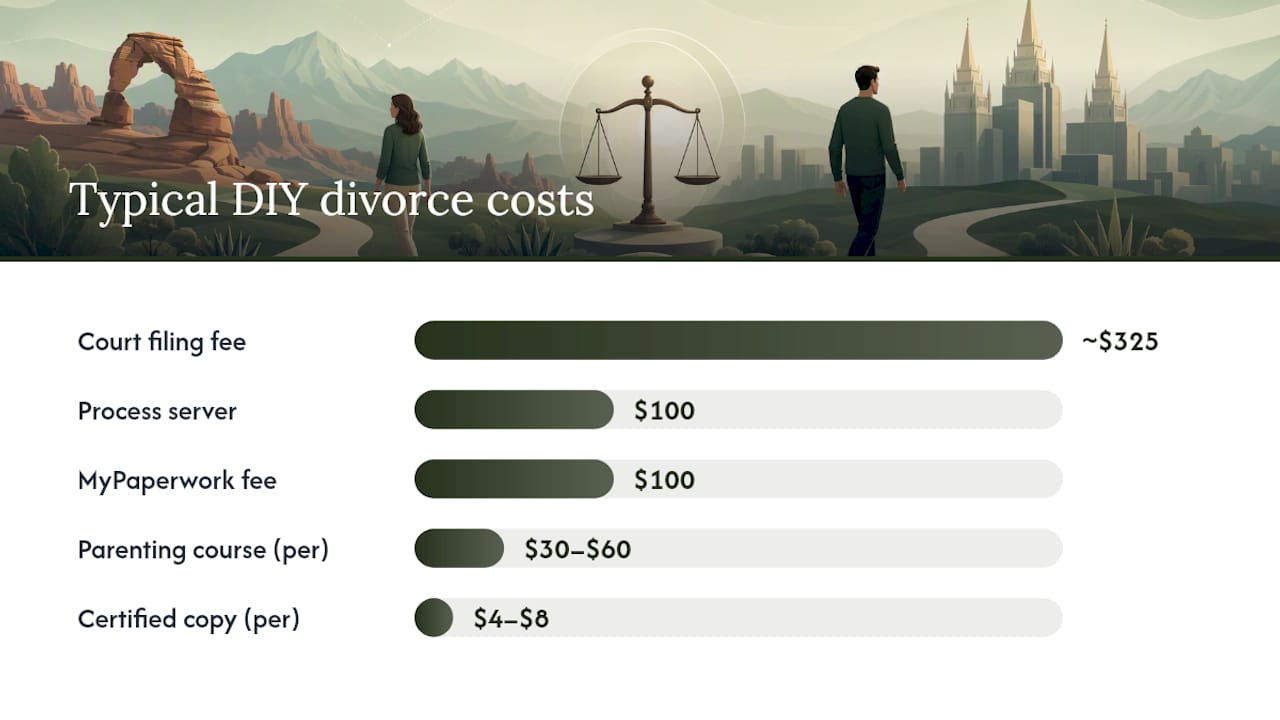
The base filing fee runs approximately $358, with total uncontested DIY costs typically ranging from $358 to $600. That range covers the filing fee, service costs, and parenting course fees. It does not include any paid document assistance, attorney review, or mediation.
| Cost Item | Typical Range | Notes |
|---|---|---|
| Court filing fee | ~$358 | Verify with your county clerk |
| Process server | $100 | Avoidable with Acceptance of Service |
| Divorce Orientation | $30 per person online | Required when the parties have a minor child |
| Divorce Education for Parents | $35 per parent | Required for parents of a minor child |
| Certified copies of decree | $4–$8 per copy | Needed for name changes, accounts |
| MyPaperwork petition add-on | $60 added to the filing fee | No fee to use the program. A petition prepared with MyPaperwork adds $60 under Utah Code § 78A-2-501(5). Later filings are not charged that add-on. The older $20 OCAP fee is out of date. |
Verify your county's exact filing fee before you go to the courthouse. Salt Lake County and Utah County fees may differ from rural counties.
Fee waivers
If your income falls below the court's threshold, you can apply to have the filing fee waived. The Motion to Waive Fees can be generated through MyPaperwork as part of your initial packet. You will need to attach income documentation, such as recent pay stubs or a benefits letter. Courts typically process waiver requests at the time of filing. Approval is not guaranteed, but qualifying filers are routinely approved.
Use Divvi's divorce cost estimator to get a clearer picture of what your specific situation will cost before you file.
Timeline expectations
The 30-day statutory waiting period is the floor, not the ceiling. Realistic timelines:
- Uncontested, no children: 30–45 days minimum
- Uncontested, with children: 60–90 days (parenting courses add time)
- Contested: several months to over a year, depending on complexity
What mistakes do DIY filers make most often in Utah?
Most delays and rejections trace back to a short list of avoidable errors.
- Serving your own papers. This is the single most common mistake. The court will reject the Proof of Service, and you will have to restart the service process.
- Missing the MyPaperwork final-form download window. After the 30-day waiting period, you must log back in and generate the final decree documents. The system does not remind you, and the download window is limited.
- Incorrect or unsigned Proof of Service. A server affidavit with missing information or the wrong server listed will be rejected.
- Ignoring parenting course deadlines. Courts will not finalize a decree with children until both parents' completion certificates are on file.
- Miscalculating child support. Judges reject support amounts that deviate from Utah guidelines without written justification.
- Assigning joint debt in the decree without refinancing. A divorce decree can assign responsibility for a debt to one spouse, but creditors are not bound by that agreement. If your name is on the loan, you remain liable to the lender regardless of what the decree says. The only real fix is refinancing the debt into one spouse's name or paying it off before finalization.
Pro Tip: Before you sign any stipulation that assigns a joint debt to your spouse, call the lender and ask what it would take to remove your name. If they say "refinance," build that into the agreement as a condition with a deadline, not an afterthought.
For a full financial disclosure checklist, Divvi's divorce discovery guide walks through every document category courts expect to see.
An honest perspective on DIY divorce in Utah
The DIY divorce path in Utah is genuinely accessible, and for straightforward uncontested cases, it works. But there is a gap between "technically possible" and "strategically sound" that most guides skip over.
Document tools generate forms. They do not tell you whether the custody schedule you agreed to will hold up when your child starts high school, or whether the asset split you negotiated leaves one spouse financially exposed in retirement. Those are judgment calls, and no automated system makes them for you.
The cases where DIY goes wrong are rarely the ones where someone filled out a form incorrectly. They are the ones where someone agreed to terms that seemed fair in the moment but created problems years later. A parenting plan with no dispute-resolution clause. A support amount set below guidelines with no written justification. A joint mortgage assigned to one spouse who then cannot refinance.
If your case is genuinely simple, use the tools, follow the steps, and save the money. If there is any complexity, a limited-scope attorney review costs far less than undoing a bad decree. Divvi's platform is built around exactly that middle ground: free for simple cases, with paid mediation available when you and your spouse can't agree.
Divvi makes the process clearer, not harder
Hiring a divorce attorney in Utah can cost thousands of dollars. Doing it entirely alone means navigating forms, deadlines, and procedural rules without a safety net. Divvi sits between those two options.
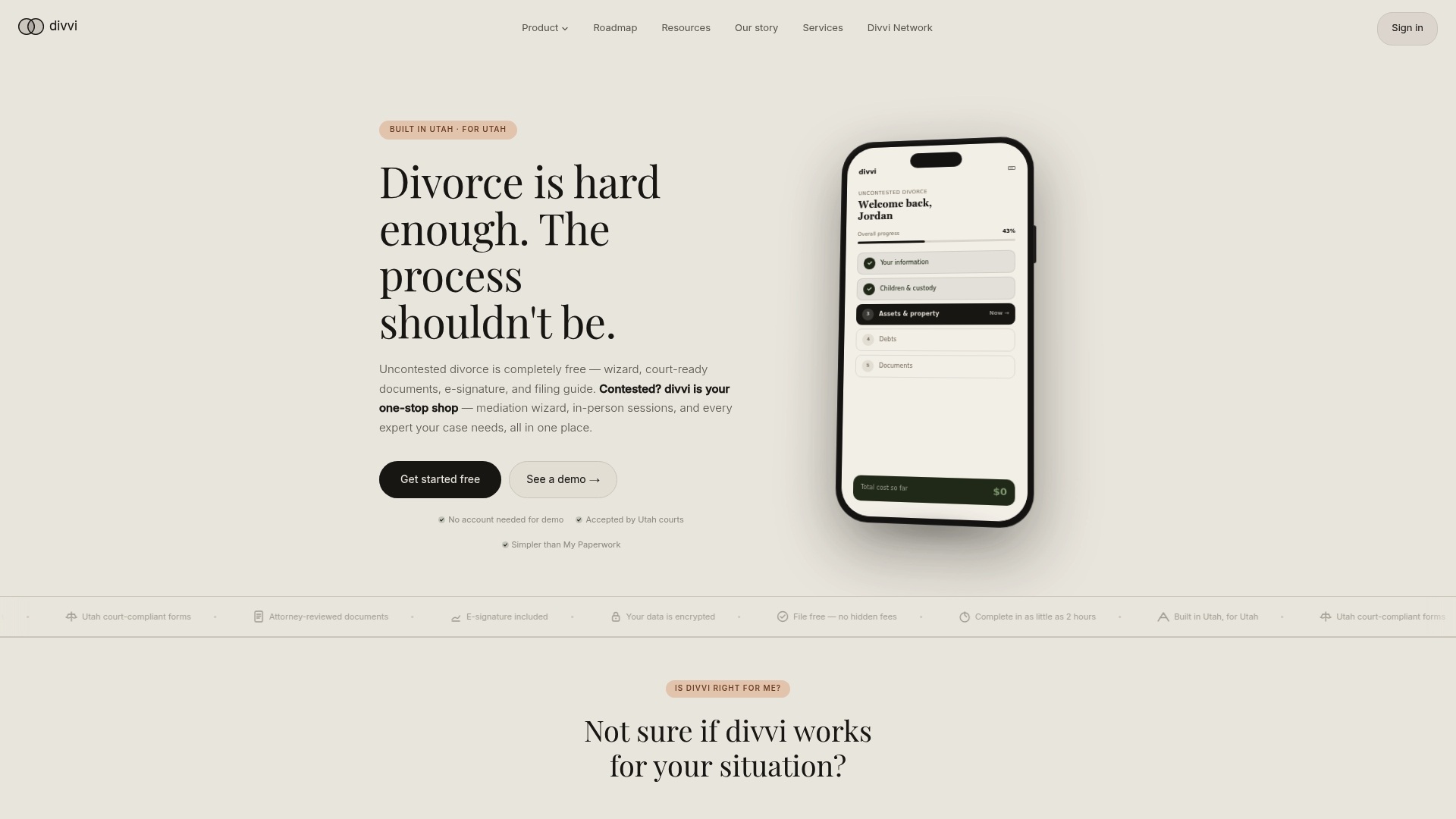
The free uncontested divorce wizard walks you through the same questions MyPaperwork asks, generates documents designed for filing aligned with Utah Courts' requirements, and includes e-signature so both parties can sign without printing and mailing. If your case gets complicated, you can add an attorney referral, mediation matching, or filing assistance without switching platforms. Post-divorce, the same account handles decree modifications, parenting plan updates, and QDRO preparation.
Divvi is Utah-specific. The forms, timelines, and county filing notes reflect Utah Courts' actual requirements, not a generic national template. Start with the free wizard and upgrade only if you need to.
Sources
Official pages to bookmark before you file:
- Divorce
- How to File for Divorce Online in Utah: Steps and Fees - LegalClarity
- Divorce
- How to File for Divorce in Utah Without a Lawyer
This article is general information, not a substitute for advice from a qualified lawyer. Consult a qualified legal professional about your own circumstances before acting on anything here.