Utah Divorce Classes: Which Ones You Must Take
Written and reviewed by the divvi team. How we research and check this.

When the parties have a minor child, a divorce requires both the Divorce Orientation Course (§ 81-4-105) and the parenting course, Divorce Education for Parents (§ 81-9-103). Couples with no minor children may take orientation but are not required to (§ 81-4-105(1)(b) and § 81-4-402(4)). The Utah Courts education page also says custody and parentage cases require only the Parenting Course, and temporary separation cases require only the Divorce Orientation. For temporary separation, § 81-4-105 applies that orientation requirement to parties with a minor child. You must use a court-approved provider. The two main registration options are Utah Courts' official class pages and Divorce, where the Divorce Orientation costs $30 online and the Parenting Education course costs $35 online.
Quick reference for required classes:
- Divorce with a minor child: Divorce Orientation Course + parenting course (Divorce Education for Parents)
- Divorce with no minor child: orientation is optional; the parenting course does not apply
- Custody or parentage case: the courts' education page says the Parenting Course only
- Temporary separation with a minor child: Divorce Orientation Course (§ 81-4-105); the courts' page describes this as orientation only
- Children ages 6–17: Free Divorce Education for Children course (optional, not required of parents)
- Can't attend? File a motion asking the judge for a waiver
Key Takeaways
Utah requires divorce education classes before a final order is issued, and completing them early prevents delays in your case.
| Point | Details |
|---|---|
| Which classes you need | Both courses when the parties have a minor child. Couples with no minor children may take orientation but are not required to. |
| Online fees | USU charges $30 for Divorce Orientation and $35 for Parenting Education online. |
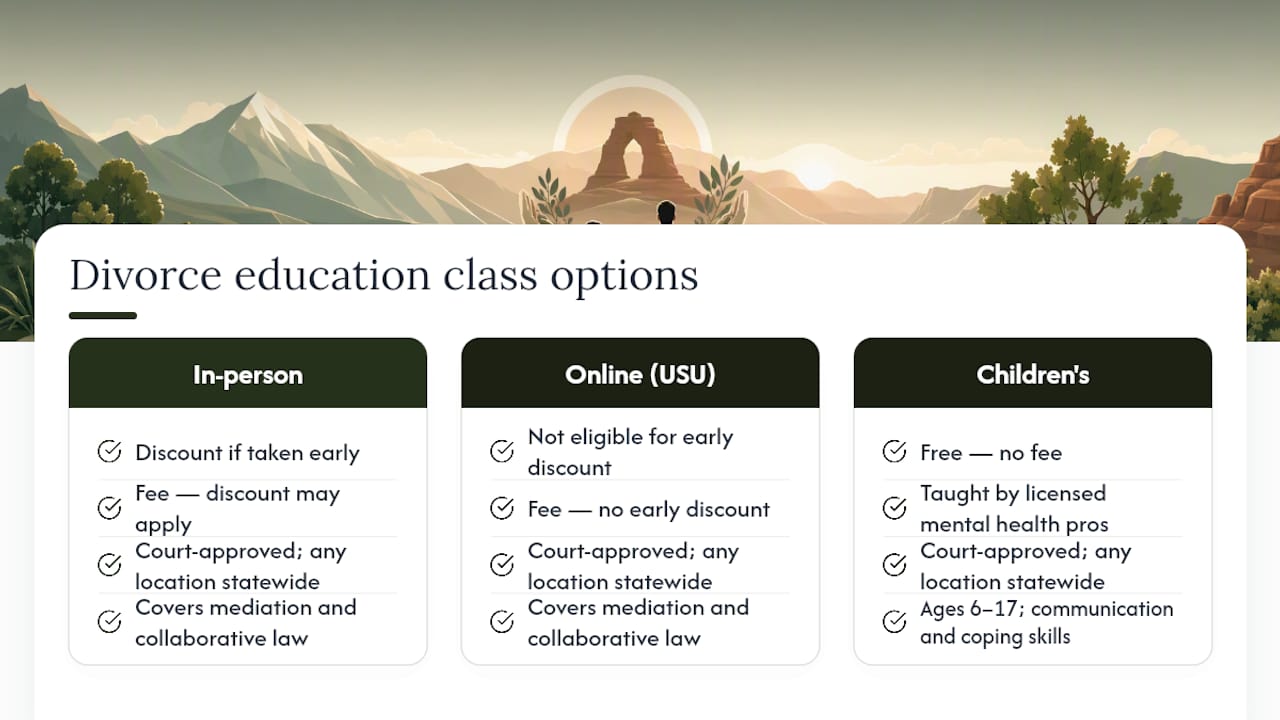
| In-person discount | The courts' education page describes an early-attendance discount for in-person orientation and quotes online at $30. UCJA Rule 4-907 describes the online discount differently; which source controls is not settled. |
| Children's course | Free for ages 6–17, taught by licensed mental health professionals, focused on coping skills. |
| Divvi's role | Handles documents designed for filing, mediation, and filing support alongside your required classes. |
Table of Contents
- Why completing your divorce education class in Utah matters early
- Divvi handles the paperwork while you handle the classes
- Sources
Why completing your divorce education class in Utah matters early
Divvi recommends finishing these classes as early in your case as possible. Courts will not issue a final decree until the requirement is satisfied, and waiting until the last minute is the single most common reason Utah divorces stall at the finish line.
The classes are designed to do real work. Parents learn about nonlitigation options like mediation and collaborative law, which can resolve custody and support disputes without a courtroom fight. The children's course, taught by licensed mental health professionals, helps kids ages 6–17 build communication skills and coping strategies during family separation. That focus on children's wellbeing is why the course is free.
On fees: the Utah Courts education page says an early-attendance discount applies to in-person Divorce Orientation and that the online course is not discounted. UCJA Rule 4-907 describes the online discount differently, and which source controls is not settled here. The online course is quoted at $30. All providers must be court-approved; a class taken through an unapproved provider will not count. You can attend any approved location statewide, regardless of which county filed your case.
Divvi handles the paperwork while you handle the classes
The court-required classes are a legal obligation. Divvi is the practical support layer for everything else.
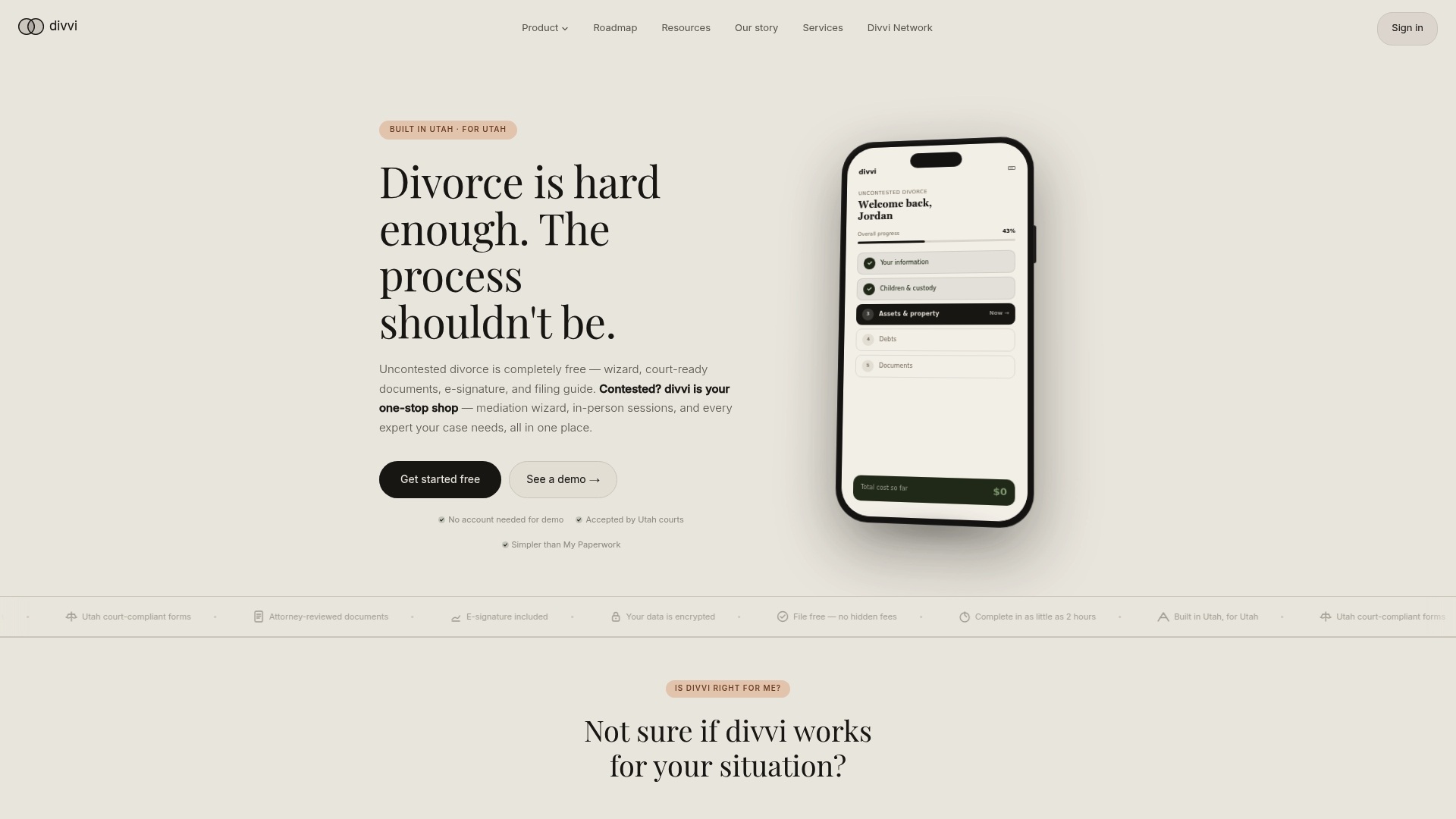
Once you've registered for your orientation or parenting course, the paperwork side of your divorce still needs to get done. Divvi's free uncontested divorce wizard generates documents designed for filing in as little as two hours, with e-signature and filing guidance built in. For more complex situations, you get access to attorney referrals, AI and human mediation matching, and connections to financial advisors and real estate professionals. Divvi does not provide court-approved education classes and does not replace them. What it replaces is the expensive, confusing paperwork process that typically follows. Start your case for free at Divvi.
Sources
Use these pages to register, confirm approved providers, and read the governing rules:
- Mandatory Education in Divorce and Temporary Separation
- Divorce and Parenting Courses | Extension | USU
This article is general information, not a substitute for advice from a qualified lawyer. Consult a qualified legal professional about your own circumstances before acting on anything here.