Afraid of Divorce? What Fear Is Really Telling You
Written and reviewed by the divvi team. How we research and check this.

Fear of divorce is defined as a persistent emotional response to the uncertainty, loss, and disruption that ending a marriage creates. It is one of the most common reasons people stay in unhappy marriages far longer than they should. Financial instability consistently ranks as the top anxiety driver, followed closely by fears about child custody and parenting time. Understanding what your fear is actually pointing to is the first step toward doing something about it.
What are the main fears people face when afraid of divorce?
Being afraid of divorce rarely comes from one single worry. It is usually a cluster of fears hitting at the same time, which is exactly why it feels so paralyzing.
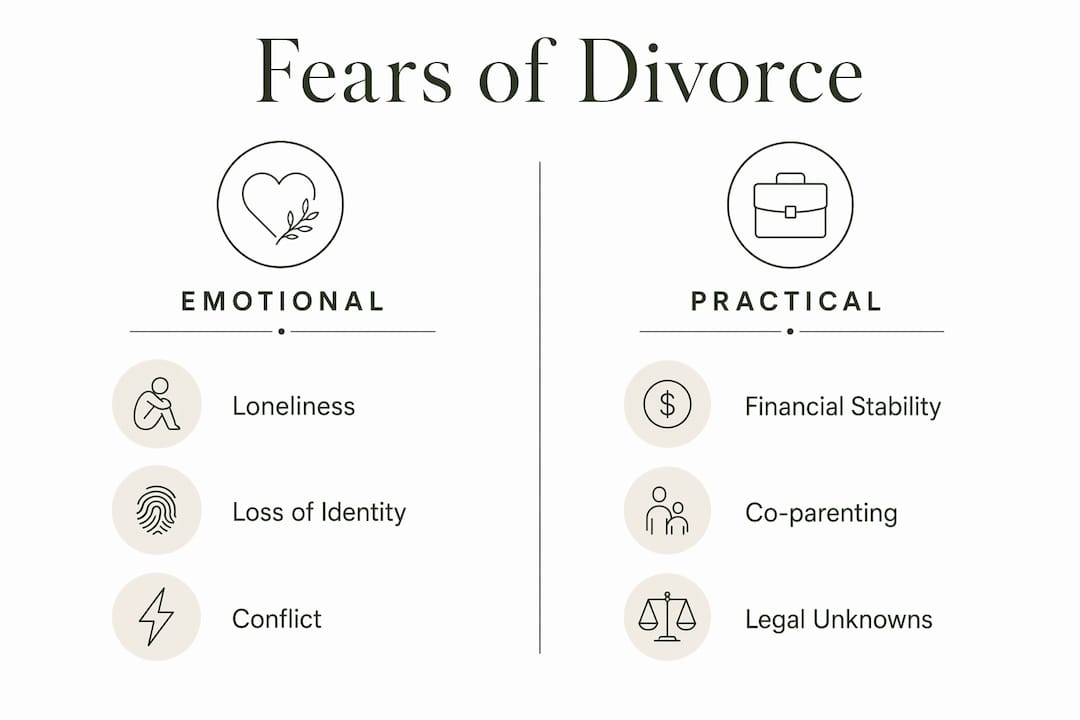
The most common fears fall into three categories: financial, relational, and emotional.
Financial fears are the most reported. People worry about:
- Losing the family home or being unable to afford rent alone
- Splitting retirement savings and starting over financially
- Taking on shared debt as a solo burden
- Not being able to maintain the same standard of living for their children
Relational fears center on children and co-parenting. Many people fear losing daily access to their kids or navigating a parenting schedule that feels foreign and painful. Open communication about these fears makes finding cooperative solutions far more realistic. Transparency reduces conflict and protects family stability, especially for children.
Emotional fears are often the quietest but the most corrosive. Fear of loneliness, loss of identity, and conflict escalation keep many people frozen. The unknown fuels anxiety more than any specific outcome. When you cannot picture what your life will look like in two years, your brain fills that gap with worst-case scenarios.

Fear-induced paralysis stems directly from unknowns. Replacing guesswork with objective financial and legal information is what breaks that paralysis. The fear does not disappear, but it becomes manageable once it has a name and a plan attached to it.
How does fear of divorce affect emotional and physical health?
Divorce fear does not stay in your head. It moves into your body.
Divorce-related stress triggers the nervous system's fight-or-flight response. When that response stays activated for weeks or months, physical symptoms follow. These include:
- Disrupted sleep and chronic fatigue
- Chest tightness, rapid heartbeat, or shortness of breath
- Panic attacks that seem to come out of nowhere
- Difficulty concentrating or making basic decisions
- Appetite changes and digestive issues
One fact that surprises many people: delayed panic attacks can occur months into the process, even for the person who initiated the divorce. The nervous system processes accumulated stress on its own timeline. Feeling worse in month three than in month one does not mean you made the wrong choice. It means your body is catching up.
Managing these symptoms requires consistent, low-drama habits. Therapy, regular exercise, sleep hygiene, and social connection all reduce the intensity of the stress response over time. None of these are quick fixes, but each one chips away at the physical toll.
Pro Tip: Keep a short daily log of your sleep, mood, and anxiety level. Patterns become visible within two weeks, and that data gives your therapist or doctor something concrete to work with.
What practical legal and financial steps reduce fear of divorce?
The most effective way to reduce divorce fear is to replace vague dread with specific information. Here is a structured approach:
Gather your financial documents first. Organizing personal financial records early in the process restores a tangible sense of control. Collect bank statements, tax returns, mortgage documents, retirement account statements, and debt records. This single step counters the chaos feeling that makes fear spike.
Consult a neutral financial professional. A certified divorce financial analyst or a fee-only financial planner can build post-divorce budget projections based on real numbers. Neutral financial data replaces catastrophic predictions with concrete, manageable plans. Visual budgets turn the unknown into something you can actually read and respond to.
Consider mediation before litigation. Mediation and collaborative divorce reduce anxiety by keeping both parties involved in decisions. A neutral mediator guides the conversation without the adversarial pressure of a courtroom. Divvi offers mediation services that give both parties a structured, lower-conflict path to resolution.
Build a post-divorce budget early. A post-divorce budget is not just a financial tool. It is a psychological one. Seeing a realistic picture of your monthly income and expenses after divorce removes the "I'll never survive this" narrative that fear creates.
Use a family management plan for parenting concerns. If child custody fears are driving your anxiety, a structured parenting plan replaces uncertainty with a clear schedule and decision-making framework.
| Approach | Best for | Key benefit |
|---|---|---|
| Mediation | Couples who can communicate | Lower cost, faster resolution |
| Collaborative divorce | High-conflict situations needing structure | Professional support without court |
| Litigation | Contested cases with no agreement | Legal protection, binding decisions |
| Self-guided document prep | Uncontested, straightforward cases | Lowest cost, fastest timeline |
Pro Tip: Before your first attorney or mediator consultation, write down your three biggest fears in plain language. Professionals can address fears directly when they know what they are.
How can you emotionally cope and prepare for life after divorce?
Emotional preparation for life after divorce starts with one important distinction. Fear of loneliness and fear of being alone are not the same thing.
Confusing these two fears is one of the most common reasons people stay in emotionally numb marriages. Loneliness is the feeling of disconnection, and it can exist just as powerfully inside a marriage as outside one. Being alone, by contrast, is a circumstance. It is manageable, and for many people, it becomes a source of unexpected peace.
Acknowledging grief is not optional in this process. Divorce involves real loss, even when it is the right decision. Skipping the grief phase tends to extend it. Strategies that support emotional resilience include:
- Maintaining a consistent sleep schedule, even when anxiety disrupts it
- Staying physically active, since exercise directly reduces cortisol levels
- Keeping at least two or three social connections active and honest
- Working with a therapist who specializes in life transitions
Professional therapy does more than provide emotional support. It helps you build new stress responses and a clearer picture of what you want your life to look like after the process ends. That forward-looking work is what separates people who recover quickly from those who stay stuck.
Pro Tip: Grief after divorce follows no set timeline. If you feel fine for three weeks and then fall apart in week four, that is normal. Build a support structure before you need it, not after.
Key Takeaways
Fear of divorce is a signal pointing to specific areas, including finances, parenting, and identity, that need preparation and professional support, not avoidance.
| Point | Details |
|---|---|
| Financial fear is the top driver | Organizing documents and consulting a neutral financial professional converts fear into a concrete plan. |
| Physical symptoms are real | Anxiety, panic attacks, and sleep disruption are common physical responses to divorce stress. |
| Mediation reduces conflict | Structured processes like mediation keep both parties in control and lower emotional costs. |
| Loneliness vs. being alone | These are different fears; confusing them keeps people in unhappy marriages longer than necessary. |
| Grief is part of recovery | Acknowledging emotional loss speeds healing; skipping it extends the difficult period. |
What fear in divorce actually taught me
Fear in divorce is not weakness. It is often described that way, and that framing does real damage. Fear is information. It tells you exactly where the gaps are in your understanding and your plan.
The people who move through divorce most effectively are not the ones who feel no fear. They are the ones who treat fear as a checklist. Financial fear? Get a budget built by a professional. Fear about your kids? Build a family management plan before you need one. Fear of conflict? Use mediation. Each fear has a corresponding action, and taking that action shrinks the fear down to a size you can work with.
The most common misstep is letting fear drive the decision to do nothing. Staying in an unhappy marriage because divorce feels too scary is a choice with its own costs: emotional numbness, modeling conflict or disconnection for children, and years of deferred grief. The fear of acting and the fear of not acting are both real. The difference is that acting gives you somewhere to go.
Legal experts note that fear is a signpost, not a stop sign. Use it to identify where you need more clarity, then go get that clarity. That is the whole strategy.
— Landon
Divvi makes the process less frightening
Knowing what to do and actually having the tools to do it are two different things. Divvi was built specifically to close that gap for Utah families.
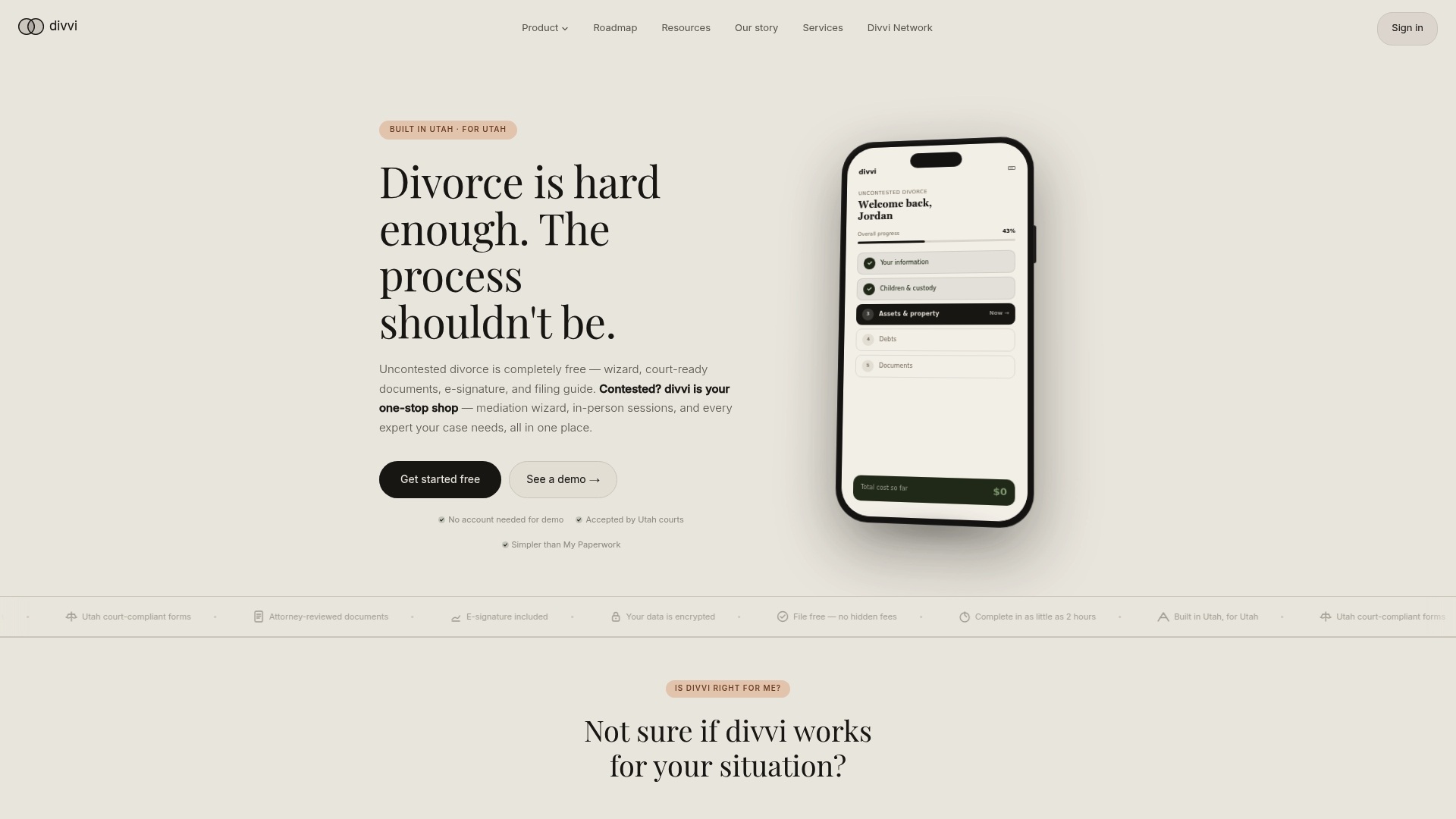
Divvi's platform walks you through the divorce process step by step, from generating divorce documents designed for filing to connecting you with attorneys, mediators, financial advisors, and therapists. The base model is free to use. You only pay for the specific services you need. Whether your case is uncontested and straightforward or involves a difficult spouse and contested assets, Divvi has a path for it. Explore the full range of divorce support services and see exactly what your situation calls for.
FAQ
What is the most common fear people have about divorce?
Financial instability is the most reported fear, including concerns about housing, debt, and retirement savings. Child custody and parenting time rank as the second most common source of divorce anxiety.
Can fear of divorce cause physical symptoms?
Yes. Divorce stress activates the nervous system's fight-or-flight response, which produces physical symptoms including panic attacks, sleep disruption, fatigue, and chest tightness. These symptoms can appear months into the process, not just at the start.
Is it normal to want a divorce but feel scared to move forward?
Wanting a divorce but feeling scared is one of the most common experiences in family law. Fear signals where more preparation or professional support is needed, not that divorce is the wrong choice.
Does mediation actually reduce divorce-related anxiety?
Mediation reduces anxiety by keeping both parties involved in decisions rather than handing control to a judge. Neutral professionals guide the process, which lowers conflict and gives both sides a greater sense of control over the outcome.
How do I stop fear from making me avoid the divorce process entirely?
Replace vague fears with specific information. Gather your financial documents, consult a neutral financial professional, and build a realistic post-divorce budget. Concrete data consistently breaks fear-driven paralysis better than any amount of reassurance alone.