How to File for Divorce in Utah: Step-by-Step Guide
Written and reviewed by the divvi team. How we research and check this.

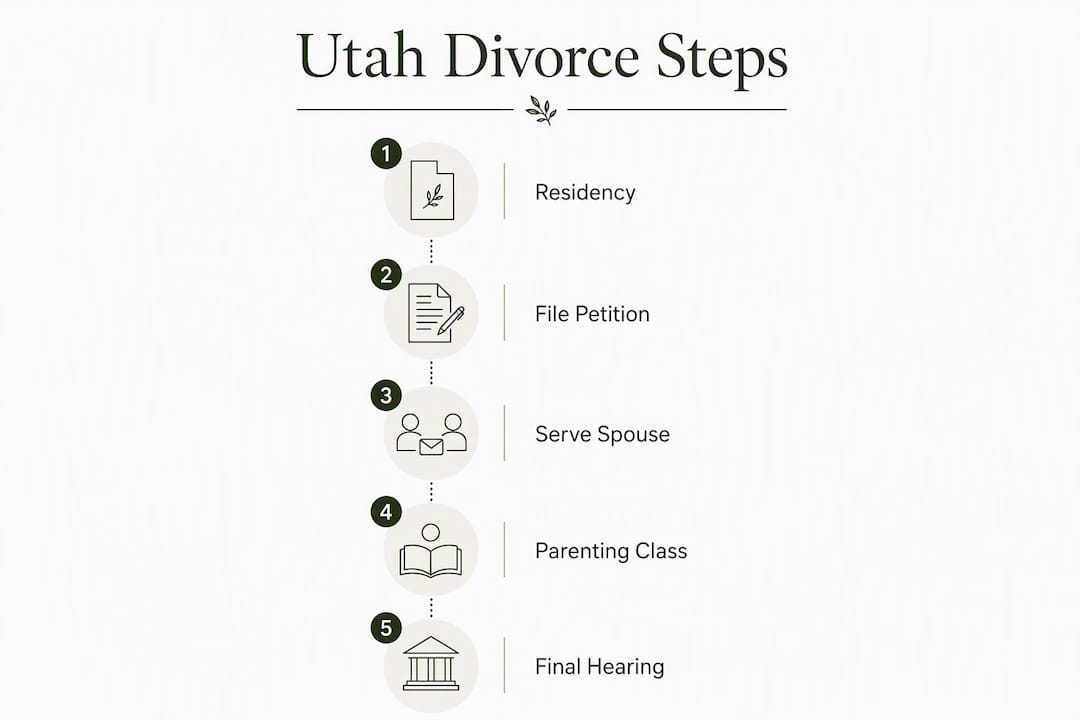
Generally, Utah’s residency requirement is met if you or your spouse has lived in the same Utah county for at least 3 months. Other requirements, including grounds and child-custody jurisdiction when applicable, also matter. Once you clear it, the process follows a predictable sequence: download the right forms, file with your district court clerk, serve your spouse, and complete any mandatory classes if children are involved.
Here is your immediate checklist before you do anything else:
- Confirm residency. You or your spouse must have lived in the same Utah county for at least 3 months before filing.
- Download your forms. Use Utah Courts' MyPaperwork to generate a Petition for Divorce designed for filing, Summons, and any parenting forms.
- File with your county clerk. Bring, email, or mail your completed packet to the district court clerk in the county where you or your spouse resides.
- Serve your spouse. You must complete service of process within a set period after filing.
- Complete parenting classes if you have minor children. The petitioner and respondent each have specific timeframes after filing or service to complete mandatory parenting classes.
Pro Tip: Utah Legal Services offers free legal help for qualifying low-income Utahns. If you are unsure whether you qualify for a fee waiver or need help reading a court order, call them before you file.
Table of Contents
- Do you meet Utah's residency and venue requirements?
- Which court handles your divorce in Utah?
- What forms and documents do you need to file?
- How to file for divorce in Utah: the step-by-step checklist
- What does it cost to file for divorce in Utah?
- How long does a divorce take in Utah?
- Contested vs. uncontested divorce: what you need to know about mediation and parenting classes
- What happens after you file for divorce in Utah?
- Key Takeaways
- The part most people get wrong about filing in Utah
- Prepare your Utah divorce documents with Divvi
- Official forms and helpful Utah resources
Do you meet Utah's residency and venue requirements?
Utah's rule is specific: the petitioner or their spouse must be a bona fide resident of the county where the petition is filed for at least 3 months before filing. Not just the state. The county. That distinction trips up people who recently moved within Utah.
3 months in the same county is the minimum residency threshold before you can file a divorce petition in Utah.
Grounds for divorce are straightforward. Utah is a no-fault state, so you can simply cite "irreconcilable differences" without proving fault. Fault-based grounds (adultery, cruelty, willful neglect, habitual drunkenness, felony conviction, and others) exist under Utah Code but are rarely necessary and often complicate proceedings.
Venue options follow a short checklist:
- File in the county where you currently reside (if you meet the 3-month rule there).
- File in the county where your spouse resides (if your spouse meets the 3-month rule there).
- If minor children are involved, consider where the children have lived for the past six months, since that may affect custody jurisdiction under the Uniform Child Custody Jurisdiction and Enforcement Act.
Military exception. Active-duty service members stationed in Utah who do not yet meet the 3-month county rule may still be able to file in certain circumstances. If you or your spouse is active military, check with a JAG officer or Utah Legal Services before filing to confirm which county applies.
Which court handles your divorce in Utah?
Divorce cases in Utah are filed in the district court of the county where you or your spouse meets the residency requirement. Each county has its own district court clerk's office, and that is where your paperwork goes.
Here is how to find and file with the right clerk:
- Identify your county. Confirm which county you or your spouse has lived in for at least 3 months.
- Locate the district court. The Utah Courts website lists every district court by county with contact information, addresses, and email addresses for clerk's offices.
- Choose your filing method. Utah district court clerks accept divorce filings three ways: in person at the clerk's window, by email to the clerk's designated address, or by mail. There is no fully online case initiation for divorce filings.
- Prepare your packet. Bring or send the complete set of documents (see the next section) along with the filing fee or a completed fee-waiver application.
- Get date-stamped copies. Whether you file in person or by mail, request or confirm that you receive date-stamped copies of every document. These are your proof of filing and your clock starts ticking from that date.
One thing worth knowing: MyPaperwork generates your PDFs designed for filing, but it does not submit them to the court for you. You still have to deliver the finished documents to the clerk yourself.
What forms and documents do you need to file?
Getting the paperwork right the first time saves you a second trip to the clerk's window. Here is what to prepare:
Core court forms (generated through MyPaperwork):
- Petition for Divorce — the document that starts the case and states your grounds, residency, and what you are asking the court to order.
- Summons — formally notifies your spouse that a case has been filed.
- Financial Declaration (Affidavit) — required in virtually every Utah divorce; discloses income, expenses, assets, and debts.
- Parenting Plan — required if you have minor children; outlines custody, parent-time, and decision-making.
- Family Management Plan — an alternative form for cases without minor children that addresses property and debt division.
- Proposed Findings of Fact and Conclusions of Law / Decree of Divorce — for uncontested cases, you submit a proposed decree the judge can sign.
Supporting documents to gather before you file:
- Marriage certificate (original or certified copy)
- Birth certificates for any minor children
- Recent pay stubs or proof of income (last 3 months minimum)
- Recent bank and investment account statements
- Property deeds, vehicle titles, or mortgage statements
- Any existing court orders (protective orders, prior custody orders)
Utah Courts' MyPaperwork tool walks you through an interview-style questionnaire and generates the correct forms for your situation, including whether children are involved. It produces PDFs designed for filing without hiring a document preparer. Compare divvi and MyPaperwork to choose the preparation workflow that fits your situation.
Pro Tip: Print two complete sets of every form before you go to the clerk. One set gets filed and date-stamped; the other is your working copy. Keep your working copy in a dedicated folder with your marriage certificate and any financial records. Courts do not give you back originals, and replacing a certified marriage certificate takes time.

For a deeper look at what financial documents to pull together, the divorce discovery checklist covers the full scope of records courts typically expect.
How to file for divorce in Utah: the step-by-step checklist
Follow these steps in order. Skipping one usually means backtracking.
- Complete your forms. Use MyPaperwork to generate your Petition, Summons, Financial Declaration, and any parenting forms. Review every page for accuracy before printing.
- Assemble your filing packet. Petition + Summons + Financial Declaration + Parenting Plan (if applicable) + Proposed Decree (if uncontested) + any supporting exhibits.
- File with the clerk. Deliver your packet in person, by email, or by mail to the district court clerk in the correct county. Pay the filing fee or submit a completed fee-waiver application at the same time.
- Get date-stamped copies. Confirm you have a file-stamped copy of the Petition. This date is your official filing date and starts the 120-day service clock.
- Arrange service of process. You cannot serve your spouse yourself. Use the county sheriff, a constable, or any adult third party who is not a party to the case. Serve within 120 days of filing.
- File proof of service. Once service is complete, the server fills out a Return of Service form. File it with the clerk promptly.
- Wait for your spouse's response. Your spouse has 21 days to respond if served in Utah, or 30 days if served outside Utah.
- Next steps depend on the response. If your spouse does not respond, you may request a default. If they respond and you agree on all terms, you move toward a stipulated decree. If they contest, the case moves into discovery, mediation, and potentially trial.
What a typical uncontested filing packet looks like:
- Petition for Divorce (signed and notarized)
- Summons (unsigned — the clerk signs it)
- Financial Declaration for both parties
- Parenting Plan (if children)
- Proposed Decree of Divorce
- Filing fee payment or fee-waiver application
Do you qualify for an uncontested divorce in Utah?
You qualify if all of the following are true:
- You and your spouse agree on how to divide all marital property and debt.
- You agree on whether either party will pay alimony, and on the amount and duration.
- If you have minor children, you agree on custody, parent-time, and child support.
- Neither spouse is contesting the divorce itself.
If any one of those is unresolved, your case is contested until you settle it — mediation is usually the fastest route back to an uncontested filing.
What does it cost to file for divorce in Utah?
The Utah Courts fee schedule lists the standard filing fees for divorce cases. Beyond the court filing fee, several other costs come up depending on your situation.
| Cost Item | Typical Range | Notes |
|---|---|---|
| Court filing fee | See Utah Courts fee schedule | Check the current schedule before filing; fees vary by case type |
| Sheriff service of process | $30 per attempt | Varies by county; private process servers may cost more |
| Parenting class (Divorce Orientation) | $30–$60 per person | Required if minor children; online options available |
| Parenting class (Divorce Education for Parents) | $30–$60 per person | Separate from Orientation; both required |
| Mediation (if required) | — | Costs split between parties unless waived |
| Attorney review (optional) | Varies | Flat-fee reviews available through services like Divvi |
How to request a fee waiver:
If you cannot afford the filing fee, Utah courts offer an indigency waiver process. Here is what you need:
- Complete the Motion to Waive Fees form (available from the clerk or through MyPaperwork).
- Attach proof of income: recent pay stubs, tax returns, or a benefits letter if you receive public assistance.
- Attach proof of expenses if relevant: rent, utilities, medical costs.
- Submit the waiver application with your filing packet. The judge reviews it and rules on it, often the same day for in-person filings.
For mandatory parenting class costs specifically, Utah Code §81-4-402 requires the court to make a formal indigency determination before ordering payment. If the court finds you indigent, it cannot require you to pay those class fees.
How long does a divorce take in Utah?
The short answer: an uncontested divorce with no children can be finalized in as little as five to six weeks after filing. A contested case with disputed custody can take a year or longer.
The floor is set by statute. Utah law requires a 30-day waiting period between the filing date and the court entering a final decree. The court can waive this only in extraordinary circumstances, which are rare.
Realistic timelines:
- Uncontested, no children: 5–8 weeks if paperwork is complete and service is prompt.
- Uncontested with children: 8–12 weeks, accounting for mandatory parenting class deadlines.
- Contested, moderate disagreements: 4–9 months, depending on mediation scheduling and court availability.
- Contested, custody dispute or trial: 12–24 months or more.
Three things that speed up any case:
- Complete mandatory parenting classes immediately after filing. Courts cannot hear certain motions until both parties finish, so delays there cascade.
- Arrange service within the first two weeks. The 120-day window feels long until it is not.
- Use stipulated forms whenever possible. A proposed decree the judge can sign without a hearing cuts weeks off the timeline.
Contested vs. uncontested divorce: what you need to know about mediation and parenting classes
Uncontested means both spouses agree on every issue: property division, debt allocation, custody, parent-time (the custody schedule), child support, and alimony (spousal support). The court reviews your proposed decree and, if it is legally sound, signs it. No hearings required in most cases. This is the simplest and least expensive route through the Utah court system.
Contested means at least one issue is unresolved. The case then moves through mandatory disclosures, discovery, and usually mediation before any trial date is set. Time and cost both increase substantially.
Mandatory mediation is required in most contested Utah divorces before the court will schedule a trial. The mediator does not decide anything; they facilitate negotiation. If mediation fails, the case proceeds to a hearing or trial. Divvi connects clients with vetted Utah divorce mediators if you need help finding one.
Mandatory parenting education applies whenever minor children are involved, regardless of whether the case is contested:
- The petitioner must complete the Divorce Orientation course and the Divorce Education for Parents course within 60 days of filing.
- The respondent must complete both within 30 days of being served.
- Courts may refuse to hear motions for temporary custody, support, or other relief until both parties have completed the required courses.
Pro Tip: Register for parenting classes the same day you file. Slots fill up, online options exist, and finishing early means the court can act on any temporary order requests without waiting on your compliance.
If your spouse refuses to cooperate or contests everything, you are not stuck. Utah Legal Services makes clear that there is no legal mechanism to prevent a divorce when one spouse wants it. The court will end the marriage if the petitioner meets filing requirements. Contested cases take longer, but they do resolve.

For a deeper look at handling a difficult case, the contested divorce support guide covers what to expect when your spouse pushes back.
What happens after you file for divorce in Utah?
Filing is the beginning, not the end. Here is the sequence of what comes next:
- Serve your spouse. Service must be completed within a deadline set by the court after filing. The sheriff, a constable, or any adult third party (not you) can serve the papers. Failing to serve in time risks dismissal.
- File proof of service. The server completes a Return of Service form. File it with the clerk as soon as service is done.
- Wait for the response. Your spouse has 21 days (served in Utah) or 30 days (served out of state) to file an Answer.
- Request temporary orders if needed. If you need immediate rulings on custody, support, or use of the marital home, you can file a motion for temporary orders. Note that courts generally will not hear these motions until mandatory parenting classes are complete.
- Move toward resolution. Uncontested cases proceed to a proposed decree review. Contested cases go through mediation and, if necessary, trial.
- Attend any required hearings. The court may schedule a prove-up hearing for uncontested cases or a scheduling conference for contested ones.
- Receive the final decree. Once the judge signs the Findings of Fact and Conclusions of Law and the Decree of Divorce, the marriage is legally ended. The decree takes effect immediately upon entry unless it states otherwise.
What temporary orders can cover:
- Temporary physical and legal custody of minor children
- Temporary child support and alimony
- Who stays in the marital home
- Restraining either party from dissipating marital assets
For a detailed breakdown of the temporary custody process, the temporary custody orders guide explains the motion process and what courts look for.
Key Takeaways
Filing for divorce in Utah generally requires 3 months of county residency, forms designed for filing from MyPaperwork, proper service within 120 days, a 30-day statutory waiting period, and mandatory parenting classes if minor children are involved.
| Point | Details |
|---|---|
| County residency rule | You or your spouse must live in the filing county for at least 3 months before filing. |
| Service deadline | You must serve your spouse within 120 days of filing the petition, or risk case dismissal. |
| Statutory waiting period | Utah law requires 30 days between filing and the court entering a final decree. |
| Parenting class deadlines | Petitioner completes classes within 60 days of filing; respondent within 30 days of service. |
| Divvi tools | Divvi's free uncontested wizard generates documents designed for filing and connects you to mediators and attorneys when needed. |
The part most people get wrong about filing in Utah
The procedural steps are not the hard part. Most people who struggle with a Utah divorce filing trip on two things: service of process and parenting class timing.
Service feels like a formality until it is not. Practical filings fail most often at this stage. You cannot serve your spouse yourself, the 120-day clock starts the moment you file, and if service fails or proof of service never gets filed, the court can dismiss your case for lack of prosecution. Plan service before you leave the clerk's office, not after.
The parenting class requirement surprises people even more. Many filers assume they can schedule classes whenever it is convenient. They cannot. Courts will not hear motions for temporary custody or support until both parties have completed the required courses. If you file and then wait three weeks to register for classes, you have potentially delayed any temporary order by three weeks or more. Register the same day you file.
One more thing worth saying plainly: if your spouse refuses to cooperate, that does not stop the divorce. Utah courts are designed to allow a marriage to end when one spouse wants it to. An uncooperative spouse can slow things down through contested proceedings, but they cannot prevent the outcome. Knowing that early keeps you focused on paperwork and timing rather than tactics that do not work.
For self-represented filers, Utah Legal Services and the district court self-help centers are genuinely useful first stops. They will not represent you, but they can review forms and answer procedural questions at no cost.
Prepare your Utah divorce documents with Divvi
Most people filing for divorce in Utah spend more time hunting for the right forms than actually completing them. Divvi cuts that problem down to a single session.
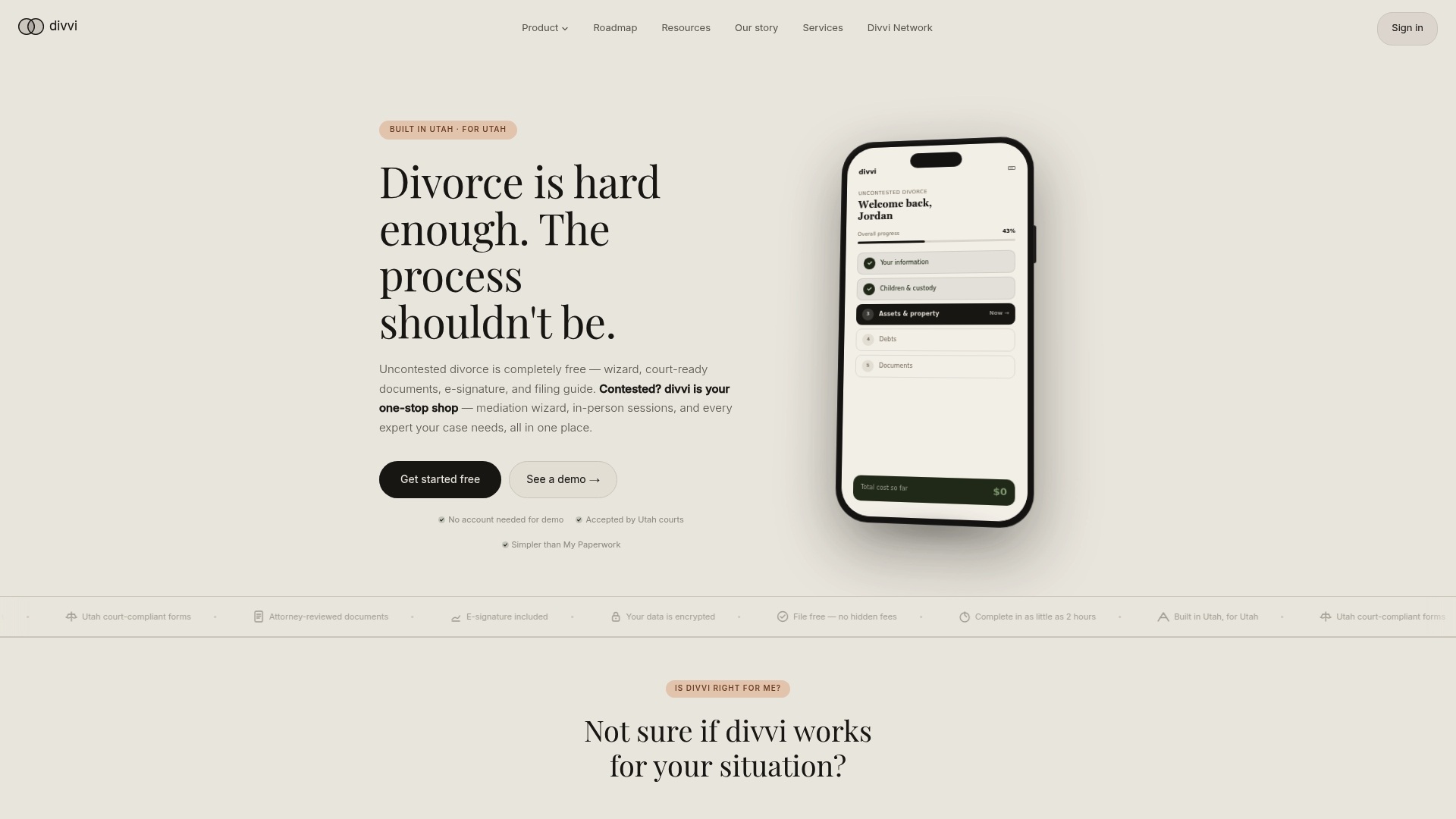
The free uncontested divorce wizard walks you through every Utah-specific question, generates a filing packet, and covers e-signature so both parties can sign without coordinating an in-person meeting. For cases that get complicated, Divvi connects you directly to attorney referrals, vetted mediators, financial advisors, and real estate professionals — you pay only for what you actually need. Think of it as the TurboTax of divorce: the base tools are free, and every upgrade is optional.
The divorce cost estimator gives you a realistic picture of what your specific case will cost before you commit to anything. If you have children, the family management plan tool generates a parenting plan the court can accept. Ready to get your documents done? Start your Utah divorce on Divvi at no cost and upgrade only if your case needs it.
Official forms and helpful Utah resources
Use these sources directly. Each one serves a specific purpose in the filing process.
- Utah Courts — Divorce Self-Help: The primary starting point for forms, procedural instructions, and county court contact information. Best for understanding the full process and finding your clerk's office.
- MyPaperwork — Utah Courts: The interview-based tool that generates your petition designed for filing, Summons, Financial Declaration, and parenting forms as PDFs. Use this to build your filing packet.
- Utah Courts Fee Schedule: Lists current filing fees for divorce and related case types. Check this before you go to the clerk so you bring the correct amount or the right fee-waiver forms.
- Utah Code §81-4-402 (FindLaw): The statute governing mandatory divorce education, the 30-day waiting period, and the indigency determination for class fees. Read the relevant sections if you have children or need a fee waiver.
- Utah Legal Services: Free legal assistance for qualifying low-income Utahns. Best for procedural questions, form review, and understanding your rights before or during filing.
- Divvi — Utah Divorce Platform: Free uncontested divorce wizard, attorney referrals, mediation matching, and post-decree modification tools for Utah residents.
This article provides general information about Utah divorce procedures and is not legal advice. For guidance specific to your situation, consult a licensed Utah attorney or contact Utah Legal Services.
Recommended
- How to File an Uncontested Divorce in Utah (Step-by-Step) | Divvi
- Can You Get Divorce Without a Lawyer in Utah?
- Divorce Discovery Checklist for Utah: Complete 2026 Guide
- Utah Divorce Laws in 2026: What You Need to Know