Utah Prenuptial Agreement: Requirements and Enforceability
Written and reviewed by the divvi team. How we research and check this.

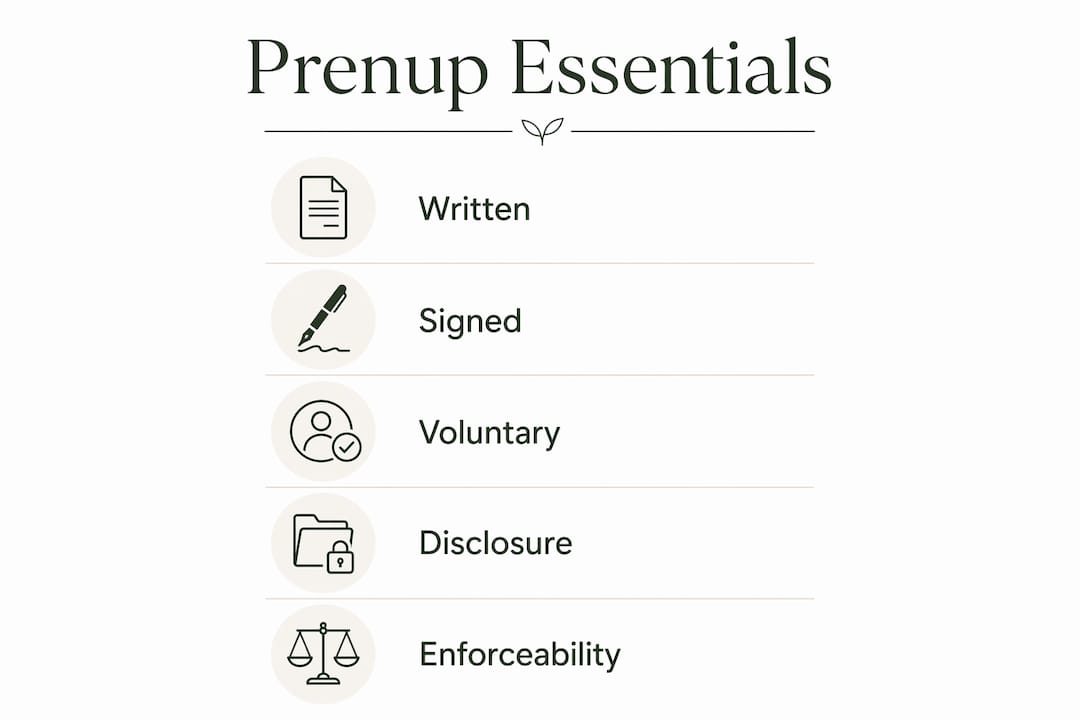
A Utah prenuptial agreement is enforceable when it is written, signed by both parties, entered voluntarily, and backed by reasonable financial disclosure under Title 81, Chapter 3, Part 2 of the Utah Code. No notarization, witnesses, or court filing are required by law, though notarizing signatures is a smart precaution that strengthens the evidentiary record. The single most common reason courts throw out a prenup is inadequate financial disclosure, not a missing signature.
What Utah law requires:
- Written agreement, signed by both parties
- Voluntary execution (no coercion or duress)
- Reasonable financial disclosure with schedules attached at signing
What Utah law does not require: notarization, witnesses, or court filing.
What a prenup cannot govern: Under Utah Code § 81-3-203, a premarital agreement cannot affect a child's right to support, medical insurance, medical expenses, or child care. Courts retain final authority over all child-related matters.
Quick defensibility checklist:
- Written and signed by both parties
- Financial disclosure schedules attached at signing
- Each party has independent review time
- Signed well before the wedding (not the night before)
- Both spouses keep independent, secure copies
Pro Tip: Attach financial schedules listing every real estate holding, bank account, investment account, retirement account, business interest, and debt at the time of signing. A court cannot fault disclosure it can read.
Table of Contents
- What should you put in a Utah prenuptial agreement?
- How to create a prenuptial agreement in Utah without a duress problem
- How Utah courts decide whether to throw out a prenup
- What does a Utah prenuptial agreement actually cost?
- What are your options if you never signed a prenup?
- Divvi makes prenup-related divorce support practical
- Key Takeaways
What should you put in a Utah prenuptial agreement?
Utah Code § 81-3-203 permits contracting over a broad range of financial matters. The most defensible agreements address these categories directly:
Separate vs. marital property. Identify assets each spouse owns before marriage and state explicitly that appreciation on those assets stays separate. Utah follows equitable distribution, not community property, so the default split at divorce is "fair" rather than 50/50. A prenup locks in your own definition of fair.

Debts. List existing student loans, credit card balances, and business liabilities. Without this, a spouse can sometimes be held responsible for debt the other brought into the marriage.
Spousal support. You can waive, cap, or define the terms of alimony, with one caveat: a court can still override a spousal-support clause it finds unconscionable at the time of enforcement, particularly if one spouse would qualify for public assistance as a result.
Estate coordination. A prenup can specify inheritance rights and disposition of life insurance death benefits, which matters when either spouse has children from a prior relationship.
What to leave out: child support, custody arrangements, and child healthcare costs. Any clause touching those topics is void under Utah law and could invite a judge to scrutinize the rest of the agreement.
How to create a prenuptial agreement in Utah without a duress problem
Timing is the most underestimated risk. Presenting a prenup days before the wedding is a recognized red flag for Utah courts; practitioners recommend starting at least 90 days before the ceremony.
Step-by-step process:
- Start the conversation early. Raise the topic at least three to four months before the wedding. Both parties should feel they had time to think, not react.
- Compile full financial disclosure. Each spouse lists all assets and debts with supporting documents: recent tax returns, pay stubs, account statements, and property appraisals. Attach these as schedules to the final agreement.
- Draft the agreement. Use a guided platform or an attorney. The draft should address every category you want covered and nothing that falls outside Utah's permitted scope.
- Independent review. Each party reviews the draft with their own counsel, or at minimum has uninterrupted time to read and question every clause. This step is what separates a signed contract from a coerced one.
- Negotiate and revise. Changes are normal. Document each revision with a dated draft.
- Sign with time to spare. Sign at least 30 days before the wedding. Consider notarizing signatures through a service like Notary Page to create an objective record of voluntary execution.
- Store securely. Each spouse keeps an original or certified copy, plus an encrypted digital backup. If the document is needed years later, independent copies prevent one party from controlling access.
How Utah courts decide whether to throw out a prenup
Utah Code § 81-3-205 sets the enforceability standards. A signed prenup is presumed valid; the party challenging it carries the burden of proof. That burden is real, but courts have four main grounds to refuse enforcement:
Involuntariness. Signing under threat, pressure, or with no meaningful time to review qualifies. A prenup handed over the night before the wedding is the textbook example.
Unconscionability at execution. The agreement was so one-sided at the time of signing that enforcing it would be fundamentally unfair. Courts look at the circumstances when the ink dried, not years later.
Inadequate disclosure. One party concealed or misrepresented assets or debts. This is the most litigated ground. Attached, itemized financial schedules are the most effective defense against this claim.
Fraud or misrepresentation. Deliberate false statements about the nature or value of assets. Courts treat this as a separate ground from mere inadequate disclosure.
What does a Utah prenuptial agreement actually cost?
Attorney-drafted prenups in Utah can vary significantly in cost depending on asset complexity and negotiation, and online document services offer lower-cost options. The timeline from first conversation to signed agreement usually spans several weeks, with most practitioners recommending starting well in advance of the wedding.
Complex situations, such as business ownership, significant real estate holdings, or prior divorce decrees, push costs toward the higher end. A straightforward agreement between two people with modest, clearly documented assets sits at the lower end.
What are your options if you never signed a prenup?
No prenup does not mean no options. Three paths are worth knowing:
Postnuptial agreement. Utah recognizes agreements made after marriage. The same enforceability rules apply: written, signed, voluntary, with full financial disclosure. Courts tend to scrutinize postnups slightly more carefully because the power dynamics of an existing marriage can complicate "voluntary" execution.
Negotiated divorce settlement. When a marriage ends, spouses can negotiate their own property division rather than leaving it to a judge. Utah's equitable-distribution standard gives courts wide discretion, so a negotiated settlement often produces a more predictable outcome than litigation. Review Utah divorce laws to understand the default rules you are negotiating against.
Mediation. A neutral mediator helps both parties reach agreement on property, support, and other financial terms without a courtroom. Mediation is faster and less expensive than contested litigation, and agreements reached in mediation can be incorporated into a divorce decree.
Divvi makes prenup-related divorce support practical
When a prenup is in play or you are heading into divorce without one, the paperwork and process can pile up fast. Divvi cuts through that. The platform offers guided document preparation, guided financial disclosure workflows, and mediation services, covering the exact steps that determine whether a prenup holds up or a divorce settles cleanly.
For prenup-related concerns, Divvi's guided wizard walks you through disclosure schedules, flags court-reserved topics like child support, and connects you with an attorney for review when your asset picture is complex. If divorce is already on the table, the free divorce tools handle uncontested filings at no base cost, with attorney referrals, mediation, and support for contested cases. Business ownership, suspected asset concealment, or a prior divorce decree are the clearest signals to add attorney review to your order. Start at divviutah.com to see which services fit your situation.
Key Takeaways
A Utah prenuptial agreement is enforceable when it is written, signed voluntarily, and supported by attached financial disclosure schedules under Title 81, Chapter 3, Part 2.
| Point | Details |
|---|---|
| Statutory requirements | Written, signed, voluntary, and financially disclosed under Utah Code § 81-3-202. |
| Child matters are off-limits | Courts control child support, medical costs, and custody; prenup clauses on these topics are void. |
| Disclosure is the highest risk | Attach itemized financial schedules at signing; inadequate disclosure is the most litigated invalidation ground. |
| Cost and timing | Attorney-drafted agreements typically cost between $1,000 and $10,000, and it is best to begin at least 90 days before the wedding. |
| Divvi | Offers guided document prep, optional attorney referrals, disclosure workflows, and mediation for prenup and divorce support in Utah. |