Utah Custody Schedule: The Default Parent-Time Rules
Written and reviewed by the divvi team. How we research and check this.

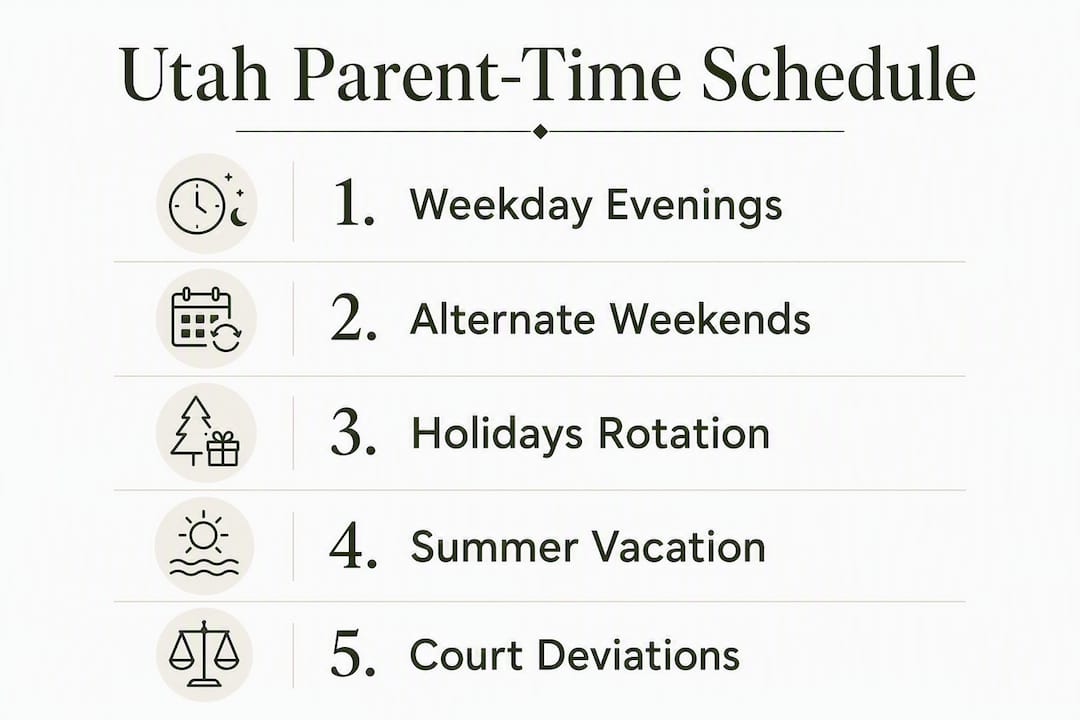
Utah law sets a default parent-time schedule under Utah Code § 81-9-302 that kicks in automatically for children ages 5–18 when parents cannot agree on their own arrangement. For children under five, Utah Code § 81-9-304 governs with a graduated, age-specific schedule. The default for school-age children gives the noncustodial parent one weekday evening per week and alternating weekends, plus defined holiday windows and up to four weeks of summer time. Best-interest factors that justify deviating from those minimums live in Utah Code § 81-9-207.
Pro Tip: Never rely on a verbal agreement. Even if both parents shake hands on a custom schedule, courts enforce the written order, not the conversation. Get any agreed arrangement signed and filed as a formal parenting plan through the Utah Judiciary self-help center before you count on it holding up.
Table of Contents
- What does the Utah parent-time schedule look like for school-age children?
- Age-by-age parent-time rules for children under 5
- How holiday parent-time and summer time work under Utah law
- When can a court deviate from the statutory minimum?
- How to turn a schedule into an enforceable court order
- Common disputes and what the law actually says
- Key Takeaways
- What parents actually struggle with, and where the statute falls short
- Divvi prepares your parenting plan for filing, fast
- Authoritative sources and where to find court forms
What does the Utah parent-time schedule look like for school-age children?
Utah Code § 81-9-302 is the controlling statute when parents of a child ages 5–18 cannot reach their own agreement. The schedule it sets is a floor, not a ceiling. Courts can and do approve more generous arrangements, but they will not go below these minimums without a compelling best-interest finding.
The default time windows
The noncustodial parent receives one weekday evening each week, running from 5:30 p.m. to 8:30 p.m. The noncustodial parent selects which weekday applies. Alternately, if the child is not in school that day, the visit can run from 9:00 a.m. to 8:30 p.m. Alternating weekends run from Friday at 6:00 p.m. through Sunday at 7:00 p.m. When school is not in session on Friday, the weekend can begin at 9:00 a.m. instead.

The statute also sets a clear order of precedence when time blocks collide. Mother's Day and Father's Day take top priority, followed by the child's birthday, then the holiday schedule, then extended summer time, and finally the regular weekday and weekend rotation. That hierarchy matters most in spring and early summer when several blocks can overlap within days of each other.
Compact reference table
| Time Block | Default Window | Notes |
|---|---|---|
| Weekday evening | 5:30–8:30 p.m. | Noncustodial parent selects the day |
| Weekday (no school) | 9:00 a.m.–8:30 p.m. | Applies when school is not in session |
| Alternating weekend | Friday 6:00 p.m.–Sunday 7:00 p.m. | Begins 9:00 a.m. Friday if no school |
| Mother's Day / Father's Day | Per holiday schedule | Highest priority; overrides regular rotation |
| Child's birthday | Per holiday schedule | Second priority after Mother's/Father's Day |
| Extended summer | Up to four weeks | Noncustodial parent; see summer section |
One practical note: the noncustodial parent may elect to have the weekend begin at school dismissal rather than 6:00 p.m. on Friday, and may elect to have Sunday end at 8:30 p.m. rather than 7:00 p.m. Those elections must be made in writing and included in the parenting plan to be enforceable.
Age-by-age parent-time rules for children under 5
The graduated schedule in Utah Code § 81-9-304 reflects what developmental research says about young children's attachment needs. Visits start short and gradually expand as the child grows. Here is how each band works:
- Birth to 5 months. Visits are frequent but brief, typically two hours each, several times per week. Overnights are not part of the statutory minimum at this stage. The goal is consistent contact without disrupting feeding and sleep patterns.
- 5 to 9 months. Visit lengths increase to approximately three hours. The statute still does not mandate overnights, though courts may allow them by agreement or deviation if the noncustodial parent has been a consistent caregiver.
- 9 to 12 months. Visits extend further, and the statute begins introducing the possibility of an overnight as the child's attachment to both parents is more established. Courts look at the child's routine, the noncustodial parent's caregiving history, and travel distance before approving overnights at this stage.
- 12 to 18 months. One overnight per week becomes part of the statutory framework. The schedule starts to resemble a structured rotation rather than drop-in visits.
- 18 months to 3 years. The schedule expands to include alternating weekends with overnights and one weekday visit. This band is where many parents begin negotiating toward the school-age default early, especially when siblings on the § 81-9-302 schedule are in the same household.
- 3 to 5 years. The schedule closely mirrors the school-age default, with alternating weekends and a weekday visit. Overnights are routine. Courts frequently approve the full § 81-9-302 schedule at this stage when the child is in preschool and has a stable routine with both parents.
When a family has children in multiple age bands, the statute recommends considering an upward deviation for the younger child so all siblings share the same rotation. Keeping siblings on the same schedule is one of the cleaner arguments for deviation, and courts tend to accept it readily.
How holiday parent-time and summer time work under Utah law
The holiday schedule in § 81-9-302 runs on an odd/even year rotation. The parent who has the child in odd-numbered years for a given holiday does not have that child for the same holiday in even-numbered years. The rotation is automatic; parents do not need to negotiate it annually unless their parenting plan says otherwise.

Key holiday windows
Thanksgiving typically runs from Wednesday at 6:00 p.m. through Sunday at 7:00 p.m. Winter break splits on December 27 at 7:00 p.m., with the first half going to one parent and the second half to the other, alternating by year. Spring break follows the same odd/even pattern. Independence Day runs from July 3 at 6:00 p.m. through July 5 at 6:00 p.m. Pioneer Day (July 24) is treated as a fixed calendar holiday with its own window.
For most holidays, parents can elect a start time of 9:00 a.m., school dismissal, or 6:00 p.m. That election belongs in the parenting plan. Independence Day and Pioneer Day have fixed start and end times written directly into the statute, so no election is available for those two.
Summer extended parent-time: Under § 81-9-302, the noncustodial parent is entitled to up to four weeks of parent-time when school is not in session. Two of those weeks may be uninterrupted. The custodial parent retains the right to two uninterrupted weeks of their own during summer. The child must return to the custodial parent at least seven days before the first day of school.
How an odd/even year plays out in practice
Say the noncustodial parent has Thanksgiving in odd years. In 2025 (odd), they have Thanksgiving Wednesday through Sunday. In 2026 (even), the custodial parent has Thanksgiving, and the noncustodial parent's regular alternating weekend rotation resumes as if the holiday did not exist. Once a holiday window closes, the regular weekend rotation picks back up with no make-up time for the parent who missed a weekend due to the holiday overlap.
The priority rule applies here too. If a holiday falls on a regular weekend belonging to the other parent, the holiday schedule wins. The displaced weekend does not get rescheduled.
When can a court deviate from the statutory minimum?
Utah Code § 81-9-207 lists the best-interest factors a court weighs when either parent asks for a schedule that differs from the statutory default. Those factors include the child's bond with each parent, each parent's ability to prioritize the child's needs, the distance between homes, the child's school and extracurricular schedule, any history of domestic violence or substance abuse, and the child's own preference when the child is mature enough to express one.
Deviation can go in either direction. A court can grant more time than the statutory minimum, or it can restrict time below the minimum if safety concerns justify it.
How to request a modification
- Confirm a material change in circumstances. Utah courts require a showing that something significant has changed since the last order, such as a parent's relocation, a change in the child's school, or a substantial shift in either parent's work schedule.
- Attempt mediation first. Courts strongly prefer that parents try to resolve schedule disputes before filing. Divvi's mediation service connects parents with vetted mediators who can facilitate a faster resolution than litigation.
- File a Motion to Modify Decree. The motion goes to the district court that issued the original order. Attach the proposed parenting plan, a declaration explaining the material change, and any supporting evidence (school records, work schedules, relocation notice).
- Serve the other parent. Proper service is required. Failure to serve correctly can delay or void the proceeding.
- Attend the hearing. A commissioner or judge reviews the motion, hears both sides, and either approves the modification or sets a trial date for contested issues.
A straightforward modification with no contested facts typically moves through the Utah court system in two to four months. Contested modifications, where both parents dispute the facts or the proposed schedule, can take six months or longer depending on the district. For a deeper look at the process, the divorce decree modification guide covers timelines and what to expect at each stage.
Relocation adds a layer of complexity. If the relocating parent is the custodial parent, Utah law requires advance written notice to the other parent and, in many cases, court approval. The relocation rules under Utah Code § 81-9-209 explain the notice requirements and how courts weigh a move-away request against the existing parent-time order.
Parent-time and child support are entirely separate obligations. A parent cannot legally withhold visitation because the other parent is behind on support payments, and a parent cannot stop paying support because they are being denied visits. Each must be enforced through its own legal track.
How to turn a schedule into an enforceable court order
An informal agreement, even a written one that both parents sign, is not a court order. If the other parent stops following it, you have no legal mechanism to enforce it without going back to court and starting from scratch. A signed, filed parenting plan is the only version that carries enforcement weight.
Sample parenting-time clause (statutory language)
You can adapt that clause directly into a decree or parenting plan. The family management plan tool at Divvi walks you through building a complete parenting plan designed for filing without needing to draft it from scratch.
Filing checklist
- Completed parenting plan or stipulated decree language
- Petition or motion (depending on whether this is an initial filing or a modification)
- Financial declaration if child support is being set simultaneously
- Proof of service on the other parent
- Filing fee payment (check current fees with your local district court)
- Proposed order for the judge's signature
If you need the order in place quickly while a final hearing is pending, a temporary custody order can hold the schedule in place during the gap.
Common disputes and what the law actually says
Most enforcement problems come down to a handful of recurring misunderstandings. Knowing where the law stands on each one saves time and avoids unnecessary conflict.
- Withholding visits over unpaid support. This is one of the most common mistakes. Utah courts are explicit: parent-time and child support are separate. Withholding visits exposes the custodial parent to a contempt finding, regardless of whether support is current.
- Overlapping holidays and regular weekends. When a holiday falls on a regular weekend, the holiday schedule controls. The displaced weekend does not get rescheduled. Many parents assume they are owed a make-up weekend; the statute does not provide one.
- Verbal changes to the schedule. Courts revert to the written order. A verbal agreement to swap weekends or skip a holiday is not binding if one parent later disputes it. Document every change in writing, even a text message thread.
- Old Title 30 citations in existing orders. The 2024 recodification moved Utah's domestic relations statutes from Title 30 into Title 81. An order that references § 30-3-35 is citing what is now § 81-9-302. The substance has not changed, but referencing the old number in a new filing or motion creates confusion. Use current Title 81 citations in any document you file today. The 2026 Utah divorce law overview covers the recodification in more detail.
- Right of first refusal. This right only applies if it is written into the parenting plan. There is no automatic statutory right of first refusal in Utah. If you want it, it must be drafted explicitly and included in the order.
When a dispute arises, the recommended sequence is: document the incident, request mediation, and if mediation fails, file a motion to enforce with the court. Contempt is available as a remedy for willful violations, and courts can order make-up time, attorney fees, and other sanctions.
Key Takeaways
Utah's statutory parent-time schedule under § 81-9-302 is the legal floor for children ages 5–18, and any agreed schedule that goes above it must be filed as a court-approved parenting plan to be enforceable.
| Point | Details |
|---|---|
| Controlling statutes | § 81-9-302 governs ages 5–18; § 81-9-304 governs children under five with age-band schedules. |
| Holiday rotation | Odd/even year rotation applies automatically; once a holiday window closes, no make-up weekend is owed. |
| Summer entitlement | Noncustodial parent gets up to four weeks; two may be uninterrupted; child returns seven days before school starts. |
| Support vs. parent-time | These are separate obligations; withholding visits over unpaid support is legally wrong and can result in contempt. |
| Divvi parenting plan tool | The family management plan wizard produces parenting plan documents designed for filing at no base cost. |
What parents actually struggle with, and where the statute falls short
The statutory schedule in § 81-9-302 is a workable baseline, but it was written for a generic family. It does not account for shift workers, parents who live an hour apart, or kids with demanding extracurricular schedules. The statute is a floor, and treating it as a finished product is where most co-parenting friction begins.
The holiday rotation is the clearest example. The odd/even system sounds tidy until you realize that one parent can end up with both Thanksgiving and winter break's first half in the same year, while the other parent gets neither. That is technically what the statute produces in certain year combinations. Parents who catch this early and negotiate a custom holiday split avoid years of resentment. Parents who discover it on November 20th file emergency motions.
The under-5 schedule is another area where the statute's minimums often underserve families. The birth-to-5-months band gives the noncustodial parent very limited time, which is developmentally defensible but practically hard on parents who were equally involved caregivers before separation. Courts do allow upward deviation when both parents agree and the child's routine supports it. The statute is not a ceiling; it just requires a written agreement and a filed order to go above it.
The most consistent piece of advice for any Utah parent navigating this: do not wait for a dispute to formalize the schedule. Every month a custom arrangement runs on a handshake is a month of evidence that courts will largely ignore if the relationship sours.
Divvi prepares your parenting plan for filing, fast
Knowing the statutory schedule is step one. Getting it into a signed, filed order that actually protects your time with your child is where most parents get stuck.

Divvi's parenting plan wizard generates documents designed for filing at no base cost, walking you through the statutory language, holiday rotation, and summer provisions in a step-by-step format built specifically for Utah courts. If your situation is more complex, attorney referrals and mediation services are available through the same platform. You pay only for what you actually need.
For parents who want a complete filing handled end to end, Divvi's divorce and modification services cover everything from the initial parenting plan through post-decree modifications. Start with the free wizard, and add professional support only if your case calls for it.
Authoritative sources and where to find court forms
Use these primary sources when drafting filings, verifying current statute text, or preparing for a modification or enforcement hearing. The 2024 recodification moved Utah's domestic relations statutes from Title 30 into Title 81; always reference Title 81 section numbers in any document filed today.
- Utah Code § 81-9-302: Full statutory text for the minimum parent-time schedule for children ages 5–18, including the holiday schedule table and summer provisions.
- Utah Code § 81-9-304: Full statutory text for the graduated parent-time schedule for children under five, organized by age band.
- Utah Courts — Child Custody and Parent-Time self-help: Court-facing guidance on statutory minimums, best-interest factors, enforcement procedures, and links to downloadable court forms and local court procedures.
- Divvi family management plan tool: Free parenting-plan wizard that generates documents designed for filing using current Utah statutory language.
This article provides general legal information about Utah parent-time statutes and is not a substitute for legal advice. Verify current statute text and court procedures with the Utah Legislature's official code or a licensed Utah family law attorney before filing.