Utah Alimony Calculator: How Spousal Support Works
Written and reviewed by the divvi team. How we research and check this.

An alimony calculator for Utah estimates spousal support by applying statutory factors, but it does not produce legally binding results. Utah courts rely on judicial discretion under Utah Code § 81-4-502 to determine alimony amounts, weighing eight specific factors rather than running a fixed formula. Effective september 1, 2024, Utah moved spousal support provisions to Title 81, updating how courts evaluate income, needs, and marriage duration. This guide explains what those factors are, how informal guidelines help you estimate a range, and how to use a spousal support calculator in Utah without misreading its output.
What does an alimony calculator in Utah actually measure?
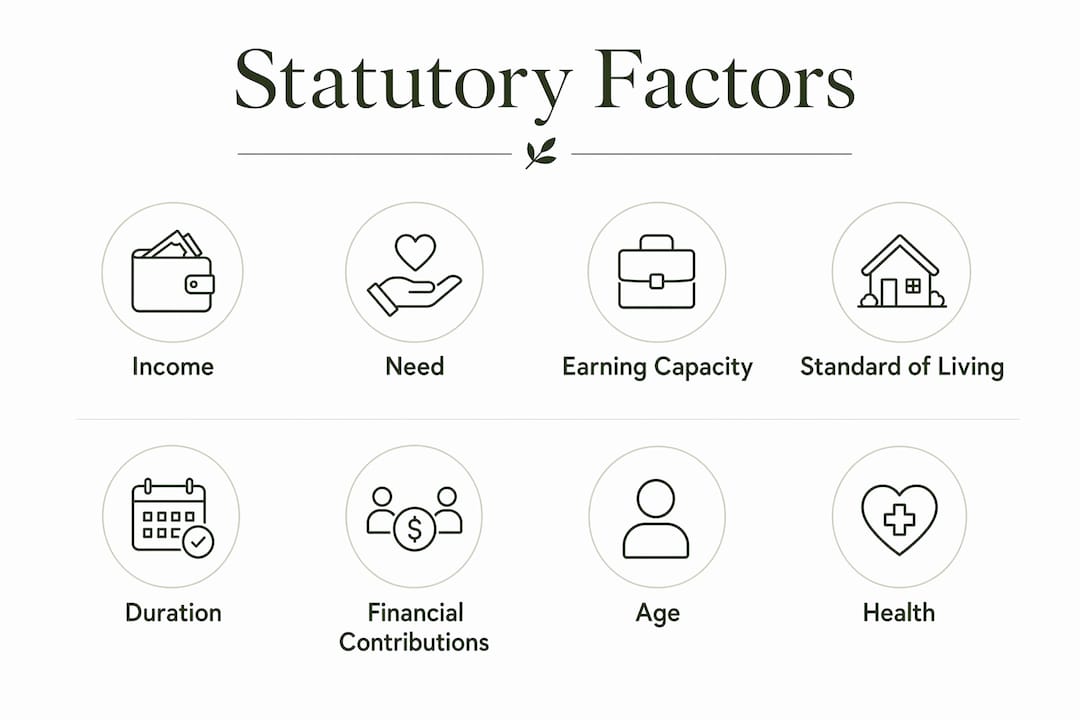
A Utah alimony calculator models the eight statutory factors from § 81-4-502 to produce an estimated range of spousal support. The key word is "estimated." Calculators cannot replicate judicial discretion or issue binding decisions. Two judges reviewing identical financial facts can reach very different awards, which is why any online alimony calculator functions as a planning tool, not a prediction.
The purpose of alimony in Utah is rehabilitative. Judges focus on equalizing the standards of living between spouses and helping the lower-earning spouse move toward financial independence, not on punishing either party. That rehabilitative intent shapes every factor a court weighs, and it shapes what a calculator tries to model.

Before you enter a single number into any estimator, understand that the output reflects a range of likely outcomes, not a guaranteed figure. Treat it the way you would treat a mortgage pre-qualification: useful for setting expectations, not a contract.
What are the eight statutory factors Utah courts consider?
Utah Code § 81-4-502 lists eight factors courts must evaluate when deciding whether to award alimony and how much to set. Courts weigh all eight together rather than treating any single factor as decisive.
- Standard of living during the marriage. The court looks at the lifestyle both spouses maintained and tries to preserve it for the lower-earning spouse where possible.
- Financial condition and needs of the recipient spouse. This includes monthly expenses, debts, and assets the recipient holds independently.
- Earning capacity of the recipient spouse. Courts consider current income, education, work history, and whether caregiving responsibilities reduced career development.
- Ability of the paying spouse to provide support. A court will not order payments that leave the paying spouse unable to meet their own basic needs.
- Length of the marriage. Duration directly caps how long alimony can last. A five-year marriage generally produces a shorter award than a twenty-year marriage.
- Custody of minor children. When the recipient spouse has primary custody, courts factor in the time and financial demands of caregiving when assessing earning capacity.
- Contribution to the paying spouse's education or earning capacity. If one spouse worked to put the other through school or supported career advancement, courts recognize that sacrifice.
- Fault of the parties. Adultery, abuse, or financial misconduct can influence whether alimony is awarded and on what terms.
Pro Tip: Document every contribution you made to your spouse's career or education. Pay stubs, tuition receipts, and emails showing career support all strengthen your argument in court.
How do informal guidelines help estimate Utah alimony amounts?
No official formula exists, but family law practitioners in Utah commonly reference informal guidelines to frame initial negotiations. Alimony typically ranges between 30% and 35% of the income difference between spouses. When the paying spouse also owes child support, that figure often drops to around 25%.
Here is how that plays out in a realistic scenario:
- Calculate the income gap. If the higher earner makes $120,000 per year and the lower earner makes $45,000, the annual difference is $75,000, or $6,250 per month.
- Apply the 35% guideline. Thirty-five percent of $6,250 equals $2,187.50 per month in estimated alimony.
- Adjust for child support. If the paying spouse also owes child support, reduce the percentage to roughly 25%, bringing the monthly estimate to about $1,562.50.
- Factor in statutory considerations. A short marriage, significant fault, or the recipient's strong earning capacity can push the final number well below these estimates.
- Treat the result as a range, not a verdict. Courts are not bound by these percentages. A judge can award more, less, or nothing at all based on the full picture.
The $2,188 monthly figure from the example above is a useful anchor for negotiation. It is not what a court will automatically order.
Pro Tip: Run the calculation both ways before any mediation session. Knowing the range from both the payer's and recipient's perspective puts you in a stronger negotiating position.
A spousal support calculator in Utah applies these same percentages to your specific income figures. The output gives you a realistic ballpark, but the eight statutory factors can shift that number significantly in either direction.
What limits and duration rules does Utah enforce on alimony?
Utah law caps alimony duration at the length of the marriage. A ten-year marriage produces a maximum ten-year alimony obligation, and temporary alimony paid during divorce proceedings counts toward that total. Courts can extend duration in extenuating circumstances, but that requires clear evidence.
The 2024 reform introduced one significant change for longer marriages. A rebuttable presumption now favors equalizing standards of living in marriages lasting ten or more years when one spouse sacrificed career development for caregiving. That presumption shifts the burden: the paying spouse must present evidence to argue against equalization rather than the recipient having to argue for it.
| Situation | Duration rule |
|---|---|
| Marriage under 10 years | Alimony cannot exceed the marriage length |
| Marriage 10 or more years with caregiving sacrifice | Rebuttable presumption favors equalizing living standards |
| Temporary alimony during proceedings | Counts toward the total duration cap |
| Recipient remarries | Alimony terminates automatically |
| Recipient cohabitates with a new partner | Court may terminate or reduce alimony |
| Death of either party | Alimony terminates unless the decree specifies otherwise |
These rules matter when you use an online alimony calculator. Any estimator that ignores marriage length or cohabitation risk is giving you an incomplete picture.
How to use a Utah alimony calculator step by step
A spousal support calculator works only as well as the data you feed it. Garbage in, garbage out applies here as much as anywhere. Follow these steps to get a meaningful estimate.
- Gather verified income figures. Use gross monthly income for both spouses, not take-home pay. Pull the numbers from recent pay stubs, tax returns, or profit-and-loss statements if either spouse is self-employed.
- List monthly expenses for both households. Courts look at actual financial need. Estimate rent or mortgage, utilities, food, insurance, and debt payments separately for each spouse.
- Record the marriage length in months. Be precise. If you married in march 2012 and separated in october 2024, that is approximately 151 months. This number directly affects the duration estimate.
- Note any child support obligations. If child support is already ordered or likely, input that figure. Most calculators adjust the alimony estimate downward when child support is present.
- Input fault or special circumstances if the calculator allows it. Some estimators include fields for adultery, abuse, or career sacrifice. These fields shift the output range meaningfully.
- Read the output as a range. A good calculator returns a low, mid, and high estimate. Focus on the mid-range figure for planning purposes and use the spread to understand your risk exposure.
Calculators require detailed financial inputs and produce estimated ranges that reflect court considerations. They do not account for a specific judge's tendencies, local court culture, or the persuasiveness of your attorney.
Pro Tip: Use the divorce cost estimator from Divvi to model your financial picture before entering any formal negotiation. It gives you a grounded starting point without attorney fees.
One factor most people overlook: the post-2018 tax treatment of alimony. Alimony is no longer deductible for the payer, nor is it taxable income for the recipient under the Tax Cuts and Jobs Act. That change affects your net financial position and should factor into any settlement calculation.
Key Takeaways
Utah alimony is determined by judicial discretion under Utah Code § 81-4-502, not a fixed formula, making calculator estimates useful for planning but not predictive of actual court orders.
| Point | Details |
|---|---|
| No fixed formula exists | Courts weigh eight statutory factors; no two judges will necessarily reach the same award. |
| Informal guideline: 30–35% of income gap | Reduce to about 25% when child support runs concurrently with alimony. |
| Duration caps at marriage length | Temporary alimony paid during proceedings counts toward the total cap. |
| 10-year marriages get special treatment | A 2024 reform creates a rebuttable presumption favoring equalized living standards. |
| Calculators estimate, not decide | Use verified gross income, actual expenses, and marriage length for the most accurate output. |
How Utah alimony disputes actually play out
Utah's alimony system rewards preparation and punishes assumptions. The most common mistake I see is treating a calculator output as a negotiating floor. It is not. A judge who finds the recipient spouse has marketable skills and chose not to use them can award far less than any calculator suggests.
Alimony disputes drive up divorce costs fast. Utah's median contested divorce costs about $13,200, and attorneys charge around $293 per hour on average. Every hour spent arguing over alimony factors is money neither spouse gets to keep. The couples who resolve alimony through mediation almost always spend less and reach more durable agreements than those who litigate every factor.
Documentation is the single most powerful tool you have. Bank statements, tax returns, medical records showing a disability, school enrollment records, and emails about career decisions all build a factual record that a judge can actually use. Vague claims about sacrifice or need carry little weight without paper behind them.
The 2024 reform matters more than most people realize. If your marriage lasted ten or more years and one spouse stepped back from work to raise children, the presumption now favors equalizing living standards. That is a meaningful shift in leverage for the caregiving spouse, and it changes how both sides should approach settlement talks.
My honest advice: use a Utah spousal support calculator to understand your range, then invest that knowledge in a mediation session rather than a courtroom. You will spend less, move faster, and have more control over the outcome.
— Landon
Divvi can help you prepare for the alimony process
Figuring out spousal support is one piece of a much larger financial puzzle during divorce. Divvi gives Utah residents a step-by-step platform that generates documents designed for filing, models financial scenarios, and connects you with attorneys, mediators, and financial advisors when you need them.
The base platform is free to use. AI negotiation (Divvi Resolve) is included free with contested divorce. Divorce mediation and modification mediation are separate prices. divvi is not a law firm and doesn't give legal advice. (If your spouse has stopped responding altogether, that is a default divorce — Divvi does not prepare those papers.) Start with the Utah divorce platform. You can also use the document audit tool to check your paperwork for missing or inconsistent information before you file.
FAQ
What is alimony in Utah?
Alimony in Utah is a court-ordered payment from one spouse to another after divorce, governed by Utah Code § 81-4-502. Its purpose is rehabilitative: to help the lower-earning spouse maintain the marital standard of living and move toward financial independence.
How is alimony calculated in Utah?
Utah courts calculate alimony by weighing eight statutory factors, including income, financial need, earning capacity, marriage length, and fault. No fixed formula exists, so two judges can reach different awards from the same financial facts.
How long does alimony last in Utah?
Alimony duration cannot exceed the length of the marriage, and temporary alimony paid during proceedings counts toward that cap. Courts may extend duration in extenuating circumstances, and a 2024 reform creates a rebuttable presumption favoring equalized living standards in marriages of ten or more years.
Is alimony taxable in Utah?
Under the Tax Cuts and Jobs Act, alimony paid under agreements finalized after 2018 is not deductible for the payer and not taxable income for the recipient. This tax treatment affects the real financial impact of any alimony award and should factor into settlement negotiations.
Can I use an online alimony calculator to predict my court award?
An online alimony calculator produces estimates based on income, expenses, and marriage length, but it cannot predict a court order. Actual awards depend on judicial discretion, case-specific evidence, and the eight statutory factors under § 81-4-502.