Temporary Custody Orders in Utah: A Parent's Guide
Written and reviewed by the divvi team. How we research and check this.

What is a temporary custody order in Utah?
A temporary custody order in Utah is a legally binding, short-term court order that governs child custody, parent-time, and child support while a family law case is still pending. Courts issue these orders to fill the gap between when a case is filed and when a judge enters a final ruling, which can take months. Without one, parents have no enforceable framework for where the children live, how often each parent sees them, or who pays what.
Parent-time is Utah's statutory term for what most people call the custody schedule or visitation schedule; the words mean the same thing.
Utah State Courts allow either party in a divorce, parentage, or custody case to request a temporary order. The order can address:
- Child custody (physical and legal)
- Parent-time schedules (including the statutory minimum schedule)
- Child support payments
- Living arrangements for the children
- Health insurance and medical expense sharing
- Temporary alimony in divorce cases
One thing parents often miss: a temporary order carries real weight. Judges sometimes look at how well a temporary arrangement has worked when deciding the final order. If the current setup is stable and the children are thriving, courts tend to leave it in place. That is why getting the temporary order right from the start matters more than most people expect.
Joint physical custody in Utah is defined as a child spending a significant portion of nights per year with each parent. Relocation of a substantial distance triggers specific procedural requirements under Utah law.
Table of Contents
- When and how to request a temporary custody order in Utah
- What legal standards does the court apply to temporary custody requests?
- Why a court order beats a private custody agreement every time
- What happens after a temporary custody order is granted
- How Divvi helps Utah families navigate temporary custody
- Divvi: custody documents designed for filing, without the attorney price tag
- Key Takeaways
When and how to request a temporary custody order in Utah
You can request a temporary custody order at two distinct points: when you first file a new case, or when you need to modify an existing custody arrangement. The process differs depending on which situation applies to you.

For new cases, the Motion for Temporary Order is filed alongside or shortly after the initial divorce or custody petition. For existing orders, the bar is higher. You must show clear proof of immediate harm, a planned relocation of 150 or more miles, or a need to formalize arrangements that parents are already following informally.
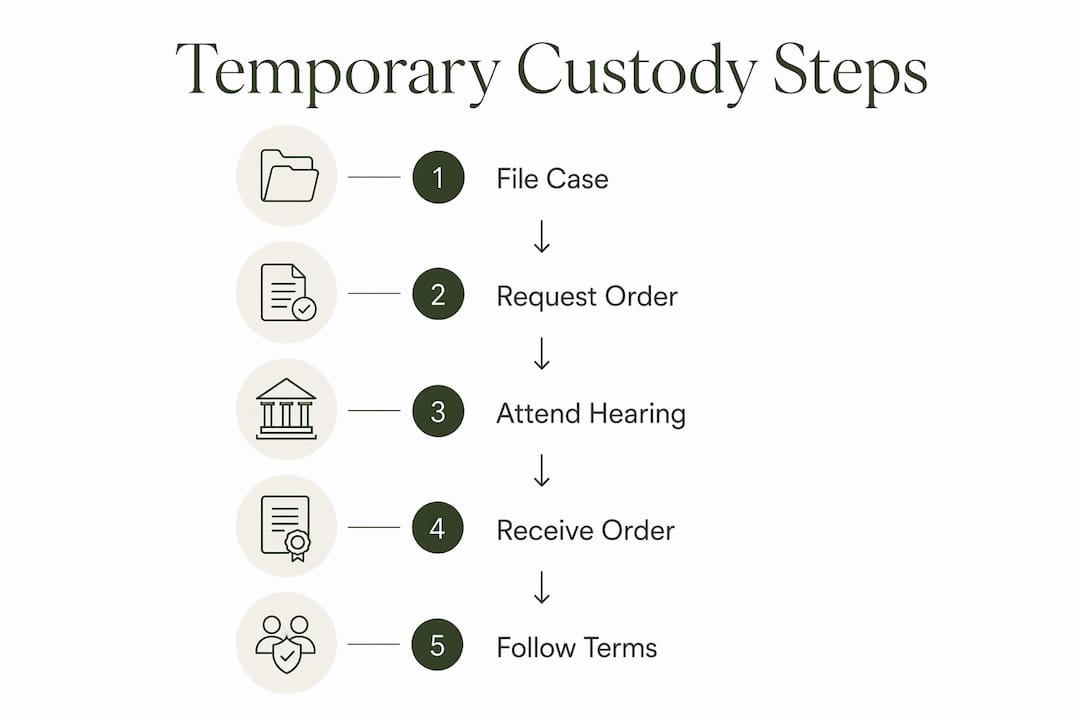
Here is what the filing process looks like:
- File a Motion for Temporary Order with the appropriate district or juvenile court. The form is available through Utah State Courts.
- Attach a Parenting Plan if you are requesting joint legal or physical custody. Skipping this step means the court will reject your joint custody request outright.
- Complete required courses. Utah law requires parents to finish a Divorce Orientation class and a Parenting Course before the court can hear motions affecting custody or parent-time. File the certificates of completion with the court.
- Prepare supporting evidence. Gather school records, medical records, text messages, photos, or any documentation that supports your position on custody and parent-time.
- Submit a letter of explanation if your situation is complex or if you are seeking an emergency order.
- Request a hearing date. The court will schedule a temporary custody hearing in Utah where both parties present their positions.
Pro Tip: When documenting co-parenting issues to support your motion, specificity beats volume. Judges respond to dated, factual records rather than general complaints. A resource like co-parenting documentation guidance can help you build a credible, organized record before you file.
Timing matters. Courts cannot hear your motion until the required course certificates are filed. Parents who wait until the last minute to complete those classes delay their own hearings.
What legal standards does the court apply to temporary custody requests?
The foundation of every temporary custody decision in Utah is the best interest of the child, as set out in Utah Code Title 81, Chapter 9. Courts do not start from a blank slate. Utah law presumes that joint legal custody serves the child's best interest unless one parent presents evidence that rebuts that presumption.
Factors courts weigh include:
- The child's physical and emotional safety
- Each parent's ability to cooperate and communicate
- The child's relationship with each parent
- Stability of the proposed living arrangement
- History of domestic violence, abuse, neglect, or substance abuse
- The child's ties to school, community, and extended family
Physical vs. legal custody are treated separately. Legal custody covers decision-making authority over education, healthcare, and religion. Physical custody determines where the child lives. Courts can award joint legal custody while granting sole physical custody to one parent, or any combination that fits the child's circumstances.
Modifying an existing final custody order is significantly harder than filing in a new case. You need to demonstrate a substantial material change in circumstances, not just a preference for a different arrangement. Immediate harm situations, such as documented abuse, active drug use, or credible threats to the child, can justify emergency relief. Standard temporary modifications require more.
One nuance worth knowing: temporary changes to child support are easier to obtain than changes to custody or parent-time. The evidentiary burden is lower, which is why courts sometimes grant child support adjustments while leaving custody arrangements intact during litigation.
Why a court order beats a private custody agreement every time
Some parents try to handle custody informally, with a written agreement between themselves or through a private guardianship arrangement. These arrangements have real limits that can catch parents off guard.
- Private agreements are contracts, not court orders. They are not enforceable by a judge and carry no contempt-of-court consequences if one parent ignores them.
- Medical providers and insurers may not recognize them. A private custody agreement does not give a non-parent or non-custodial parent the legal authority to consent to a child's medical treatment in most Utah facilities.
- Private guardianship agreements typically last up to six months and are designed for short-term care situations, not contested custody disputes.
- They cannot establish legal custody or parent-time under Utah law. Only a court can do that.
- The Office of Recovery Services (ORS) handles child support enforcement but cannot establish or modify custody or parent-time arrangements. Parents who contact ORS expecting help with custody are redirected to the courts.
The practical risk: if you rely on a private agreement and the other parent stops honoring it, you have no legal recourse beyond filing a new court action, which puts you back at square one. A court-issued temporary custody order gives you immediate enforcement tools.
Pro Tip: If you and the other parent genuinely agree on custody terms, you can still submit a joint Parenting Plan to the court and ask the judge to enter it as a temporary order. That converts your agreement into an enforceable court order without a contested hearing.
What happens after a temporary custody order is granted
Once the court enters a temporary custody order, both parents are legally bound to follow it. Violating the order, whether by withholding parent-time, refusing to pay child support, or relocating without notice, can result in a motion to enforce and a finding of contempt of court.
A few things to understand about life under a temporary order:
- The order stays in effect until the court enters a final order, modifies the temporary order, or terminates it. Cases can take a year or more to resolve, so temporary orders often govern daily life for an extended period.
- Temporary arrangements influence final outcomes. Courts notice when a custody arrangement has been working well. Stability during the temporary period often carries into the final ruling.
- Child support payments during this period are typically routed through the Office of Recovery Services via mandatory income withholding, unless the court approves direct payments.
- You can request modifications if circumstances change significantly. Filing a motion to modify a temporary order follows a similar process to the original motion, though the court will want a clear reason for the change.
- Mediation is often required or strongly encouraged before contested hearings on custody modifications.
One common misunderstanding: parents sometimes think a temporary order automatically becomes the final order. It does not. The final order requires a separate hearing or settlement agreement. But if the temporary arrangement has been running smoothly, judges often adopt similar terms in the final decree.
For parents navigating parent-time arrangements during a pending divorce, understanding how temporary orders interact with the final decree is worth the time to research before your case concludes.
How Divvi helps Utah families navigate temporary custody
Getting a temporary custody order right requires accurate paperwork, procedural knowledge, and often a Parenting Plan that holds up to judicial scrutiny. Divvi was built specifically for Utah families facing exactly this situation.
Here is what the platform offers:
- Step-by-step document automation for the Motion for Temporary Order and Parenting Plans, generating documents designed for filing without the confusion of blank legal forms
- An optional attorney referral if you want a lawyer to check your documents before you file
- Mediation options for parents who want to resolve custody disputes without a contested hearing, available through both AI-assisted and human mediator pathways
- Child support tools, including a child support estimator to understand what the court is likely to order before you file
- Post-divorce modification support for parents who need to adjust custody or support terms after a final order is entered
- Connections to vetted attorneys, mediators, and financial advisors for cases that need professional legal representation
- A free base model that lets you start the process without upfront cost, paying only for the services your specific situation requires
Whether you are filing a new custody case or need to modify an existing decree, Divvi covers both contested and uncontested situations. The platform handles the procedural complexity so you can focus on what actually matters: your children.
Divvi: custody documents designed for filing, without the attorney price tag
Hiring a family law attorney in Utah to handle a temporary custody motion typically costs thousands of dollars before you ever reach a hearing. Divvi gives you a different path.

The platform generates attorney-reviewed, documents designed for filing for your Motion for Temporary Order and Parenting Plan at a fraction of traditional legal costs. You get the same quality of paperwork, the same compliance with Utah procedural rules, and the same professional review, without paying for hours of attorney time on forms that follow a predictable structure.
For parents in a contested custody situation, Divvi connects you to full contested divorce support, including human mediators and licensed attorneys when your case needs them. For parents who agree on the basics, the free uncontested tools get you to a completed filing fast.
Start your temporary custody filing at divviutah.com/divorce and see exactly what your case requires before you spend a dollar.
Key Takeaways
A temporary custody order in Utah is a court-enforceable arrangement that governs child custody, parent-time, and support during pending litigation, and its terms often shape the final outcome.
| Point | Details |
|---|---|
| Court order vs. private agreement | Only a court-issued temporary order is legally enforceable; private agreements carry no contempt-of-court consequences. |
| Parenting Plan requirement | Joint custody requests require a Parenting Plan attached to the motion, or the court will reject the joint custody request. |
| Relocation trigger | A planned move of 150 or more miles requires specific court procedures before the relocating parent can move with the child. |
| Temporary orders influence final rulings | Courts often adopt stable temporary arrangements in the final decree, making the initial order more consequential than many parents realize. |
| Divvi | Generates attorney-reviewed, Motion for Temporary Order documents designed for filing documents and Parenting Plans for Utah families at a fraction of traditional legal costs. |