Post Divorce Financial Planning: Your 2026 Recovery Guide
Written and reviewed by the divvi team. How we research and check this.

Post divorce financial planning is the deliberate process of reestablishing your financial independence through systematic reassessment of your income, assets, taxes, retirement accounts, insurance, and estate plans. This process, which financial professionals call post-divorce financial restructuring, covers six core domains that interact with each other in ways most people do not anticipate. The stakes are real: women who divorce suffer an average income loss of 41%, nearly double that of men. Acting early and methodically is the difference between recovering your footing and spending years correcting avoidable mistakes.
What does post divorce financial planning actually involve?
Post divorce financial planning covers six interdependent domains: income and cash flow, taxes, retirement accounts, insurance, estate planning, and credit and debt management. Each domain affects the others, which is why changing one without reviewing the rest creates gaps. For example, updating your budget without adjusting your tax withholding can leave you with a surprise bill in april.
Regulatory changes also reshape the math. Since 2019, IRS rules make alimony non-deductible for the payer and non-taxable for the recipient. That single change affects how much cash you actually keep each month, and it must factor into any realistic budget you build.

Delaying financial planning until after the divorce is finalized often causes a mismatch between what your legal agreement says and what your actual cash flow can support. The best time to start is before the ink dries. The second best time is right now.
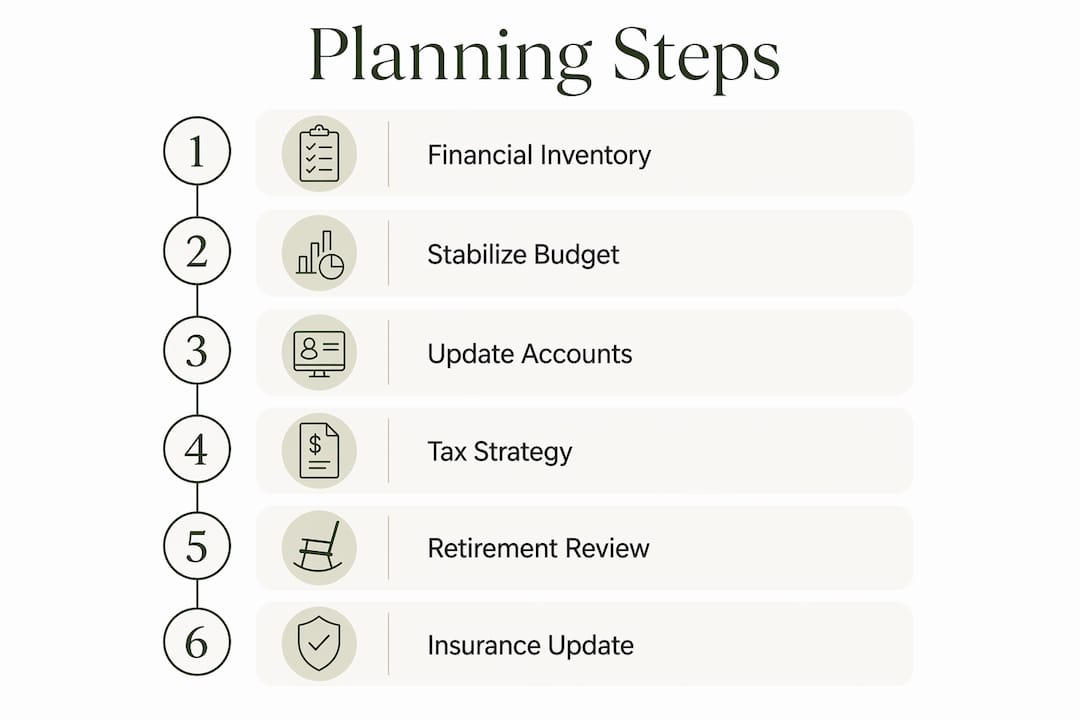
How to assess and stabilize your new financial reality
Your first task after divorce is building an accurate picture of where you stand. Start with a full inventory of every income source, monthly expense, debt balance, and asset you now own individually. Include jointly held property that has not yet been transferred, because those assets still carry legal and financial weight until the title changes.
- Pull your credit report. Review all three bureaus (Equifax, Experian, and TransUnion) to identify joint accounts, shared debts, and any obligations you may not have tracked closely during the marriage.
- List every fixed and variable expense. Fixed costs include rent or mortgage, car payments, and insurance premiums. Variable costs include groceries, utilities, and discretionary spending. Many people underestimate variable costs by 20–30% when building their first solo budget.
- Identify your new tax filing status. Your status changes to single or head of household, which affects your standard deduction and bracket. Adjust your W-4 withholding at work immediately to avoid underpaying.
- Calculate your net monthly income. Use take-home pay, not gross salary. Factor in any child support or spousal support you receive or pay, using the post-2019 tax treatment.
- Build an emergency fund. A fund covering 3–6 months of essential living expenses is the standard recommendation. This buffer protects you from making panicked financial decisions when an unexpected expense hits.
Pro Tip: Focus on stabilization before growth. Resist the urge to immediately invest your settlement or restructure your portfolio. Verify your cash flow is sustainable first, then make longer-term moves.
What accounts and estate documents should you update after divorce?
Updating your legal and financial documents is not optional. It is urgent. Many people complete their divorce and then wait months to handle administrative updates, which creates serious legal exposure.
- Bank and brokerage accounts. Remove your ex-spouse from joint accounts or close them and open individual accounts. Leaving joint access open after divorce creates liability for their spending and complicates your financial records.
- Retirement account beneficiaries. Beneficiary designations do not automatically update after divorce in all states. If your ex-spouse is still listed as the beneficiary on your 401(k) or IRA, they may legally receive those funds when you die, regardless of what your will says. Update these designations immediately.
- Life insurance policies. Review every policy you own and change the beneficiary to a person you currently intend to benefit, such as a child, sibling, or trust.
- Will, power of attorney, and health care directive. These documents almost certainly name your former spouse in key roles. Revise all three to reflect your current wishes and appoint a trusted person in their place.
- Payable-on-death and transfer-on-death accounts. These assets pass outside of probate and outside of your will. They follow the beneficiary designation on file, so they require a separate, manual update.
Pro Tip: Overlooking a single beneficiary designation can override years of careful estate planning. Set a deadline of 30 days post-divorce to complete every update on this list.
Timing matters here. Some states have automatic revocation laws that void a former spouse's beneficiary status after divorce, but many do not. Do not assume your state protects you. Verify with an estate attorney or a post-divorce financial planner who knows your state's rules.
How to build a realistic budget as a single-income household
Budgeting after divorce requires you to think differently about money than you did during the marriage. Two incomes, two sets of tax benefits, and shared fixed costs are gone. Your budget must reflect the actual cost of running a single-income household, not a scaled-down version of your married budget.
- Start with your verified net income. Use three months of bank statements to confirm your real take-home pay, not your theoretical salary. Include all income streams: wages, freelance work, child support, and investment income.
- Separate fixed from flexible costs. Fixed costs (rent, loan payments, insurance) are non-negotiable in the short term. Flexible costs (dining, subscriptions, entertainment) are where you find room to adjust.
- Account for child support and spousal support accurately. If you pay support, treat it as a fixed expense. If you receive it, treat it as income with a plan for what happens if payments are late or stop.
- Track shared liabilities. If you and your ex-spouse share a mortgage, car loan, or credit card debt from the marriage, your credit score is still tied to how those accounts are paid. Monitor them monthly until they are fully resolved or refinanced.
- Review your budget quarterly. Your expenses will shift during the first year. Housing costs, childcare arrangements, and income changes all require budget adjustments. Build a quarterly review into your calendar.
Avoiding common mistakes matters as much as following the right steps. The most frequent errors in divorce settlement budgeting are underestimating taxes, ignoring the cost of health insurance, and treating a one-time settlement as ongoing income. A lump-sum property settlement is not a salary. Spending it like one creates a crisis within two years.
How does retirement account division work after divorce?
Dividing retirement assets correctly is one of the most technically demanding parts of managing finances post divorce. The rules differ depending on the type of account, and getting them wrong triggers immediate tax penalties.
IRAs vs. employer-sponsored plans
IRAs and employer-sponsored plans follow different legal tracks. An IRA is divided through a transfer incident to divorce under IRC § 408(d)(6). This process is relatively straightforward: the account is split and transferred directly to the recipient spouse's IRA without triggering taxes or penalties.
Employer-sponsored plans, including 401(k), 403(b), and pension plans, require a Qualified Domestic Relations Order, commonly called a QDRO. A QDRO is a court order that instructs the plan administrator to transfer a specific portion of the account to the alternate payee. Failing to use a QDRO for these plans triggers immediate taxes and early withdrawal penalties, which can eliminate a significant portion of the asset before you ever see it.
| Account type | Division method | Tax risk if done incorrectly |
|---|---|---|
| Traditional IRA | Transfer incident to divorce | Taxes and penalties on improper withdrawal |
| Roth IRA | Transfer incident to divorce | Penalties on improper distribution |
| 401(k) / 403(b) | QDRO required | Immediate income tax plus 10% early withdrawal penalty |
| Pension plan | QDRO required | Loss of future benefit or full taxation |
Rebuilding your retirement after division
Once the division is complete, your retirement picture has changed. You may have fewer years to rebuild than you planned. Maximize your annual contribution limits as soon as your cash flow allows. If you are 50 or older, the IRS permits catch-up contributions to both IRAs and 401(k) plans, which accelerates rebuilding.
Pro Tip: Do not make investment changes inside your retirement accounts in the first 90 days after divorce. Emotional decisions made during high-stress periods consistently underperform. Stabilize first, then realign your allocation with your new time horizon and risk tolerance.
Certified Divorce Financial Analysts provide objective financial analysis specifically designed to coordinate settlement terms with long-term cash flow needs. Their expertise is particularly valuable when retirement assets represent a large share of the marital estate.
Key Takeaways
Effective financial recovery after divorce requires immediate stabilization, precise account updates, and a long-term rebuilding plan executed in deliberate steps rather than reactive decisions.
| Point | Details |
|---|---|
| Start with a full financial inventory | List every income source, debt, asset, and expense before making any financial moves. |
| Update beneficiaries within 30 days | Designations on retirement accounts and insurance override wills and do not update automatically. |
| Use a QDRO for employer plans | Dividing a 401(k) or pension without a QDRO triggers immediate taxes and penalties. |
| Build a 3–6 month emergency fund | This buffer prevents panic-driven financial decisions when unexpected costs arise. |
| Delay major investment changes | Stabilize cash flow first; realign your portfolio only after your new financial baseline is clear. |
What rebuilding after divorce actually takes
The most common mistake I see is not the one you'd expect. People obsess over the settlement itself, fighting over specific assets, and then walk away without a plan for what comes next. The settlement is the starting line, not the finish line.
The second mistake is speed. Divorce creates urgency that feels financial but is often emotional. Rushing to buy a new home, liquidate investments, or restructure everything at once almost always costs more than it saves. The research is consistent on this: aligning investment strategies with new goals and timelines produces better outcomes than immediate overhauls.
What actually works is a staged approach. Stabilize in month one. Update accounts and documents in month two. Build a realistic budget in month three. Then, and only then, start thinking about long-term investment strategy. This sequence feels slow when you are anxious to move forward. It is also the sequence that works.
The emotional weight of divorce is real, and it affects financial judgment in ways people rarely admit. Working with a Certified Divorce Financial Analyst is not a sign of weakness. It is the same logic as hiring a tax professional instead of guessing at your return. The cost of professional guidance is almost always lower than the cost of a correctable mistake left uncorrected.
If you are a woman rebuilding after divorce, the income loss data is sobering but not a verdict. It is a reason to plan more carefully, not less confidently. Use the divorce planning checklist designed specifically for your situation and treat your financial recovery as a project with milestones, not a crisis to survive.
— Landon
How Divvi supports your financial recovery
Divvi gives recently divorced individuals in Utah access to more than documents designed for filing. The platform connects you with financial advisors, mediators, real estate agents, and attorneys, so your legal agreements and financial plans actually align.
The Divvi divorce services page walks you through every step, from document preparation to post-divorce financial tools, including a post-divorce budget resource built specifically for life after separation. The base platform is free to use, and you pay only for the professional services you actually need. Whether your situation is straightforward or complicated, Divvi handles it without the cost of a full traditional legal process.
FAQ
What is post divorce financial planning?
Post divorce financial planning is the process of reassessing and restructuring your income, taxes, retirement accounts, insurance, estate plans, and debt after a marriage ends. It covers six core domains that each affect the others.
How soon should I start financial planning after divorce?
Start before the divorce is finalized if possible. Delaying until after the settlement is complete often creates a mismatch between your legal agreements and your actual cash flow needs.
Do beneficiary designations update automatically after divorce?
No. Beneficiary designations on retirement accounts, life insurance, and payable-on-death accounts do not update automatically after divorce in most states. You must update them manually and promptly.
What is a QDRO and why does it matter?
A Qualified Domestic Relations Order is a court order required to divide employer-sponsored retirement plans like 401(k) and pension accounts. Without one, the division triggers immediate income taxes and early withdrawal penalties.
How much should I save in an emergency fund after divorce?
Financial planning standards recommend saving 3–6 months of essential living expenses. This fund protects you from making reactive financial decisions when unexpected costs arise during the transition period.