Post Divorce Checklist: Your Complete After-Divorce Guide
Written and reviewed by the divvi team. How we research and check this.

The five things to do within 72 hours of your final decree: get certified copies of the decree, lock in health insurance before the 60-day enrollment window closes, separate every joint financial account, update beneficiaries on retirement accounts and life insurance, and transfer or confirm housing and insurance coverage. Everything else builds from those five.
Here is the full staged checklist, from day one through month twelve.
Your first 48–72 hours:
- Get certified copies of the decree. Order more than you think you need. Banks, the DMV, mortgage lenders, and insurance carriers each want their own copy and rarely return documents.
- Health insurance. If you were on your spouse's plan, you have a limited time to enroll in COBRA or a Marketplace plan. Start this today, not next week.
- Separate finances. Open individual checking and savings accounts before closing joint ones. Move direct deposits and recurring payments first.
- Update beneficiaries. Retirement accounts, life insurance, and investment accounts need new designations immediately. ERISA rules mean a beneficiary form can override your will.
- Housing and insurance. Confirm title transfers are in motion per the decree. Update auto and homeowner policies to reflect the new ownership and remove your ex from coverage.
Pro Tip: Set a phone calendar reminder for day 55 after your decree date. If you have not confirmed new health insurance by then, you are cutting it dangerously close to the 60-day deadline.
Table of Contents
- Legal must-dos: review the decree, get certified copies, and update your estate documents
- How to clean up joint accounts, credit, and investment accounts
- Health insurance and time-sensitive benefits you cannot afford to miss
- How to update deeds, vehicle titles, and insurance policies after divorce
- Child custody, support, school records, and co-parenting logistics
- How to separate debt, protect your credit, and start rebuilding
- Tax filing status, QDROs, retirement splits, and beneficiary updates
- Daily-life security: passwords, mail, locks, and personal logistics
- Your printable staged checklist: immediate, short-term, and long-term
- When and how to enforce or modify divorce orders
- Mental health and emotional support after divorce
- How to update or close subscriptions and memberships tied to your ex
- Key Takeaways
- Why the checklist matters more than the decree itself
- Divvi makes the document-heavy steps faster and less expensive
- Authoritative sources to verify rules for your state
Legal must-dos: review the decree, get certified copies, and update your estate documents
Your divorce decree is a court order, not a summary. Read it front to back before you do anything else. Family law practitioners treat the decree as the control document for everything that follows, and auditing it line by line for deadlines and transfer instructions is the single highest-impact first step you can take.
Pull out every deadline and write it on a calendar. Property transfers, loan refinancings, QDRO submission windows, and deed recordings all have timelines. Some require additional court filings to enforce if the other party does not comply.
On certified copies: order at least five to seven. Each institution typically wants its own original certified copy, and they do not return them. Your county clerk's office issues them, usually for a small per-copy fee.
If you are changing your name, the sequence matters. The Social Security Administration must process the change before most state DMVs will issue a corrected license. Many DMVs verify SSA records electronically and will reject an application submitted out of order. Start with SSA, then the DMV, then your passport.
Revoke any powers of attorney or health-care proxies that name your former spouse. Execute new documents with a notary and witnesses as your state requires. Pair this with a full estate planning review — your will, any trusts, and health-care directives all need to reflect your current wishes. In some states, divorce automatically revokes certain provisions, but relying on that default is a risk not worth taking.
Pro Tip: Create a single folder, physical or digital, labeled "Post-Divorce Documents." Every certified copy, confirmation email, and signed form goes in it. You will need these records if you ever have to enforce the decree.
How to clean up joint accounts, credit, and investment accounts
Start with a full inventory. List every bank account, credit card, loan, mortgage, and investment account that is joint or carries either name. This list becomes your working document for the next several weeks.

Open individual accounts before closing joint ones. Automated deposits and recurring payments need a destination before the joint account disappears. Transfer direct deposit with your employer first, then redirect utilities, subscriptions, and any automatic loan payments.
The creditor rule that catches people off guard: a divorce decree does not change what lenders see. If your name is still on a loan or credit card, the creditor can pursue you regardless of what the court ordered. Refinancing or formally removing your name is the only way to cut that liability.
| Account Type | Documents Needed | Who Must Sign | Typical Timeline |
|---|---|---|---|
| Joint bank account | Certified decree, ID | Both parties or one per bank policy | 1–2 business days |
| Joint credit card | Certified decree, written request | Primary cardholder | 1–2 weeks |
| Mortgage / home loan | Certified decree, refinance application | Both parties (for refinance) | 30–90 days |
| Auto loan | Certified decree, title | Both parties | 1–4 weeks |
| Investment / brokerage | Certified decree, ACATS form | Both parties | 1–3 weeks |
| Retirement (ERISA plan) | QDRO, plan administrator forms | Plan administrator approval required | 60–180 days |
Keep an audit trail for every change: dates, confirmation numbers, and the name of the representative you spoke with. If a dispute arises later, that paper trail is your evidence. For deeper guidance on rebuilding your financial picture, the post-divorce financial planning guide on Divvi's site covers budgeting and account strategy in detail.
Health insurance and time-sensitive benefits you cannot afford to miss
Loss of a spouse's employer-sponsored health plan is a qualifying life event. That status gives you a special enrollment window, but it is short. You typically have as few as 60 days to enroll in COBRA or a new plan through the Marketplace at Healthcare.gov. Miss that window and you may wait until the next open enrollment period, which could leave you uninsured for months.
Stat to know: The 60-day special enrollment window starts from the date of the qualifying event, which is typically the date the divorce is finalized, not the date you receive paperwork.
Your options when coverage ends:
- COBRA: Extends your ex-spouse's employer plan for up to 36 months, but you pay the full premium plus a 2% administrative fee. Expensive, but it preserves continuity of care.
- Marketplace plan: Often less expensive than COBRA, especially with income-based subsidies. Compare at Healthcare.gov before defaulting to COBRA.
- Employer plan: If your own employer offers coverage, a qualifying life event lets you enroll outside of open enrollment.
- Medicaid: If your income dropped significantly post-divorce, check eligibility.
If children are covered, the decree should designate which parent is responsible for maintaining their health insurance. Confirm this in writing with the plan administrator and get a case number.
Beyond health insurance, check your employer's other benefits. Flexible spending accounts (FSAs), dependent care accounts, and employee assistance programs (EAPs) often have post-divorce options and their own deadlines. Contact HR in writing and save every response.
How to update deeds, vehicle titles, and insurance policies after divorce
Recording a deed and paying off a mortgage are two different things. This distinction trips up a lot of people. If the decree awards real property to one spouse, a quitclaim or warranty deed must be executed and recorded with the county recorder's office. Recording updates the public ownership record. It does not, however, remove the other spouse from mortgage liability. That requires either a refinance or a written release from the lender.
Key steps for property and vehicle transfers:
- Execute the required deed type (quitclaim is most common in divorce) and record it with the county recorder promptly. Delays create title complications.
- If you are keeping the home but your ex remains on the mortgage, refinancing into your name alone is the cleanest solution. Divvi's mortgage and refinance specialists can connect you with professionals who handle exactly this scenario.
- Transfer vehicle titles at the DMV with a certified copy of the decree and the signed title. Fees and required forms vary by state.
- Update auto and homeowner insurance immediately. Call your insurer the same week the decree is final. Confirm effective dates in writing and get a new declarations page.
Pro Tip: If your ex is keeping the house but you are still on the mortgage, do not remove yourself from the title until you are also removed from the mortgage. Staying on the title gives you leverage to ensure the debt is being paid.
Child custody, support, school records, and co-parenting logistics
The parenting plan in your decree is the operating document for your children's lives going forward. Pull it out and confirm the specifics: visitation schedule, holiday rotation, pickup and dropoff logistics, and who holds decision-making authority for education, medical care, and extracurriculars.
Share a copy of the relevant custody sections with schools, daycare providers, and pediatricians. Many schools require written documentation of custody arrangements before they will restrict access or add a parent to emergency contacts. A certified copy of the decree satisfies most requests.
For child support, document everything:
- Note the exact amount, due date, and required payment method from the decree.
- Set up automatic payments if your state's system allows it. Automatic payments create a built-in paper trail.
- Keep receipts and bank records for every payment made or received.
- If payments are missed, document the date, amount, and any communication about it.
A centralized co-parenting contact list should include current phone numbers, home addresses, work numbers, and preferred communication channels for both parents, plus emergency contacts for the children. Store it somewhere both parties can access securely. Divvi's family management plan tool is built for exactly this kind of shared logistics document.
How to separate debt, protect your credit, and start rebuilding
The most common misconception after divorce: people assume the decree protects them from creditors. It does not. If your name is on a loan or credit card, the creditor can still pursue you regardless of what the court assigned. The decree governs your relationship with your ex, not your relationship with the bank.
Pro Tip: Pull your credit reports from all three bureaus at AnnualCreditReport.com within the first two weeks after your decree. You may find joint accounts or authorized-user relationships you forgot existed.
Steps to take now:
- Run credit reports from Equifax, Experian, and TransUnion. Dispute any inaccurate joint items in writing.
- Place a fraud alert or credit freeze if you suspect your ex has access to your financial information.
- If the decree assigns certain debts to your ex and they fail to pay, keep the decree and your own payment records. You will need them to pursue enforcement or to defend your credit.
- Start rebuilding with a secured credit card or a credit-builder loan from a credit union. Keep utilization below 30% and pay the balance monthly.
An emergency fund matters as much as the credit score right now. Even $1,000 set aside reduces the pressure to use credit for unexpected expenses during the transition. For a structured approach to rebuilding your budget, the post-divorce budget resources at Divvi walk through the numbers.
Tax filing status, QDROs, retirement splits, and beneficiary updates
Your filing status for the year of divorce depends on your marital status on December 31. If the decree was final before year-end, you file as single or, if you have a qualifying dependent, potentially as head of household. The IRS Publication 504 covers divorce-related tax rules in detail and is worth bookmarking.
For employer retirement plans governed by ERISA — 401(k)s, pensions, profit-sharing plans — splitting benefits requires a Qualified Domestic Relations Order (QDRO). A QDRO is a separate court order that instructs the plan administrator how to divide the account. It must be drafted correctly, submitted to the plan administrator for pre-approval, and then entered by the court. The timeline runs 60–180 days in most cases, so start this process immediately after the decree is final. IRAs, SEP IRAs, and Roth IRAs do not require QDROs; they transfer via a different process called a transfer incident to divorce.
Beneficiary designations are where people get burned most often. For ERISA-governed plans, the beneficiary form controls who receives the benefit, not your will. If your ex-spouse is still named on a 401(k) beneficiary form, they may receive that money even if your will says otherwise. Update every beneficiary designation — retirement accounts, life insurance, annuities, and investment accounts — as soon as the decree is final.
Pro Tip: Adjust your W-4 withholding after divorce. If you were filing jointly and now file single, your withholding may be too low, which means a tax bill in April. A quick W-4 update with your employer prevents that surprise.
Daily-life security: passwords, mail, locks, and personal logistics
Change passwords first. Email, banking apps, cloud storage, social media, and any shared streaming or subscription accounts. Enable two-factor authentication on a new phone number or authenticator app your ex cannot access. Remove your ex as an authorized user from any accounts where that status still exists.
Set up mail forwarding with USPS to your new address and notify banks, the IRS, your employer, utilities, and any creditors of the address change in writing. Close or convert family-shared email accounts that might expose personal correspondence.
Physical security matters too. Rekey locks if your ex had a key to your home, even if the split was amicable. Change the admin credentials on smart-home devices, security cameras, and shared Wi-Fi networks. These are often overlooked and can expose your location, schedule, or home access.
For name changes, the sequence is SSA first, then DMV, then your passport, then financial institutions. Attempting the DMV before SSA processes the change leads to rejected applications. Once SSA issues your updated Social Security card, the rest of the agencies fall into line.
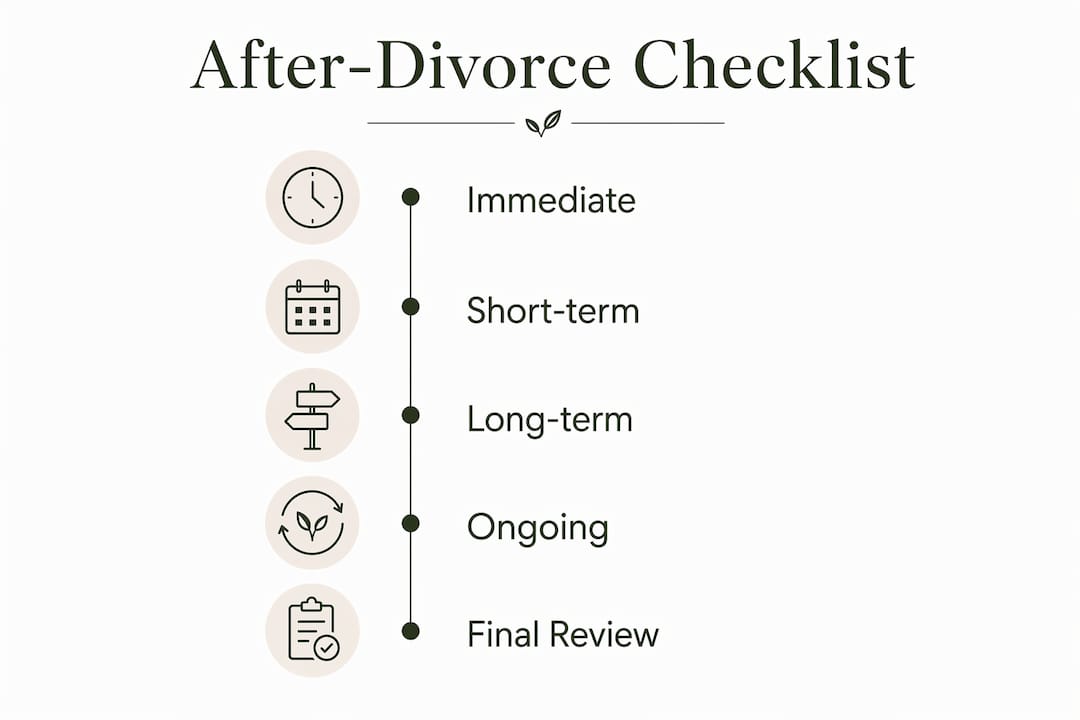
Your printable staged checklist: immediate, short-term, and long-term
Use this table as a working document. Print it, check items off, and note the date completed and any confirmation numbers in the margin.
| Stage | Task | Priority |
|---|---|---|
| Immediate (within 2 weeks) | Order 5–7 certified copies of the decree | Critical |
| Enroll in COBRA or Marketplace health insurance (within 60 days of your decree) | Critical | |
| Open individual bank and savings accounts | Critical | |
| Update beneficiaries on retirement accounts and life insurance | Critical | |
| Update school and medical emergency contacts for children | High | |
| Change passwords and remove ex from shared digital accounts | High | |
| Short-term (2–12 weeks) | Execute and record deed transfers per decree | Critical |
| Submit QDRO paperwork to plan administrator | Critical | |
| Refinance joint mortgage or auto loans where assigned | High | |
| Update or revoke powers of attorney and health-care proxies | High | |
| Transfer vehicle titles at DMV | High | |
| Update auto and homeowner insurance policies | High | |
| Open new credit account to begin rebuilding credit | Medium | |
| Set up child support automatic payments | High | |
| Update estate documents: will, trusts, health-care directives | High | |
| Long-term (3–12 months) | Monitor all three credit reports quarterly | Medium |
| Complete any remaining deed or mortgage refinances | High | |
| Review retirement plan contributions and long-term goals | Medium | |
| Assess tax impact of divorce for year-end planning | Medium | |
| Consider ongoing therapy or financial planning support | Medium |
When and how to enforce or modify divorce orders
A decree is enforceable from the day it is signed. If your ex fails to transfer property, pay support, or complete a court-ordered task, you have legal remedies. The most direct is a motion for contempt filed with the court that issued the decree. Courts take contempt seriously because the decree is their order, not just a private agreement.
Keep documentation of every missed obligation: dates, amounts, communications, and any witnesses. If support payments stop, document each missed payment immediately. Waiting too long to act can complicate enforcement and, in some jurisdictions, limit your remedies.
Circumstances change. If income, custody needs, or living situations shift significantly, either party can petition the court to modify the decree. Common modifications include child support adjustments, custody schedule changes, and alimony termination or reduction. Most courts require a showing of a substantial material change in circumstances before they will modify an existing order. Divvi handles post-decree modifications and can connect you with mediation or legal support when a modification is needed.
Mental health and emotional support after divorce
The administrative checklist is only half the picture. Divorce is one of the most stressful life events a person can go through, and the weeks after the decree are often harder emotionally than the process itself. The structure of the legal fight is gone, and what is left is the actual adjustment.
A practical mental health checklist for the post-divorce period:
- Schedule an appointment with a therapist or counselor within the first two weeks, even if you feel fine. Grief and stress often surface on a delay.
- Identify two or three people in your life who can serve as a support network. Be specific about what you need from them.
- Limit major financial or life decisions for the first 60–90 days when possible. Stress impairs judgment, and the administrative tasks are already demanding enough.
- Use your employer's EAP if one is available. Many offer free counseling sessions that most employees never use.
- Consider a divorce support group. Peer support from people in the same situation provides a kind of understanding that friends and family often cannot.
Building a post-divorce support team that includes a therapist alongside your attorney and financial advisor reduces the risk of costly emotional decisions during the transition. These are not luxuries. They are risk management.
How to update or close subscriptions and memberships tied to your ex
Shared accounts are easy to forget and expensive to ignore. Go through your bank and credit card statements from the past three months and flag every recurring charge. Streaming services, gym memberships, Amazon household accounts, Costco memberships, meal delivery subscriptions, and family phone plans all need attention.
For each shared account, decide: cancel, transfer to your name, or remove your ex. Most streaming services allow account separation or profile removal. Family phone plans require contacting the carrier directly and may involve an early termination fee if the account is under contract.
Utilities at a shared residence need to transfer to the person keeping the property. Electricity, gas, water, trash, internet, and cable should all be in the name of the person responsible for the home. Leaving your name on utilities at a property you no longer own creates both financial and privacy exposure.
Check for any memberships that auto-renew annually. These are easy to miss on a monthly statement review. A full audit of your email inbox for receipts from the past 12 months often surfaces accounts you had forgotten about entirely.
Key Takeaways
The single most important thing you can do right after your decree is treat it as a court order with deadlines, not a document to file away.
| Point | Details |
|---|---|
| Certified copies first | Order at least five to seven certified decree copies; institutions rarely return them and each requires its own. |
| Health insurance is time-critical | You have as few as 60 days from the decree date to enroll in COBRA or a Marketplace plan. |
| Creditors ignore the decree | Refinance or remove your name from joint loans; the decree does not protect you from creditors. |
| Beneficiary forms override wills | Update retirement accounts and life insurance designations immediately; ERISA plan documents control who receives benefits. |
| Divvi for Utah document prep | Divvi's free document wizard, optional attorney referrals, and post-divorce tools cover the most document-heavy steps on this checklist. |
Why the checklist matters more than the decree itself
Most people treat the signed decree as the finish line. It is not. The decree is a set of instructions. The checklist is what converts those instructions into actual legal and financial reality. Administrative follow-through is what turns a legal right into a practical one.
The conventional wisdom is to tackle everything at once, as fast as possible. That approach leads to errors, missed deadlines, and burnout. A better approach: batch similar tasks into single sessions. Handle all government ID and name-change tasks in one trip. Handle all financial account changes in one afternoon with your certified copies in hand. Handle all insurance calls in one block. Batching reduces the cognitive load and cuts down on repeated courthouse or DMV visits.
The other thing most guides understate: the value of a small professional team assembled early. An attorney for decree enforcement questions, a financial advisor for QDRO and tax strategy, and a therapist for the emotional side of the transition. These are not optional extras for people with complicated situations. They are the difference between a clean transition and one that drags on for years because a QDRO was submitted incorrectly or a beneficiary form was never updated.
Time-sensitive items come first, always. Health insurance, beneficiary designations, and certified copies cannot wait. Everything else can be scheduled. Use the staged checklist above as your calendar, not just a reference document.
Divvi makes the document-heavy steps faster and less expensive
For anyone working through this checklist in Utah, the most time-consuming parts are the documents: forms designed for filing, QDRO guidance, deed preparation, and co-parenting agreements. That is exactly where Divvi fits.

Divvi's platform generates attorney-reviewed, documents designed for filing through a guided wizard that takes most users a fraction of the time and cost of traditional legal prep. The base model is free for uncontested cases. For more complex situations, including contested divorces, QDRO processing, and post-decree modifications, Divvi connects you with attorneys, financial advisors, real estate specialists, and mediators, so you pay only for the help you actually need.
Post-divorce tools on the platform include a co-parenting family management plan, a post-divorce budget calculator, and modification support for when circumstances change. If you want someone to handle the filing itself, divviFile submits your documents to the court on your behalf.
Start with the Divvi divorce platform to see which services apply to your situation. The first step costs nothing.
Authoritative sources to verify rules for your state
Rules for enrollment windows, name-change timing, deed recording, and tax filing vary by state and change over time. Verify current requirements directly with these primary sources before acting:
- IRS Publication 504 (irs.gov): Filing status rules, alimony tax treatment, and dependency exemptions after divorce.
- Healthcare.gov: Marketplace enrollment rules, special enrollment windows, and COBRA comparison tools.
- Social Security Administration (ssa.gov): Name-change process, required documents, and timing before DMV updates.
- Your state's DMV: Vehicle title transfer procedures, required forms, and fees. Requirements differ significantly by state.
- Your county recorder's office: Deed recording requirements, fees, and turnaround times for property transfers.
- Utah Courts (utcourts.gov): Utah-specific decree enforcement, contempt procedures, and modification filing guidance.
- FindLaw (findlaw.com): Plain-language summaries of post-divorce financial steps and beneficiary update requirements.
Save these links. When a bank, insurer, or government office gives you conflicting information, the primary source is what you cite.
This article is general information, not legal, tax, or financial advice. Confirm current rules and deadlines with the relevant primary source or a qualified professional for your specific situation.