How to Have a Peaceful Divorce: A Practical Guide
Written and reviewed by the divvi team. How we research and check this.

Yes, a peaceful divorce is possible — and you can start today. Confirm that both of you are willing to cooperate, choose a non-adversarial pathway (mediation, collaborative law, or an uncontested filing), and pull together your basic financial and parenting documents. That's the whole first move.
Here's what to do in the next 24 hours:
- Have an honest conversation with your spouse about whether both of you can commit to a cooperative process
- Decide on a first-pass pathway: mediation, collaborative divorce, or a simple uncontested filing
- Begin collecting bank statements, tax returns, mortgage documents, and any existing parenting arrangements
- If you're in Utah, Divvi's free document wizard can walk you through the paperwork from day one
Pro Tip: Write down your top three non-negotiables before any conversation with your spouse. Knowing your priorities in advance keeps the first discussion focused and prevents it from spiraling into old grievances.
Table of Contents
- What does a peaceful divorce actually look like?
- Which peaceful divorce pathway fits your situation?
- How do you actually start and run a peaceful divorce?
- How do you keep conversations from derailing the process?
- What legal protections should you never skip?
- When is a peaceful approach unsafe or likely to fail?
- What does a peaceful divorce cost, and how long does it take?
- How do you choose a mediator or collaborative attorney?
- What does the research say about peaceful divorce outcomes?
- Key Takeaways
- The part most guides get wrong about peaceful divorce
- Divvi makes a peaceful Utah divorce simpler
- Helpful resources and where to start
What does a peaceful divorce actually look like?
A peaceful divorce, often called an amicable separation, replaces courtroom tactics with structured cooperation. The goal isn't to pretend the marriage ended without pain. It's to minimize harm and preserve relationships — especially when children are involved — and to build a foundation for healthier lives after the marriage ends.

In practice, that means both spouses agree to share financial information honestly, negotiate in good faith, and reach a written settlement that a judge can approve and enforce. The process looks less like a courtroom battle and more like a series of structured conversations, sometimes with a neutral professional in the room.
Three methods qualify as genuinely peaceful:
- Mediation: A single neutral mediator facilitates negotiation. Neither spouse's interests are formally "represented" by the mediator, so attorneys may still review any agreement before signing.
- Collaborative divorce: Each spouse has their own collaboratively trained attorney, and the team can include financial neutrals and mental health professionals. Everything happens in private meetings, not a courtroom.
- Uncontested filing: Both spouses agree on every term before filing. No mediator or collaborative team is required, though a document review by an attorney is still wise.
Pro Tip: An amicable separation doesn't require you to agree on everything before you start. You only need to agree that you'll try to work it out cooperatively. The process itself is designed to get you to agreement.
Which peaceful divorce pathway fits your situation?
Mediation and collaborative divorce let couples retain control over outcomes and focus on solutions outside court. The right choice depends on your conflict level, asset complexity, and whether children are involved.

| Pathway | Best for | Typical cost | Privacy | If it fails |
|---|---|---|---|---|
| Uncontested filing | Low conflict, simple assets, full agreement | Lowest | High | N/A — already agreed |
| Mediation | Moderate conflict, some disagreements | Low–moderate | High | Either party can exit; attorneys not disqualified |
| Collaborative divorce | Complex assets, children, moderate-to-high conflict | Moderate–high | Highest | Collaborative attorneys must withdraw |
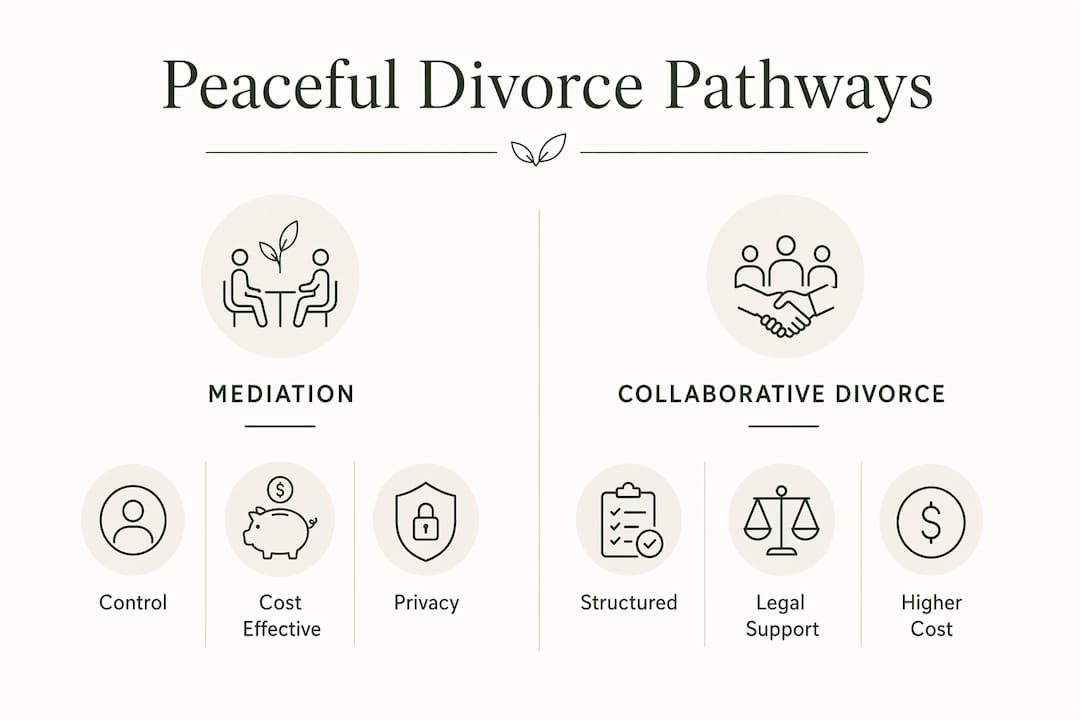
Uncontested filing works when you've already agreed on property division, custody, and support. It's the fastest and cheapest route, and platforms like Divvi can generate documents designed for filing without an attorney on retainer.
Mediation suits couples who have real disagreements but can still sit in the same room. A neutral mediator doesn't decide anything — they help you talk through the issues. You can bring attorneys to mediation sessions or have them review the final agreement separately. Some couples start with mediation and bring attorneys in later; others hire lawyers first and pursue a collaborative or amicable path. There's no single right sequence.
Collaborative divorce is the most structured option. Each spouse has their own collaboratively trained attorney, and the team can expand to include a financial neutral or a child specialist. It's better suited for complex assets, business ownership, or situations where one spouse needs more support to negotiate effectively. The trade-off: if the process breaks down, both attorneys must withdraw, and you'll need to hire new counsel for litigation.
- Mediation tends to be more affordable and flexible
- Collaborative law offers the most support but carries the disqualification trade-off
- Uncontested filing is fastest when you're already aligned
Pro Tip: If you're unsure which path fits, start with a single mediation session. It costs relatively little and quickly reveals whether you and your spouse can negotiate productively — or whether you need more structure.
How do you actually start and run a peaceful divorce?
The process has a clear sequence. Skipping steps, especially the financial disclosure phase, is the most common reason amicable divorces fall apart.
- Confirm mutual willingness. Both spouses must agree to cooperate. If one party refuses, mediation and collaborative law won't work.
- Run a safety check. If there's any history of domestic violence, coercion, or financial control, a peaceful process may not be appropriate. See the red flags section below.
- Choose your pathway. Mediation, collaborative law, or uncontested filing — match the method to your conflict level and complexity.
- Sign a participation agreement. In collaborative divorce, this is a binding contract committing both parties to transparency and a no-court clause. In mediation, it's typically a shorter confidentiality and process agreement.
- Gather financial disclosures. Both spouses must share complete financial information. No exceptions.
- Hold structured meetings. In collaborative divorce, lawyers often meet first to plan the structure before joint sessions begin. Financial neutrals or child specialists join when needed.
- Draft the settlement agreement. Cover property division, debt allocation, custody and parenting time, child support, and spousal support.
- Get independent legal review. Even in mediation, each spouse should have an attorney review the final agreement before signing.
- File with the court. The signed settlement goes to a judge for approval. In Utah, Divvi's document wizard handles this step for uncontested cases.
| Phase | Key documents | Who's involved |
|---|---|---|
| Financial disclosure | Bank statements, tax returns, retirement accounts, mortgage docs | Both spouses, attorneys |
| Parenting plan | Custody schedule, holiday plan, decision-making authority | Both spouses, child specialist (if used) |
| Settlement draft | Property division, debt allocation, support terms | Attorneys, financial neutral (if used) |
| Court filing | Final decree, parenting plan, financial affidavits | Attorneys or filing service |
When stalls happen, the fix is almost always to bring in a neutral. A financial specialist can break a deadlock over asset valuation; a therapist or divorce coach can defuse an emotional standoff. Escalating to litigation should be the last resort, not the first response to a difficult session.
- Use a divorce document checklist to make sure nothing gets missed during financial disclosure
- Set a clear agenda before each meeting so sessions don't drift into unproductive territory
- Agree in writing on a process for handling disagreements before the first joint session
How do you keep conversations from derailing the process?
The single biggest threat to a cooperative divorce isn't legal complexity. It's emotional escalation during negotiations. A few concrete rules make a real difference.
Conversation rules that work:
- Time-box every discussion to 90 minutes or less. Fatigue turns reasonable people into combative ones.
- Use "I" statements: "I need the kids on school nights" lands differently than "You always put work first."
- Agree on a neutral meeting space — not the family home, where every room carries a memory.
- Submit financial proposals in writing before meetings so neither party is blindsided.
- Avoid relitigating the past. The question on the table is always: what does the future look like?
Scripts for common flashpoints:
- On money: Instead of "You hid that account," try "I'd like us both to share a complete financial statement by [date] so we're working from the same numbers."
- On parenting time: Instead of "You're never available," try "I want the kids to have consistent time with both of us. Can we look at a schedule together?"
- On leaving the home: Instead of "I'm not going anywhere," try "I need to understand what staying or leaving means financially before I can agree to anything."
The most durable settlements come from couples who treat the process like a business negotiation — not a therapy session and not a courtroom. Emotions are real and valid, but they belong in a therapist's office, not at the negotiating table. Bring your feelings to your own support system; bring your priorities to the meetings.
When a session gets heated, call a break. A 10-minute pause resets the room more reliably than any argument. If a particular issue keeps triggering conflict, route it through your mediator or attorneys in writing rather than trying to resolve it face-to-face.
Pro Tip: Hire a divorce coach or therapist for yourself — not as a couple's therapist, but as your own emotional support during the process. People who manage their emotional state outside negotiations reach more durable agreements.
What legal protections should you never skip?
Peaceful doesn't mean unprotected. The most common mistake in amicable separations is treating goodwill as a substitute for legal safeguards.
Documents you must have:
- Full financial disclosure from both parties (bank accounts, retirement accounts, real estate, debts, business interests)
- Signed, written settlement agreement covering all terms
- Court-approved parenting plan with a specific custody schedule
- Any required temporary orders (support, use of the family home, restraining orders if needed)
Before you sign anything in collaborative divorce, understand what the participation agreement commits you to. It's a legally binding contract requiring voluntary, transparent sharing of information. It also typically includes a no-court clause: if the collaborative process fails, your collaborative attorneys must withdraw. That's a significant trade-off. Know it before you sign.
Numbered steps for legal protection:
- Hire independent counsel to review any settlement agreement before you sign, even if you used a mediator.
- Confirm that the settlement covers every asset and debt — courts generally won't reopen a signed agreement over something you forgot to include.
- Get temporary orders in place early if support or housing is contested, so neither party is left in financial limbo during negotiations.
- For estate planning implications, consult a family law attorney who also handles estate matters — beneficiary designations and powers of attorney need updating after a divorce.
Pro Tip: A postnuptial or settlement agreement that isn't reviewed by an attorney before signing may be unenforceable. Spending a few hundred dollars on a document review is far cheaper than reopening a case later.
When is a peaceful approach unsafe or likely to fail?
Situations involving domestic violence, substance abuse, or significant power imbalances may require a different strategy entirely, including immediate legal protection. Recognizing these red flags early protects you and your children.
Red flags that rule out peaceful methods:
- Any history of physical, emotional, or financial abuse
- One spouse controls all financial information and refuses to disclose
- Active substance abuse that impairs judgment or creates safety risks
- Threats or coercion tied to the divorce process itself
- Deep power imbalances where one party cannot advocate for themselves
If any of these apply, do not proceed with mediation or collaborative divorce without first speaking to an attorney. A mediator is a neutral facilitator, not a protector — they cannot shield you from a spouse who is manipulating the process.
Immediate steps if you're in danger:
- Contact local law enforcement or call the National Domestic Violence Hotline (1-800-799-7233) for immediate safety planning.
- Seek a protective order through your local family court before any divorce proceedings begin.
- Route all communication through your attorney rather than directly with your spouse.
- If you need legal representation for a domestic violence situation, a domestic violence attorney can help you understand your options and protect your rights.
- Document everything: save messages, take photos of any evidence, and keep records of financial accounts you can access.
If the collaborative process fails: both collaborative attorneys must withdraw. You'll need to hire new litigation counsel, which adds cost and time. Preserve all documents from the collaborative sessions — they may be relevant even if confidentiality provisions limit what attorneys can use. Pivot to litigation with a clear record of what was agreed and what remains disputed.
Pro Tip: If you're unsure whether your situation is safe for mediation, consult a family law attorney for a single confidential session before committing to any process. That one conversation can clarify your options without locking you into anything.
What does a peaceful divorce cost, and how long does it take?
The cost and timeline gap between peaceful methods and full litigation is significant. Amicable divorces reduce court costs and legal fees because most of the process happens through negotiation rather than courtroom appearances.
| Method | Typical timeline | Relative cost |
|---|---|---|
| Uncontested filing | Weeks to a few months | Lowest |
| Mediation | 1–3 months (typical) | Low to moderate |
| Collaborative divorce | 2–6 months (typical) | Moderate to high |
| Litigation | Many months to several years | Highest |
What drives cost in any peaceful process: attorney hourly rates, the number of neutral specialists involved, the complexity of asset valuation (business interests, real estate, retirement accounts), and how many sessions it takes to reach agreement.
Using an online platform cuts the document preparation and filing costs substantially. Divvi's free uncontested wizard generates documents designed for filing without an attorney on retainer, and its divviFile service handles the court filing step for Utah users who want a hands-off process. For couples who need mediation or attorney review, those services are available as paid add-ons — you pay only for what you actually need.
Cost reality check: The largest cost driver in any divorce isn't the method — it's the number of contested issues. Every issue you resolve before hiring professionals saves money. Come to your first mediation or attorney meeting with a written list of what you've already agreed on.
- Attorney review of a mediated agreement typically costs far less than full representation
- Financial neutral fees vary by complexity but are usually shared between both spouses
- Post-divorce modifications (custody changes, support adjustments) are a separate cost to plan for
How do you choose a mediator or collaborative attorney?
The professional you hire shapes the entire process. A mediator who defaults to splitting the difference, or a collaborative attorney who can't resist adversarial instincts, will undermine a peaceful process faster than any disagreement between spouses.
Questions to ask before hiring:
- How many collaborative or mediated divorces have you handled in the past year?
- What specific training do you have in collaborative practice or mediation (certifications, organizations)?
- What happens if we reach an impasse — how do you handle it?
- What is your fee structure, and how do you bill for preparation time between sessions?
- Do you have any conflict of interest with my spouse or their attorney?
- Can you provide references from clients who used a peaceful process?
Credential checklist:
- Collaborative attorney: training through the International Academy of Collaborative Professionals (IACP) or a state collaborative practice group
- Mediator: certification through a recognized body such as the Association for Conflict Resolution (ACR)
- Financial neutral: Certified Divorce Financial Analyst (CDFA) designation
- Child specialist: licensed mental health professional with family law experience
Many couples don't realize they can use limited-scope representation — hiring an attorney only to review a mediated agreement rather than for full representation. This keeps costs down while still protecting your rights.
Pro Tip: Ask any mediator or collaborative attorney how they handle a session when one party becomes emotionally dysregulated. Their answer tells you more about their practical skill than any credential.
What does the research say about peaceful divorce outcomes?
The evidence consistently supports peaceful methods over litigation for most couples. Collaborative divorce and mediation let couples retain control over outcomes and focus on solutions rather than legal posturing.
Practitioners who work in this space regularly note that clients are surprised by what peaceful divorce actually involves. It's less about being nice and more about structured fact-gathering and communication. Moving away from blame toward future planning is the key factor that determines whether an agreement holds.
What the research shows: Peaceful methods increase both parties' sense of control over the outcome, reduce emotional escalation during the process, and produce agreements that are more likely to be followed voluntarily — because both parties helped design them.
A few key points practitioners emphasize:
- Professional oversight (legal and financial) is still necessary to make agreements enforceable and prevent inadvertent waiver of rights
- Collaborative practice creates a built-in incentive to settle: the disqualification clause keeps both parties focused on resolution rather than positioning for court
- Peaceful divorce demands active emotional work, not passivity — clients who prepare emotionally and financially tend to reach more durable settlements
The process works best when both parties treat it as a structured problem-solving exercise rather than a referendum on who was right.
Key Takeaways
A peaceful divorce is achievable when both spouses commit to a cooperative process, choose the right pathway for their situation, and protect their legal rights throughout.
| Point | Details |
|---|---|
| Confirm willingness first | Both spouses must agree to cooperate before mediation or collaborative law can work. |
| Match the method to complexity | Uncontested filing suits simple cases; mediation fits moderate conflict; collaborative law handles complex assets or higher conflict. |
| Never skip legal review | Every signed settlement should be reviewed by independent counsel to stay enforceable and protect your rights. |
| Know the red flags | Domestic violence, financial secrecy, or coercion rules out peaceful methods until safety is established. |
| Divvi for Utah couples | Divvi's free uncontested wizard, attorney referrals, and mediation connections support a structured, low-cost filing process in Utah. |
The part most guides get wrong about peaceful divorce
Most articles on amicable separation treat it as a personality trait — as if the couples who succeed are just naturally calm and reasonable. That framing misses the point entirely.
Peaceful divorce is a structured process, not a disposition. Couples who reach durable agreements aren't necessarily more mature or less hurt than couples who end up in court. They've usually just made a deliberate choice to use a process that channels conflict into productive negotiation rather than legal combat. The structure does the work that goodwill alone cannot.
The other thing most guides understate: the emotional labor is real and it's ongoing. You will have sessions where you want to walk out. You will have weeks where the whole thing feels impossible. The couples who get through it aren't the ones who never feel that way. They're the ones who built in the right supports — a therapist, a divorce coach, a mediator who knows how to reset a room — so that a bad session doesn't become a lawsuit.
Professional oversight matters just as much as emotional readiness. Peace without enforceability isn't protection. A handshake agreement that never gets filed with a court is worth nothing when circumstances change. The goal is an agreement that's fair, signed, court-approved, and built to last.
Divvi makes a peaceful Utah divorce simpler
Most Utah couples pursuing an amicable separation face the same friction: the paperwork is confusing, the filing process is opaque, and hiring a full-service attorney for a low-conflict case is expensive. Divvi is built specifically for that gap.
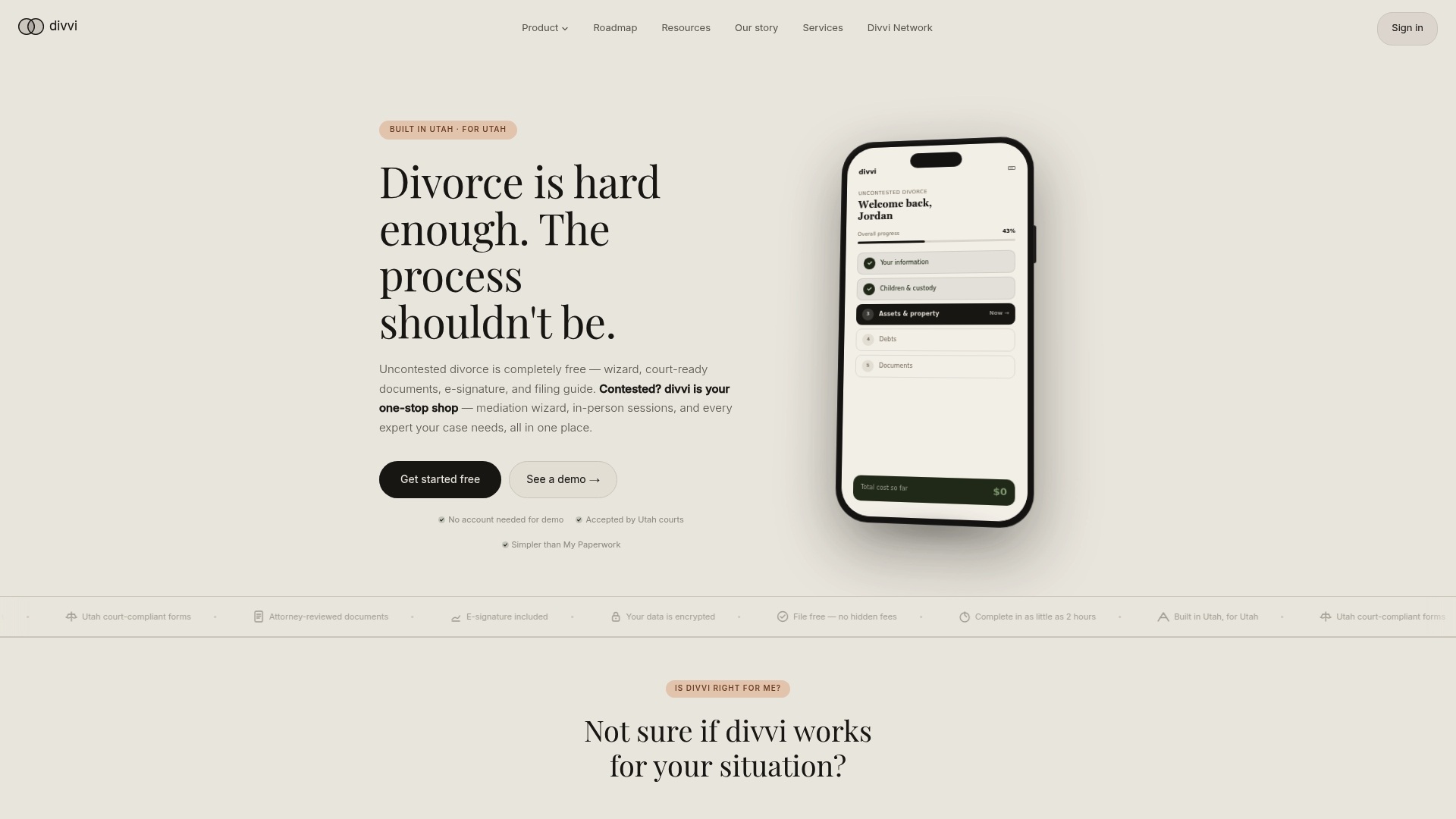
The free uncontested wizard generates documents designed for filing in as little as two hours, covering property division, child custody, and support terms. When you need more, Divvi's paid services include attorney referrals, mediation connections, financial advisor referrals, and a family management plan tool for co-parenting after the decree. You pay only for what your situation actually requires. For couples who want the filing handled entirely, the divviFile service submits your documents to the Utah court on your behalf.
Start with the free tools at Divvi and add professional support only where your case needs it.
Helpful resources and where to start
Safety resources:
- National Domestic Violence Hotline: 1-800-799-7233 (call or text)
- Your local family court's self-help center for protective order guidance
- Domestic violence legal assistance for immediate legal support
Mediation and collaborative practice:
- Association for Conflict Resolution (ACR): mediator directory and certification standards
- International Academy of Collaborative Professionals (IACP): collaborative attorney and professional directory
- Your state bar's family law section for referrals to collaboratively trained attorneys
Divvi tools for Utah users:
- Free uncontested divorce wizard and family management plan — start here for document preparation
- divviFile court filing service — hands-off filing for Utah courts
- Post-divorce budgeting resources — financial planning after the decree
- Divorce planning checklist — document and process checklist
How to choose where to start:
- Safety concern? Call the hotline or a domestic violence attorney before anything else.
- Simple, agreed case in Utah? Start with Divvi's free wizard.
- Moderate conflict or complex assets? Contact a certified mediator or collaborative attorney for an initial consultation.
- Need estate planning integrated with your divorce? A divorce and estate planning attorney can address both at once.
This article provides general information about divorce processes in the United States and is not legal advice. Laws and procedures vary by state. Confirm the current rules with a licensed family law attorney in your jurisdiction before making decisions about your own situation.