Military Divorce Checklist: A Complete Guide for 2026
Written and reviewed by the divvi team. How we research and check this.

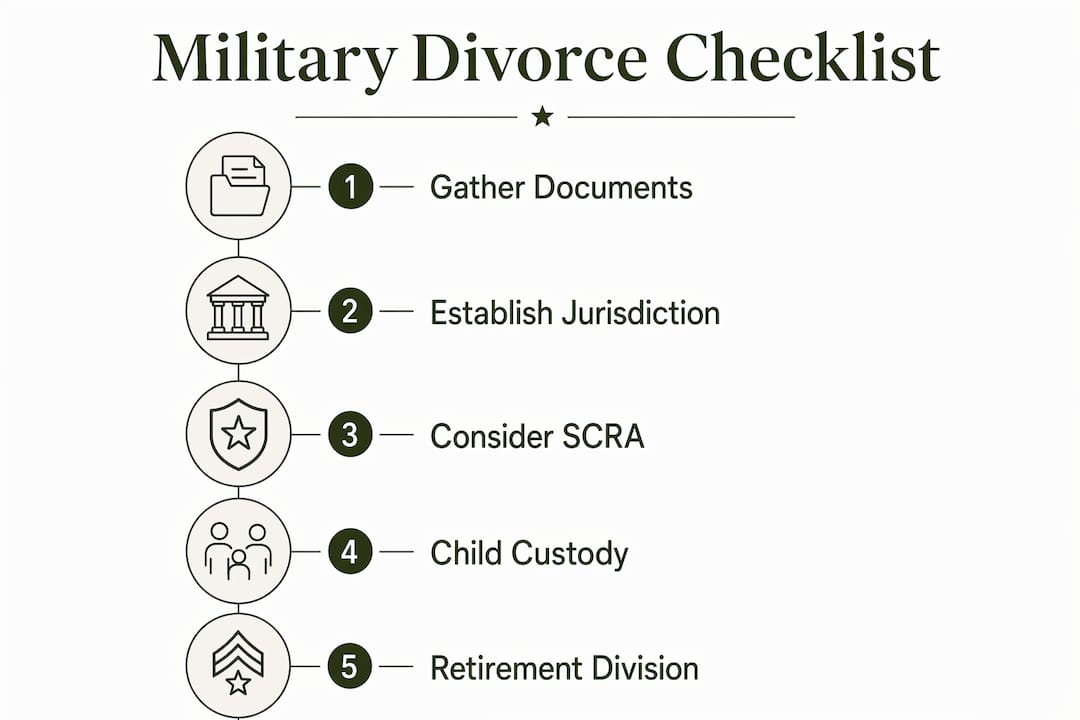
A military divorce checklist is a structured list of legal, financial, and personal steps required to dissolve a marriage when one or both spouses serve in the U.S. armed forces. Military divorces differ from civilian divorces in critical ways: federal statutes like the Servicemembers Civil Relief Act (SCRA) and the Uniformed Services Former Spouses' Protection Act (USFSPA) govern key parts of the process, and documents like the Leave and Earnings Statement (LES) replace standard pay stubs. Getting this checklist right from the start saves time, money, and significant legal headaches.
What are the legal requirements for a military divorce?
Jurisdiction is the first decision you make in the military divorce process, and it is more complicated than in civilian cases. You have three options: file in the state where the service member is stationed, the state where the civilian spouse lives, or the state the service member claims as their legal residence (home of record). Each option carries different residency rules, property laws, and timelines.

Most states require at least 6 months of residency before you can file for divorce. Military service counts toward that period, which means time spent stationed in a state qualifies even if you never intended to make it your permanent home. Navy and Marine Corps members can use their ship's home port as a qualifying jurisdiction.
Key jurisdiction factors to confirm before filing:
- Home of record: The state listed on enlistment papers. This is often the most favorable jurisdiction for the service member.
- Domicile vs. station: Courts distinguish between where you are stationed and where you legally reside. These are not always the same state.
- Deployment timing: Filing while a service member is deployed triggers SCRA protections that can pause proceedings.
- State property laws: Community property states (like Arizona and California) divide assets differently than equitable distribution states (like Utah).
- Residency documentation: Gather utility bills, tax filings, and military orders to prove residency in your chosen jurisdiction.
Utah divorce laws in 2026 follow equitable distribution rules, which means the court divides property fairly but not necessarily equally. If you are filing in Utah, the 90-day residency requirement is shorter than most states, which can work in your favor.
How does the SCRA impact divorce proceedings?
The Servicemembers Civil Relief Act is the most misunderstood federal law in military divorce. Many spouses assume it simply delays everything indefinitely. The reality is more specific and more manageable.
Under the SCRA, an active-duty member can request a minimum 90-day stay if military duties prevent participation in court proceedings. The court can grant additional stays at its discretion, but those extensions require documented proof that the service member's duties still prevent participation. A blanket deployment does not automatically freeze a case forever.
Courts also carry a legal obligation before issuing any default judgment. Courts must verify military status and appoint an attorney before a default judgment can proceed against a service member. This protection prevents a civilian spouse from winning a divorce by default simply because the service member did not respond while deployed.
Pro Tip: A deployed service member who wants to move the divorce forward can participate remotely. Remote participation options exist specifically for this purpose, and using them signals good faith to the court, which matters for custody and support rulings.
Practical SCRA points every military spouse should know:
- The 90-day stay is a floor, not a ceiling. Courts can and do extend it.
- A service member who ignores proceedings entirely loses credibility with the judge.
- SCRA does not pause financial obligations like child support or spousal support already in place.
- Civilian spouses can still gather documents, consult attorneys, and prepare filings during a stay.
- An attorney who does not know SCRA can make procedural errors that damage either party's position.
What key documents must be gathered for a military divorce?
Document preparation is where most military divorces stall. Missing a single form can delay proceedings by months. Gather these before you file anything.
- Marriage certificate — Required by every court to establish the legal marriage.
- Birth certificates — Needed for all children named in custody or support orders.
- Last 6 months of LES — The LES details base pay, BAH, BAS, and special pays that directly affect support calculations. Attorneys unfamiliar with the LES format routinely undercount income.
- Last 3 years of tax returns — Establishes income history and identifies additional income sources.
- Retirement point summary — Reserve and National Guard retirement point summaries are required to calculate the coverture fraction under 10 U.S.C. § 1408, which governs how the pension is divided. Missing this document weakens any pension claim.
- TSP (Thrift Savings Plan) statements — The military equivalent of a 401(k) and subject to division.
- Bank statements (6 months) — Required for community property and debt allocation.
- DEERS enrollment records — Confirms dependent status and affects post-divorce benefit eligibility.
- SGLI beneficiary designation — Servicemembers' Group Life Insurance beneficiary must be updated after divorce.
- VA disability rating letter — Disability pay is excluded from divisible retired pay under federal law. This document protects that income.
- Mortgage or lease documents — Establishes housing obligations and property value for asset division.
Pro Tip: Request your LES history through the MyPay portal and your retirement point summary through the Defense Finance and Accounting Service (DFAS). Both are free and can be pulled within days.
| Document | Why it matters |
|---|---|
| LES (6 months) | Captures all pay types for accurate support calculation |
| Retirement point summary | Required for USFSPA pension division calculation |
| VA disability letter | Excludes disability pay from divisible marital assets |
| DEERS records | Determines post-divorce health benefit eligibility |
| SGLI beneficiary form | Must be updated immediately after divorce is final |
A complete divorce document checklist covers most of these items and can serve as a useful cross-reference even for military cases.
How do child custody and support issues differ in military divorces?
The best interests of the child standard applies in military divorces, just as it does in civilian cases. The difference is that military life adds layers of unpredictability that a standard parenting plan cannot handle.
A military parenting plan must include specific clauses for deployment notice timelines, temporary custody shifts, travel cost allocations, and reunification scheduling. A civilian parenting plan that simply says "alternating weekends" falls apart the moment one parent receives deployment orders. Courts expect military parents to anticipate these scenarios in writing before the order is signed.
Child support in military cases uses the same income-based formula as civilian cases, but the income figure is larger than most people expect. Base pay is just the starting point. BAH (Basic Allowance for Housing) and BAS (Basic Allowance for Subsistence) are both considered income in most states, which significantly raises the support calculation. The LES is the document that captures all of this.
Key custody considerations for military families:
- Deployment custody shifts: Specify in the parenting plan who receives temporary custody during deployment and for how long after return.
- Notice requirements: Most courts require 30 to 90 days notice before a relocation or deployment affects custody.
- Virtual visitation: Courts increasingly include video call schedules as part of the parenting plan for deployed parents.
- Reunification plans: A structured schedule for reintegrating the service member into the child's routine after deployment reduces conflict.
- Mediation: Mediation is effective and underutilized in military divorce cases, particularly for custody disputes where both parties want to avoid court.
Divvi's family management plan tool generates deployment-ready parenting plans that address these clauses directly, which is a practical starting point for military families in Utah.
What should military spouses know about dividing military retirement?
Military retirement is often the largest asset in a military divorce, and the rules governing its division are entirely federal. The Uniformed Services Former Spouses' Protection Act (USFSPA) authorizes state courts to treat military retired pay as marital property, but the method of calculation matters enormously.
The coverture fraction determines the marital share of the pension. It divides the years of creditable service during the marriage by the total years of service at retirement. For Reserve and Guard members, this calculation uses retirement points rather than years, which is why the retirement point summary is non-negotiable.
Key USFSPA rules every military spouse must know:
- The 10/10 rule: Direct payment from DFAS to the former spouse requires at least 10 years of marriage overlapping with 10 years of creditable service. Below that threshold, the service member pays directly.
- The 20/20/20 rule: A former spouse married for 20 years to a service member with 20 years of service, with 20 years of overlap, qualifies for full TRICARE health coverage post-divorce.
- The 20/20/15 rule: A former spouse with 15 to 20 years of overlap qualifies for one year of transitional TRICARE coverage.
- Disposable retired pay: Only disposable retired pay is divisible. VA disability compensation is excluded, and courts cannot award a percentage of disability pay as a substitute for retirement pay.
- Survivor Benefit Plan (SBP): The divorce decree must specifically address SBP election. If the service member does not elect SBP coverage for the former spouse within one year of the divorce, that coverage is permanently lost.
Divvi's QDRO and retirement division tools help Utah residents understand how these federal rules interact with state property law before they sign any agreement.
Key Takeaways
A complete checklist for military divorces must address federal law, specialized documents, and deployment-specific custody terms that civilian divorce guides simply do not cover.
| Point | Details |
|---|---|
| Jurisdiction comes first | Choose your filing state based on residency, home of record, and applicable property laws. |
| SCRA is a pause, not a stop | The 90-day stay protects service members but does not eliminate financial obligations already in place. |
| LES is your most critical document | It captures all pay types that affect support calculations, including BAH and BAS. |
| Parenting plans must address deployment | Include notice rules, temporary custody shifts, and reunification schedules before the order is signed. |
| USFSPA governs pension division | The 10/10 rule, coverture fraction, and SBP election deadlines are non-negotiable terms to address in the decree. |
Where military divorces go wrong
Military divorces fail at the document stage more than any other point. A spouse who walks into mediation without a retirement point summary can effectively hand away tens of thousands of dollars in pension rights because no one could calculate the coverture fraction. That is not a legal failure. It is a preparation failure.
The SCRA creates a false sense of security for service members and a false sense of urgency for civilian spouses. Neither reaction helps. A deployed service member who ignores proceedings entirely does not come back to a frozen case. They come back to a default judgment that a court already verified and signed. Participation, even remote participation, is always the better choice.
The emotional weight of a military divorce is real and specific. Deployments, frequent moves, and the stress of service create a kind of marital strain that civilian courts are not always equipped to understand. That is why finding an attorney who specializes in military family law is not a luxury. It is a baseline requirement. A general family law attorney who has never read an LES will cost you more in the long run than a specialist costs upfront.
My honest advice: start the document checklist the moment you decide divorce is likely. Do not wait for a filing date. The LES, retirement point summary, and DEERS records take time to pull, and having them ready before you need them puts you in control of the timeline instead of reacting to it.
— Landon
How Divvi supports military families through divorce
Military divorces involve more paperwork, more federal rules, and more moving parts than most people expect. Divvi is built to handle exactly that complexity.

Divvi's platform generates documents designed for filing for Utah residents, including parenting plans with deployment-specific clauses and asset division agreements that account for military retirement rules. divvi is not a law firm and doesn't give legal advice. The base model is free to use. AI negotiation (Divvi Resolve) is included free with contested divorce. Optional help includes a document audit, divorce mediation, or filing assistance.
FAQ
What is a military divorce checklist?
A military divorce checklist is a structured list of legal, financial, and personal steps specific to divorces involving active-duty or reserve service members. It covers documents like the LES and retirement point summary, federal law requirements under the SCRA and USFSPA, and deployment-specific custody terms.
How long does a military divorce take?
Timeline varies by state, complexity, and whether SCRA stays are invoked. An uncontested military divorce in a cooperative jurisdiction can resolve in a few months, while a contested case with SCRA delays can take a year or more.
Can a military spouse get half of the retirement?
State courts can divide military retired pay as marital property under USFSPA, but the actual share depends on the coverture fraction calculated from years of service during the marriage. The 10/10 rule determines whether DFAS pays the former spouse directly.
Does deployment stop a divorce from moving forward?
Deployment triggers SCRA protections, including a minimum 90-day stay of proceedings. However, deployed spouses can participate remotely to keep the case moving if they choose to do so.
What happens to TRICARE after a military divorce?
Eligibility depends on the length of the marriage and service overlap. The 20/20/20 rule grants full TRICARE coverage, while the 20/20/15 rule provides one year of transitional coverage. Former spouses who do not meet either threshold lose TRICARE eligibility on the date the divorce is final.