Is Utah a No-Fault Divorce State? 2026 Guide
Written and reviewed by the divvi team. How we research and check this.

Utah is a no-fault divorce state, meaning you can legally end your marriage without proving any wrongdoing by either spouse. The primary ground is irreconcilable differences, which requires no evidence of misconduct. Under Utah Code § 81-4-405, the state also preserves nine fault-based grounds for situations where misconduct is legally relevant. Most Utah residents file on no-fault grounds because the process is faster, cheaper, and far less adversarial than pursuing a fault-based case.
Is Utah a no-fault divorce state, and what does that mean legally?
No-fault divorce is defined as the legal dissolution of a marriage without either spouse proving the other did something wrong. In Utah, irreconcilable differences is the most common ground used, and it requires no proof of misconduct whatsoever. You simply state that the marriage has broken down beyond repair.
This matters because it removes the courtroom drama that defined divorce proceedings before no-fault laws existed. Before these laws, one spouse had to prove adultery, cruelty, or abandonment just to get a divorce granted. Utah modernized its approach by allowing both systems to coexist, giving you a real choice based on your circumstances.

The second no-fault option is less known but worth understanding. Utah law also allows divorce when spouses have lived separately under a maintenance decree for three years. That ground applies in specific long-term separation situations and is rarely used compared to irreconcilable differences.
What are the grounds for divorce in Utah?
Utah Code § 81-4-405(1) lists ten grounds. One of them requires proving nothing; the rest require evidence.
Two things about the list are easy to miss. Every ground runs against the respondent — the statute speaks of adultery "committed by the respondent", desertion "of the petitioner by the respondent". And the grounds are alternatives, not a sequence: you plead the one that fits.
The no-fault ground
- Irreconcilable differences of the marriage — § 81-4-405(1)(h). No proof of wrongdoing, no evidence of who did what. This is how the overwhelming majority of Utah divorces are filed.
The fault-based grounds
- Impotency of the respondent at the time of marriage — (1)(a). Note the timing: the condition must have existed when you married. Impotency arising later in the marriage is not this ground.
- Adultery committed by the respondent after the marriage — (1)(b)
- Willful desertion of the petitioner by the respondent for more than one year — (1)(c)
- Willful neglect by the respondent to provide the common necessaries of life — (1)(d)
- Habitual drunkenness of the respondent — (1)(e)
- Conviction of the respondent for a felony — (1)(f)
- Cruel treatment of the petitioner by the respondent, to the extent of causing bodily injury or great mental distress — (1)(g)
- Incurable insanity — (1)(i)
The separation ground
- Three consecutive years living separately under a decree of separate maintenance, without cohabitation — (1)(j). This sits in neither camp comfortably: it requires no allegation of wrongdoing, but it does require an existing separate-maintenance decree and three years. Subsection (2) adds that a divorce granted on this ground does not affect either party's liability under that earlier maintenance order.
Insanity is procedurally different from the rest
Subsection (3) sets requirements no other ground carries. A court may not grant a divorce for insanity unless the respondent was adjudged insane before the action began and the court finds, on the testimony of competent witnesses, that the insanity is incurable.
Beyond that, the court shall appoint a guardian ad litem to protect the respondent, the summons and petition must be served on the county attorney as well as the respondent, and that county attorney must investigate the case, attend the proceedings, and mount a defence. Either party may have the respondent examined by two or more physicians, and may obtain leave to enter an institution where the respondent is confined.
It is, in practice, close to unusable — which is the point of the safeguards.
Each fault ground requires evidence: witnesses, documentation, and usually a contested hearing, with the burden on the spouse making the claim. That is why irreconcilable differences is the default. But fault does not disappear from the case just because you file no-fault — under § 81-4-502(2)(a) a court may weigh fault when deciding alimony.
Pro Tip: If you are unsure which ground applies to your situation, consult a Utah family law attorney before filing. Choosing the wrong ground can delay your case or require you to refile.
How does no-fault divorce simplify the process in Utah?
Filing on no-fault grounds removes the single biggest source of conflict in most divorces: blame. When you file on irreconcilable differences, the focus shifts entirely to resolving practical issues like property division, alimony, and child custody. That shift changes the entire tone of the proceedings.
Here is how the no-fault path simplifies your case step by step:
- No evidence gathering for misconduct. You do not need to document affairs, collect witness statements about behavior, or hire investigators. That alone cuts legal fees significantly.
- Shorter discovery process. Fault cases often involve extensive discovery to prove wrongdoing. No-fault cases focus discovery on finances and assets instead.
- Lower attorney fees. Less litigation means fewer billable hours. Uncontested no-fault divorces are the least expensive type of divorce in Utah.
- Reduced emotional conflict. When neither party is publicly accused of wrongdoing, negotiations tend to stay more civil. That matters especially when children are involved.
- Greater privacy. Fault allegations become part of the public court record. No-fault filings keep personal details out of the courtroom.
Fault-based divorces usually increase litigation costs and timelines without significantly improving outcomes for most people. That is not an opinion. Family law practitioners consistently report that clients who pursue fault grounds rarely achieve materially better settlements than those who file on no-fault grounds.
The exception is when misconduct directly affects alimony or custody decisions, which the next section covers in detail.
Can fault still affect your divorce even if you file on no-fault grounds?
Yes, and this is one of the most misunderstood aspects of Utah divorce law. Filing on irreconcilable differences does not erase misconduct from the court's consideration entirely. Utah courts may consider marital misconduct when deciding alimony and custody, even when the divorce itself is filed on no-fault grounds.
Here is where fault evidence can still surface and influence outcomes:
- Alimony determinations: Under Utah Code § 81-4-502(2), courts weigh the fault of either party when setting spousal support. Adultery or financial misconduct can reduce or eliminate alimony for the at-fault spouse.
- Child custody and parent-time: Abuse, substance abuse, or neglect directly affects custody decisions. A judge will consider documented misconduct when determining what arrangement serves the child's best interest.
- Property division: Utah follows equitable distribution, not a strict 50/50 split. Misconduct is not the primary factor, but it can influence how a judge views fairness in dividing assets.
Filing on no-fault grounds does not mean misconduct disappears from the case. It means you are not required to prove fault to get divorced. The court can still hear evidence of misconduct when it affects financial or custody outcomes.
It is also legally possible to switch from fault to no-fault grounds during proceedings. Some attorneys use fault grounds as an opening negotiation position, then shift to no-fault once a settlement framework is in place. This tactic can reduce final litigation costs while preserving leverage during early negotiations. It requires careful timing and legal guidance to execute well.
What are the procedural steps and timeline for a no-fault divorce in Utah?
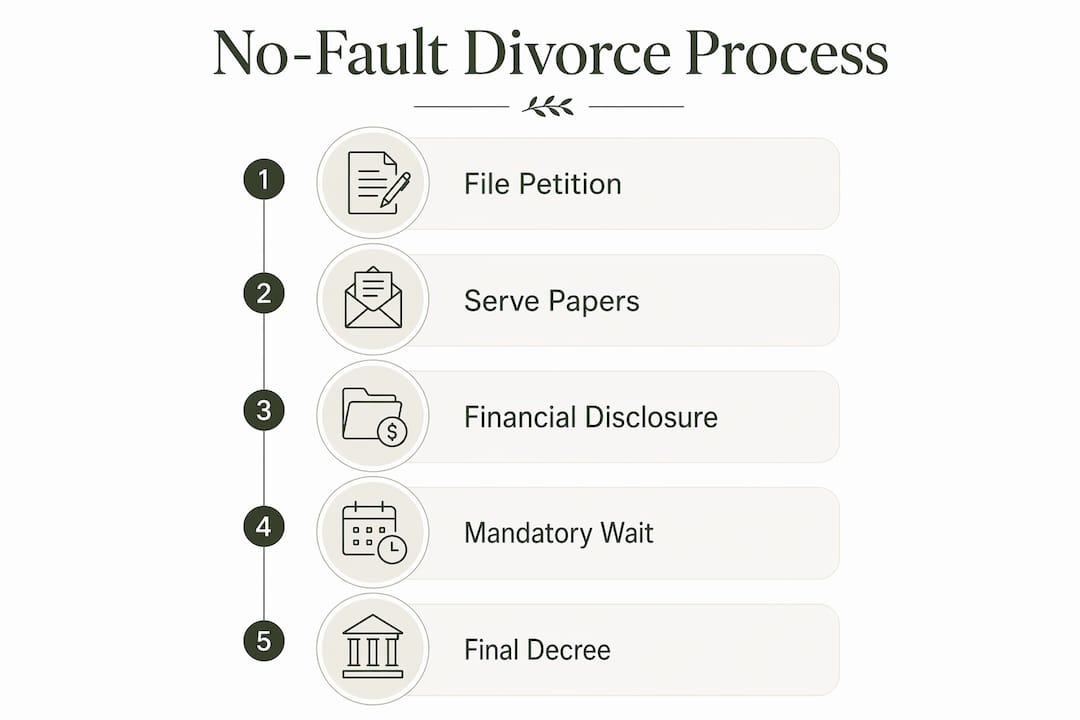
The procedural path for a Utah no-fault divorce follows a defined sequence. Understanding each step helps you set realistic expectations.
Key requirements and steps
- Residency: At least one spouse must have been a bona fide resident of the county where you file for at least 90 days before filing (Utah Code § 81-4-402(1)(a)) — county residency, not just Utah residency. You file in the district court of the county where either spouse resides.
- Filing the petition: You submit a Petition for Divorce stating irreconcilable differences as the ground. No supporting evidence of misconduct is required.
- Serving your spouse: Your spouse must be formally served with the divorce papers. They then have 21 days to respond if served in Utah.
- Mandatory waiting period: A 30-day waiting period applies after filing before the court can grant the divorce. This applies to all divorces, fault or no-fault.
- Decree of divorce: Once all issues are resolved and the waiting period passes, the court issues the final decree.
Typical timeline comparison
| Divorce type | Estimated timeline | Key driver |
|---|---|---|
| Uncontested no-fault | 30–90 days | Agreement on all terms |
| Contested no-fault | 6–18 months | Disputes over assets or custody |
| Fault-based contested | 12–24+ months | Evidence gathering and hearings |
The uncontested no-fault divorce is the fastest path available in Utah. When both spouses agree on property division, custody, and support, the case moves through the court with minimal friction. Most uncontested cases resolve within 60 days of filing once the waiting period is satisfied.
Pro Tip: Prepare a complete picture of assets and debts before filing. When an answer is filed, URCP 26.1 requires each party to serve initial disclosures within 14 days after that answer. It is unclear how that applies when no answer is filed and the parties stipulate.
You can also review how long finalization takes based on your specific circumstances to plan accordingly.
Key Takeaways
Utah's no-fault divorce law gives most residents a faster, lower-cost path by filing on irreconcilable differences, though fault evidence can still influence alimony and custody outcomes under Utah Code § 81-4-502(2).
| Point | Details |
|---|---|
| Utah allows both systems | You can file on no-fault or fault grounds under Utah Code § 81-4-405. |
| No-fault means no proof needed | Irreconcilable differences requires no evidence of wrongdoing to file. |
| Fault still affects outcomes | Courts consider misconduct for alimony and custody even in no-fault filings. |
| Mandatory 30-day wait | All Utah divorces require a 30-day waiting period after filing before a decree is issued. |
| Uncontested is fastest | Agreed no-fault divorces typically resolve in 30–90 days at the lowest cost. |
Why no-fault is almost always the right starting point in Utah
People walk into a fault-based filing convinced that proving adultery or cruelty will give them a stronger position. In most cases, it does not. The financial and emotional cost of building a fault case rarely translates into a meaningfully better settlement. Courts in Utah are experienced at separating the question of who did what from the question of what is fair going forward.
That said, fault is not irrelevant. If your spouse's misconduct directly affects your financial security or your children's safety, documenting it matters. A history of substance abuse or domestic violence belongs in front of a judge when custody is being decided. The key is using that evidence strategically, not as the centerpiece of your entire case.
The most effective approach is this: file on irreconcilable differences, focus your energy on the financial and custody terms, and let your attorney introduce misconduct evidence only where it genuinely changes the outcome. That approach keeps costs down, reduces conflict, and gets families to resolution faster. Fault grounds have narrow modern utility, mainly to address custody or alimony issues when misconduct evidence significantly impacts decisions.
If you are unsure whether fault grounds apply to your situation, talk to a qualified Utah family law professional before you file. The choice of ground sets the tone for everything that follows.
— Landon
How Divvi makes no-fault divorce filing straightforward
Filing a no-fault divorce in Utah does not require a law degree or a large legal budget. Divvi was built specifically for Utah residents who want a clear, guided process without the confusion of traditional paperwork or the expense of full attorney representation.
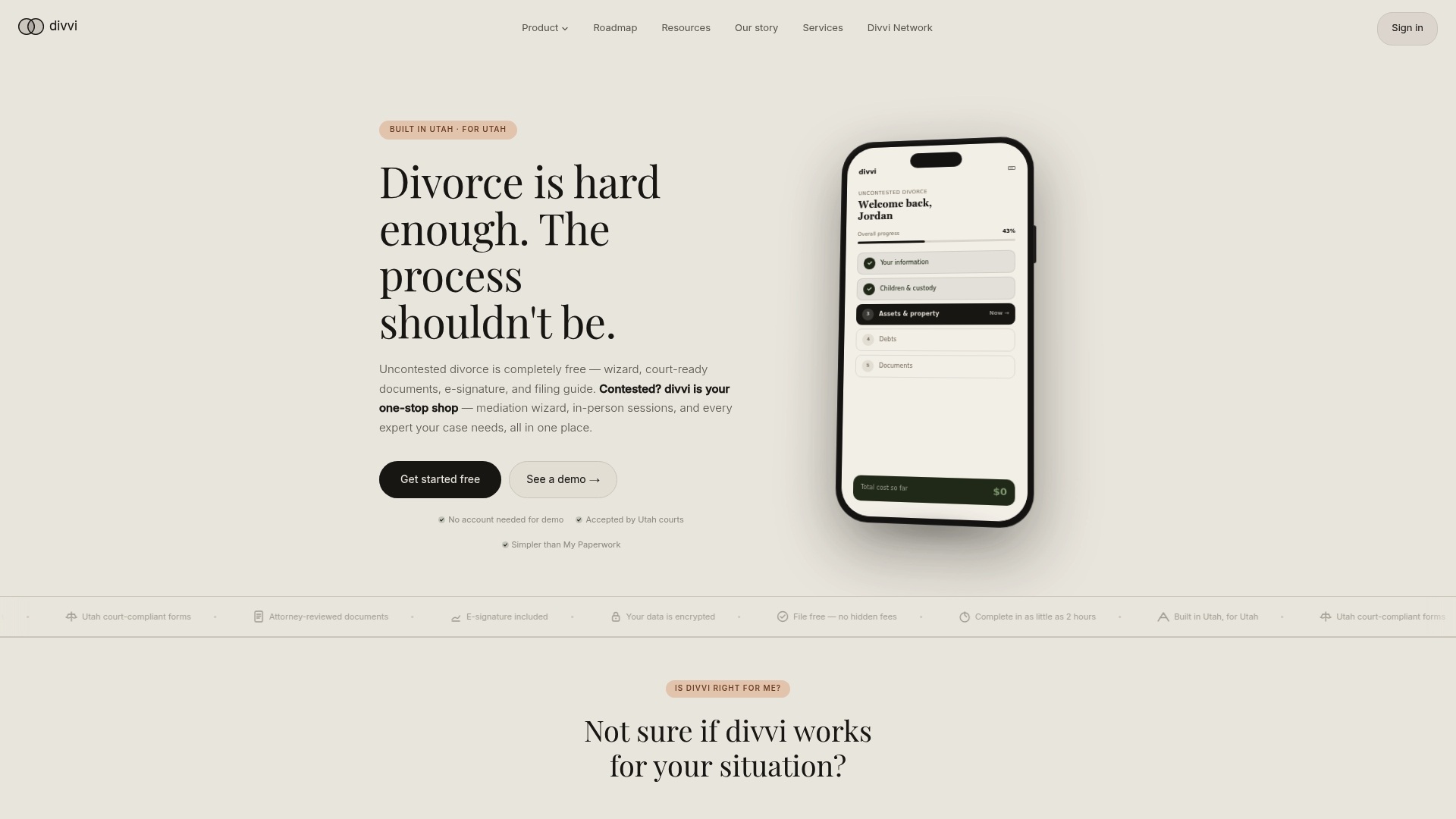
Divvi's free uncontested divorce wizard walks you through every required document, generates documents designed for filing, and covers situations involving child custody, asset division, and spousal support. Optional links to Utah legal resources mean you can have a lawyer check what you submit paperwork that meets Utah court standards. The base platform is free to use, and you pay only for the specific services you need, whether that is mediation, document review, or connecting with a Utah family law attorney. For residents ready to move forward, Divvi is the most direct path from decision to decree.
FAQ
What does no-fault divorce mean in Utah?
No-fault divorce in Utah means you can end your marriage by citing irreconcilable differences without proving any wrongdoing by either spouse. Utah Code § 81-4-405 authorizes this ground alongside nine fault-based alternatives.
How long does a no-fault divorce take in Utah?
An uncontested no-fault divorce in Utah typically takes 30–90 days from filing to final decree. A mandatory 30-day waiting period applies to all Utah divorces regardless of the grounds used.
Can I still use fault evidence if I file on no-fault grounds?
Yes. Utah courts can consider marital misconduct when determining alimony under Utah Code § 81-4-502(2) and when making custody decisions, even if the divorce petition cites irreconcilable differences.
What are the fault grounds for divorce in Utah?
Utah recognizes nine fault grounds including adultery, willful desertion, habitual drunkenness, felony conviction, and cruel treatment. Each requires proof presented in court, which adds time and cost to the process.
Can I switch from fault to no-fault grounds after filing?
Yes. Utah law permits you to change your stated grounds during proceedings. Some attorneys file on fault grounds initially as a negotiation tool, then switch to no-fault to reduce final litigation costs and reach settlement faster.