How to Prepare for Divorce Court Without a Lawyer
Written and reviewed by the divvi team. How we research and check this.

You can represent yourself in divorce court in every U.S. state. The catch: courts hold self-represented litigants (pro se) to the same procedural rules and evidence standards as licensed attorneys. The judge will not walk you through legal strategy or fill in your gaps. Three things to do right now: (1) pull up your court's local rules and required forms from the clerk's website, (2) gather financial records, identity documents, and marriage proof, and (3) confirm service requirements and filing deadlines directly with the clerk's office. Tools like Divvi's free wizard can generate documents designed for filing and guide you through your specific situation before you ever walk into a courtroom.
- Check your county court's self-help page for the exact form versions required.
- Confirm whether your court uses e-filing or paper filing.
- Ask the clerk about fee waivers if cost is a concern.
Table of Contents
- Is pro se divorce the right choice for your case?
- How do you file and serve divorce papers on your own?
- Getting ready for the hearing: what to bring and how to tell your story
- Should you try mediation before going to court?
- What does a pro se divorce actually cost, and how long does it take?
- Common pro se mistakes that derail cases
- When should you hire a lawyer, even partially?
- Key Takeaways
- The part most guides skip
- Divvi prepares your filing documents faster than starting from scratch
- Useful sources and official links
Is pro se divorce the right choice for your case?
Self-representation works best when both spouses broadly agree on the main issues: property division, debt, and if children are involved, custody and support. An uncontested divorce with no minor children, modest shared assets, and a cooperative spouse is the clearest green light for going pro se.
The picture changes fast when complexity enters. Judges must remain neutral and cannot advise you on legal strategy, so if you walk in unprepared, you are on your own. Consider these red flags that push hard toward hiring an attorney:
- High-conflict parenting disputes or allegations involving child safety
- Complex financial assets: business interests, stock options, pension plans, or real estate requiring appraisal
- Domestic violence, protective orders, or safety concerns
- Disputed property valuations where each side has different numbers
- Active discovery fights or motions you do not understand
Two quick scenarios to calibrate your situation. Scenario A: you and your spouse have been separated for a year, own one car together, rent your home, and have no children. You've agreed on who keeps what. That is a strong pro se case. Scenario B: you share a small business, a house with disputed equity, and a custody arrangement your spouse contests. That case almost certainly needs at least limited attorney involvement, even if you handle most of it yourself.
How do you file and serve divorce papers on your own?
Filing pro se is a sequence, not a single task. Follow these steps in order.
- Identify the correct jurisdiction. File in the county where you or your spouse lives and has met the residency requirement. Check your state's specific threshold.
- Get the right forms. Most state court websites offer free, approved forms. Always confirm the exact form version and page-limit rules with the clerk before printing anything.
- Complete forms accurately. Fill every field. Leave nothing blank unless it genuinely does not apply, and write "N/A" in those spaces. Sign in blue or black ink only.
- File with the clerk. Bring the original plus two copies of each form. Pay the filing fee or submit a fee-waiver application at the same time.
- Serve the other party. Court papers must be served by a neutral third party — a friend over 18, the county sheriff, or a process server. You cannot serve your own spouse.
- File proof of service. After service is complete, file the signed proof-of-service form with the clerk. This step is mandatory before the court will schedule a hearing.
- Respond to counter-filings. If your spouse files an answer or counterclaim, read it carefully and respond within the deadline the court sets.
Pro Tip: Ask the clerk whether your court offers e-filing. Many jurisdictions now allow online submission, which creates a timestamped record and eliminates the risk of a lost paper filing. Also ask about fee-waiver eligibility on the same visit.
Document checklist by category
| Category | What to gather |
|---|---|
| Identity | Government-issued ID, Social Security cards for all parties |
| Marriage proof | Marriage certificate, any prior divorce decrees |
| Financial records | Two years of tax returns, recent pay stubs, bank statements (3–6 months), retirement account statements |
| Property and debt | Mortgage statements, vehicle titles, credit card statements, loan documents |
| Parenting documents | School records, medical records, parenting logs, proposed parenting plan |
| Proposed orders | Draft decree or proposed judgment you want the judge to sign |
Getting ready for the hearing: what to bring and how to tell your story
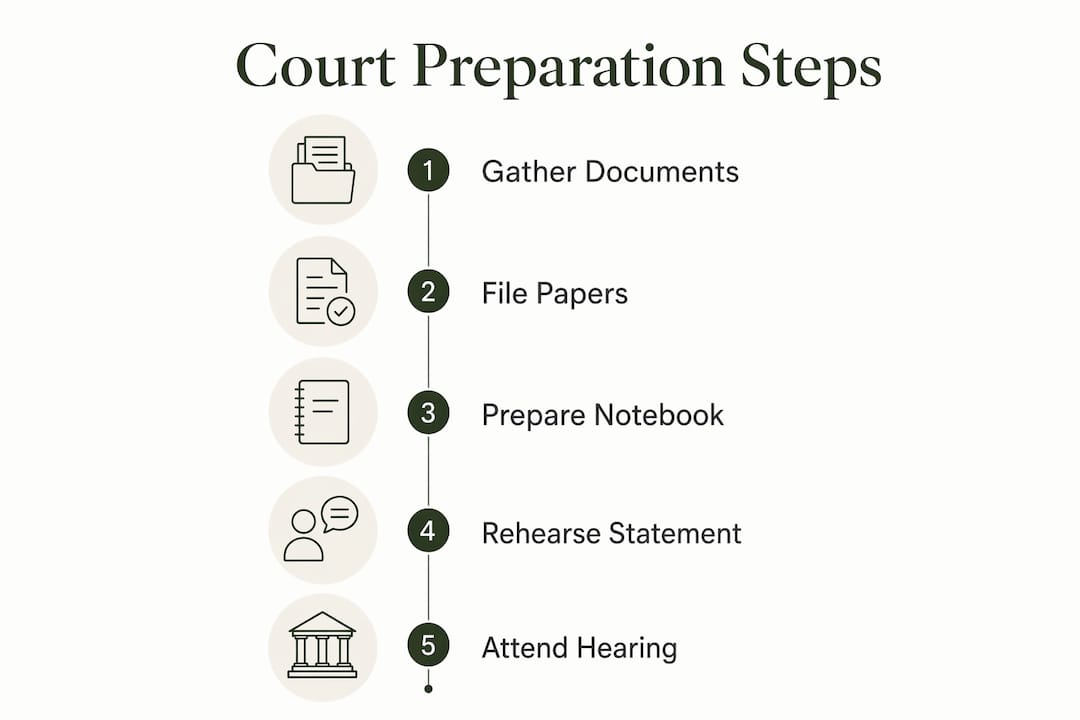
Walk in with a trial notebook. That is a binder organized with a table of contents, your exhibits labeled and tabbed, your proposed orders, copies of all filed documents, your ID, filing receipts, and a witness list with contact details. Bring three copies of every document: one for the judge, one for your spouse or their attorney, and one for yourself.

Pro Tip: Rehearse a 1–2 minute opening statement out loud, not just in your head. Practitioners consistently find that rehearsed opening statements help pro se litigants communicate their requests calmly and clearly under pressure.
A sample opening structure: "Your Honor, my name is [Name]. I am the petitioner in this case. I am asking the court to grant a divorce, award me [specific property or custody arrangement], and approve the proposed parenting plan I have submitted. I have three exhibits to support my requests." That is it. Short, factual, specific.
A few more things to get right before you walk in: arrive early and clear security to find the correct courtroom.
- Arrive 30 minutes early to clear security and find the correct courtroom.
- Dress as if you are interviewing for a professional job.
- Address the judge as "Your Honor" every time.
- Stand when speaking unless told otherwise.
- If your court offers remote appearances, confirm the technology requirements at least a week ahead.
- Organize your evidence so you can find any document within seconds, even when you are nervous.
When the judge asks questions, answer only what is asked. Keep answers factual and brief. Emotional arguments about your spouse's behavior rarely move a judge; documented facts do.
Should you try mediation before going to court?
Mediation often resolves contested issues faster and cheaper than a trial. For self-represented parties, it also removes the pressure of arguing legal procedure in front of a judge. Four formats exist:
- Court-ordered mediation: Many courts require this before a contested hearing. It is often subsidized or low-cost.
- Private in-person mediation: You hire a neutral mediator directly. More flexible scheduling, but costs more.
- Online/virtual mediation: Convenient when parties live in different cities; increasingly common post-2020.
- Settlement conferences: A judge or magistrate facilitates negotiation, often in a courthouse conference room.
Once you reach an agreement, getting it ready to file requires these steps:
- Put every term in writing before you leave the session.
- Both parties sign the agreement.
- Check whether your state requires notarization.
- Convert the agreement into a proposed order or decree using the court's required format.
- File the signed proposed order with the clerk and request a judge's signature.
Pro Tip: Ask the mediator to draft the proposed order language before you leave. If financial terms or parenting arrangements are complex, a one-hour limited-scope attorney review of that draft is money well spent. A poorly worded agreement can be nearly impossible to enforce later.
Some jurisdictions also offer informal trial processes designed specifically for self-represented litigants. Check your state's self-help resources to see whether a simplified hearing format is available in your county.

What does a pro se divorce actually cost, and how long does it take?
| Item | Uncontested | Contested |
|---|---|---|
| Filing fee | — | Same initial fee |
| Service/process server | — | —+ per attempt |
| Document preparation | Free to low-cost | Higher if complex |
| Total timeline | Weeks to a few months | Several months to years |
Filing fees vary widely by state and county. North Carolina's filing fee for an absolute divorce runs around $225. California's initial filing fee applies, though fee waivers are available for qualifying low-income filers. Always verify the current fee schedule with your specific clerk's office, since fees change.
For timeline, an uncontested case with no children and agreed terms can sometimes close in as little as a few months after the mandatory waiting period. A contested case with discovery, motions, and a trial can stretch well past a year. Check your local court's docket backlog, which varies enormously by county.
Common pro se mistakes that derail cases
Most self-represented litigants do not lose because they argued poorly. They lose because of procedural errors that could have been avoided.
- Missing a response deadline and having a default entered against them
- Using an outdated form version the court no longer accepts
- Serving papers incorrectly (you cannot serve your own spouse)
- Showing up without enough copies of exhibits
- Submitting disorganized evidence the judge cannot follow
- Including irrelevant emotional detail in declarations that dilutes the factual record
- Failing to draft a proposed order, which forces the judge to write one without your input
Pro Tip: Build your trial notebook with a numbered table of contents and three copies of each exhibit before you do anything else. Label each exhibit clearly ("Exhibit A — Bank Statement, January 2025") so you can hand the judge the right document without fumbling.
Red flags that mean you should stop and hire an attorney immediately: domestic violence allegations, a contested custody situation involving safety concerns, a business valuation dispute, or a retirement account division requiring a Qualified Domestic Relations Order (QDRO).
When should you hire a lawyer, even partially?
Limited-scope (unbundled) legal help lets you pay an attorney for one specific task rather than full representation. This keeps costs manageable while reducing the risk of a costly procedural mistake. Specific triggers to get help:
- You receive a motion you do not understand and have a response deadline approaching.
- Discovery requests arrive and you are unsure what to produce or object to.
- An emergency order (temporary restraining order, emergency custody) is filed against you.
- Safety concerns arise at any point.
- High-value assets like a pension, business, or real estate need formal valuation.
What limited-scope help looks like in practice: document review before filing, help drafting a declaration or proposed order, hearing coaching the day before trial, flat-fee consultations, or a referral clinic through your local bar association. Many court self-help centers also offer free form review and procedural guidance, though they cannot give legal advice.
Pro Tip: When you consult an attorney, ask one specific question: "What is the single biggest procedural or legal risk in my case right now, and what is the one thing I can do to address it?" That framing gets you a concrete answer instead of a general overview.
Key Takeaways
Preparing for divorce court without a lawyer is realistic for straightforward cases, but procedural compliance, organized evidence, and knowing when to get targeted help are what determine the outcome.
| Point | Details |
|---|---|
| Check local rules first | Confirm exact form versions and deadlines with your clerk before filing anything. |
| Build a trial notebook | Organize exhibits with a table of contents and bring three copies of every document. |
| Rehearse your opening | A 1–2 minute factual opening statement, practiced aloud, helps you stay calm and clear. |
| Use limited-scope help | Paying an attorney for one task (form review, hearing coaching) prevents costly mistakes. |
| Divvi for Utah filers | Divvi's free wizard generates documents designed for filing and connects you to attorney review and mediation matching. |
Caution: pro se representation carries real risk in contested cases. If safety, complex assets, or disputed custody are involved, stop and get counsel before your next filing.
The part most guides skip
Most pro se divorce guides focus on paperwork. The harder problem is psychological: you are trying to think clearly about legal procedure while also processing one of the most stressful events of your life. That combination is where people make the mistakes listed above.
The preparation that actually works is not just gathering documents. It is rehearsing your opening statement until it feels boring, building your trial notebook until finding any exhibit takes three seconds, and knowing exactly which two or three facts you need the judge to understand. Judges see hundreds of cases. The ones who get clear outcomes are the ones who made the judge's job easy.
Realistic limits matter here. If your case involves a business, a pension, a custody dispute with safety concerns, or a spouse who has hired an attorney, the cost of limited-scope legal help is almost always lower than the cost of a bad outcome. A single hearing-coaching session or a one-hour document review can change the trajectory of your case. Use those options before you need them, not after something goes wrong.
Divvi prepares your filing documents faster than starting from scratch
For Utah filers, the gap between "I need to file" and "I have documents designed for filing" is where most pro se cases stall. Divvi closes that gap with a free step-by-step wizard that generates the documents your court actually requires, reviewed by attorneys, without the hourly billing.

Here is what Divvi offers that maps directly to what you have read above:
- Free uncontested divorce wizard that produces documents designed for filing in about two hours
- Attorney referrals for contested cases or complex filings, available as a limited-scope add-on
- Mediation matching through a vetted mediator network for couples who want to settle before a hearing
- Filing guidance through divviFile for readers who want clerical help with submission
- Post-divorce tools including child support and alimony calculators, co-parenting resources, and modification support
The core platform is free. You pay only for the services you actually need. Before filing anything Divvi generates, verify the current form requirements with your county clerk. Start your Utah divorce with Divvi's free wizard today.
Useful sources and official links
Use these to verify local rules, download forms, and find state-specific guidance. No single source covers every jurisdiction, so always confirm county-specific requirements with your clerk's office.
- California Courts Self-Help Center — trial preparation guide for self-represented litigants
- North Dakota Courts — Preparing for Your Divorce Trial — evidence, witnesses, and hearing prep
- Texas Law Help — Representing Yourself in Family Court — proposed orders and filing timing
- Pennsylvania Courts — Divorce Proceedings — service rules and proof of service
- Oregon Law Help — Preparing for Your Divorce or Custody Trial — opening statements and informal trial formats
- AFCC — Representing Yourself: A Judge's Perspective — judicial neutrality and what judges expect
- LegalReach — Can You Represent Yourself in Divorce Court? — limited-scope services overview
- Arizona Courts Self-Service Center — state forms portal
- Divvi — Utah Divorce Made Simple — Utah-specific pro se guidance