How Long Does a Divorce Take to Be Finalized in Utah?
Written and reviewed by the divvi team. How we research and check this.

Timing varies by court and by case. Utah law generally doesn't let a judge enter a divorce decree until 30 days after the petition is filed (Utah Code § 81-4-402(3)(a)). The court can waive that wait only in extraordinary circumstances. After that, the time depends on serving your spouse, when the final papers are submitted, and the court's processing and the judge's review. Many uncontested divorces typically finish in about 6 weeks to 4 months from filing, but that isn't a promise. Contested divorces usually take longer.
The formal term for this process is "dissolution of marriage," and the timeline depends on whether you and your spouse agree on the major issues. Factors like mandatory parenting classes, financial disclosures, and court scheduling all push the actual finalization date well past the statutory minimum. The step-by-step version is on the Utah divorce timeline.
How long does a divorce take to be finalized in Utah?
Utah law sets a 30-day waiting period after filing before any divorce can be finalized. That waiting period is a floor, not a finish line. The court will not issue a final decree until all procedural requirements are met, regardless of how quickly both spouses agree on everything.
Uncontested divorces typically finish in about 6 weeks to 4 months from filing, but that isn't a promise. A contested divorce takes longer. How much longer depends on the disagreement and the court's calendar. divvi does not publish a set length for contested cases.

A court may waive the 30-day waiting period only after finding extraordinary circumstances (Utah Code § 81-4-402(3)(a)). The statute does not give examples. Plan your timeline around the assumption that the waiting period will run its full course.
Pro Tip: File your parenting class certificates and financial disclosures the same week you file your petition. Courts cannot schedule your final hearing until those documents are on record.
What legal steps and waiting periods shape the process?
Before the 30-day clock even starts, you must meet Utah's residency requirement. One spouse must have lived in Utah and in the filing county for at least 90 days before filing. Missing this requirement means your case gets dismissed and you start over.
The filing fee is $358 as of 2026 ($350 filing fee + $8 vital statistics surcharge). That fee initiates the case and triggers the waiting period. Once filed, the other spouse has 21 days to respond if served in Utah, or 30 days if served out of state.
Key legal requirements that affect your divorce process duration:
- Residency: 90 days in Utah and in the filing county before you can file
- Filing fee: $358 due at the time of filing ($350 filing fee + $8 vital statistics surcharge)
- Waiting period: 30 days under Utah Code § 81-4-402 before finalization
- Parenting classes: Mandatory for parents; proof of completion must be filed with the court
- Financial disclosures: Both parties must exchange complete financial declarations on a strict schedule
- Spouse response window: 21–30 days depending on where the other spouse is served
Each of these steps runs on its own clock. A delay in any one of them pushes your final decree further out. The Utah divorce laws governing these requirements changed in recent years, so confirm current rules before filing.
Pro Tip: Request certified copies of your final decree the same day the judge signs it. You will need them for name changes, bank accounts, and property transfers.
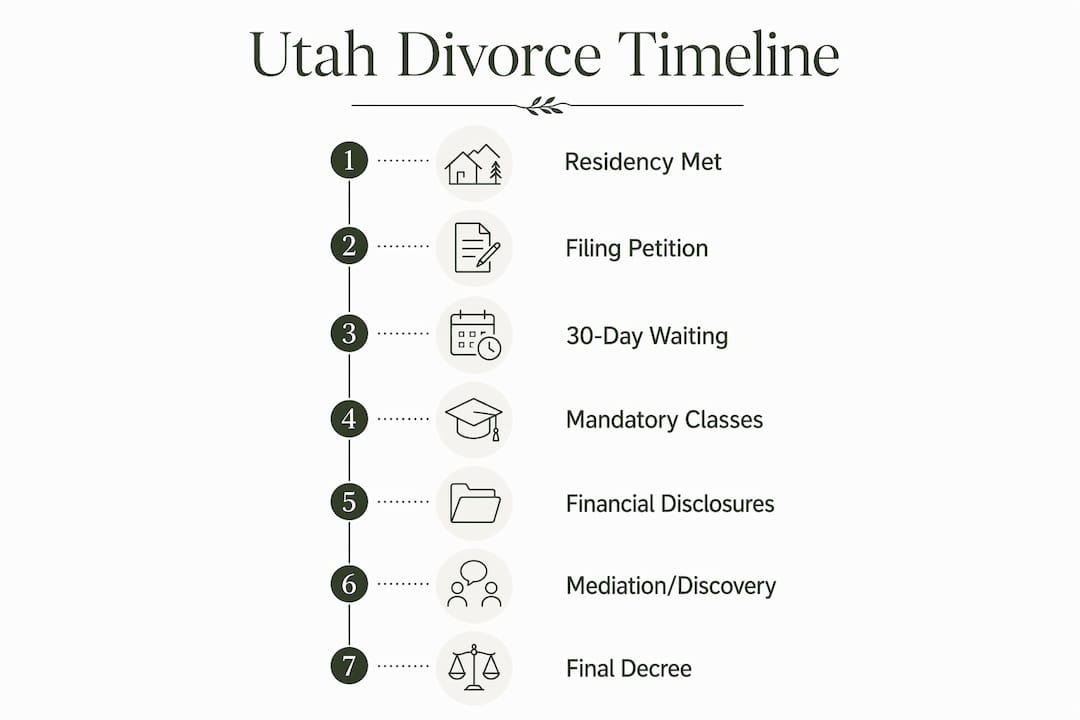
How does an uncontested divorce progress in Utah?
An uncontested divorce is one where both spouses agree on every major issue: property division, debt allocation, child custody, child support, and alimony. Agreement does not mean the process is automatic. The court still reviews every document for compliance before issuing a decree.
The typical uncontested divorce follows these steps:
- Confirm residency. Verify that you or your spouse has lived in Utah and the filing county for 90 days.
- Prepare and file the petition. Submit the Petition for Divorce along with a Summons and any required attachments.
- Serve your spouse. Deliver the filed documents to your spouse through an approved method. Your spouse then has 21–30 days to respond.
- Complete parenting classes. If you have a minor child, both parents generally complete the required courses, and the court will not finalize the divorce until proof of completion is filed.
- Exchange financial disclosures. Both parties must file complete financial declarations. Courts enforce strict deadlines on these, and missing them causes rescheduling.
- Submit the final decree for review. Once the waiting period passes and all documents are filed, the court reviews and signs the decree.
The biggest hurdle in uncontested cases is not the waiting period. It is meeting the deadlines for parenting classes and financial disclosures. Couples who complete those requirements before or immediately after filing consistently finalize faster than those who treat them as afterthoughts.
The court expects documents designed for filing. Incomplete or improperly formatted filings get rejected and reset your timeline. divvi's free uncontested divorce wizard generates documents designed for filing and flags missing information before you file.
Pro Tip: Complete your parenting class online before you even file the petition. Most approved providers offer same-week completion, and having the certificate ready eliminates one of the most common delays.
Why do contested divorces in Utah take so much longer?
A contested divorce involves at least one unresolved dispute, whether over custody, property, debt, or support. The court cannot issue a final decree until every disputed issue is either settled by agreement or decided by a judge. That process takes time.
A contested divorce takes longer than an uncontested one. How much longer depends on the case. These are general stages, not a schedule:
- Discovery: Both sides exchange financial records, property valuations, and other evidence. How long that takes depends on complexity and cooperation.
- Mandatory mediation: Utah courts require mediation before trial in most contested cases. Scheduling a mediator is one more step on the calendar.
- Pretrial motions: Either party can file motions for temporary orders on custody, support, or property use. Each motion requires a hearing and a ruling.
- Trial: If mediation fails, the case goes to trial. Trial dates are set by court availability.
Uncooperative parties make every stage longer. Courts enforce strict timelines for document exchange, and a spouse who delays disclosures or ignores deadlines forces the other party to file motions, which adds hearings. divvi prepares the documents for the parts of the case you can settle. A live mediator is available when you want one.
What common mistakes delay divorce finalization in Utah?
Most delays in Utah divorces are avoidable. They come from predictable mistakes that people make because they underestimate how procedural the process is.
The most common pitfalls:
- Skipping or delaying parenting classes. The court will not finalize your divorce without proof of completion. Waiting until after the 30-day period to enroll adds weeks to your timeline.
- Filing incomplete financial disclosures. Missing accounts, undervalued assets, or unsigned forms trigger rejection. Courts reschedule hearings rather than overlook incomplete filings.
- Treating the 30-day waiting period as automatic finalization. The waiting period is a minimum, not a guarantee. Your decree is not issued until the court reviews and approves all documents.
- Poor communication between spouses. Delays in responding to document requests or negotiation offers force court intervention and add months.
- Filing documents without legal review. Courts reject improperly formatted documents. Each rejection resets the clock on your hearing date.
Pro Tip: Use Divvi's document audit tool before submitting anything to the court. It checks your filings for completeness and flags errors that would otherwise cause rejection.
The average time for divorce to complete is longer than most people expect because they focus on the waiting period and ignore the procedural requirements surrounding it. Preparation before filing is the single most effective way to shorten your actual timeline.
Key Takeaways
Utah divorce finalization depends far more on preparation and compliance than on the statutory 30-day waiting period alone.
| Point | Details |
|---|---|
| Minimum waiting period | Utah law requires 30 days after filing before any divorce can be finalized. |
| Uncontested timeline | Many uncontested divorces typically finish in about 6 weeks to 4 months from filing, but that isn't a promise. |
| Contested timeline | A contested divorce takes longer. The length depends on the case. divvi does not publish a set duration. |
| Parenting class requirement | If you have a minor child, both parents generally complete the required courses and file proof before the decree is entered. |
| Biggest delay source | Incomplete financial disclosures and missing parenting class certificates cause more delays than the waiting period itself. |
Why Utah divorces drag on unnecessarily
The 30-day waiting period gets all the attention, but it is almost never the real bottleneck. The cases that drag on for months past the minimum share one common trait: the parties did not prepare before filing. They enrolled in parenting classes after the waiting period ended. They submitted financial disclosures with missing accounts. They filed petitions with formatting errors that the court rejected on the first review.
The uncomfortable truth is that most divorce delays are self-inflicted. A long contested divorce is not always the result of a genuinely complex case. Often it reflects two people who are using procedural delays as a proxy for the conflict they cannot resolve emotionally. Courts are not therapists. Every extra motion adds time.
Cooperation is not the same as surrender. You can disagree on the outcome and still agree to exchange documents on time, show up to mediation prepared, and respond within the required window. Those behaviors shorten the timeline.
The other misconception I see constantly is that the 30-day waiting period is a cooling-off period designed to change minds. It is not. Utah's 30-day minimum is one of the shortest in the country precisely because the legislature recognized that artificial delays do not save marriages. They just cost people more money. Use that time to complete your requirements, not to second-guess your decision.
If you are in a contested case, get into mediation as early as possible. Mediated agreements almost always produce faster, cheaper, and more durable outcomes than judge-imposed rulings. The parties who fight every issue to trial rarely feel like they won, even when they did.
— Landon
How Divvi makes the process faster and less expensive
Paperwork errors and missed deadlines are the two most common reasons Utah divorces take longer than they should.
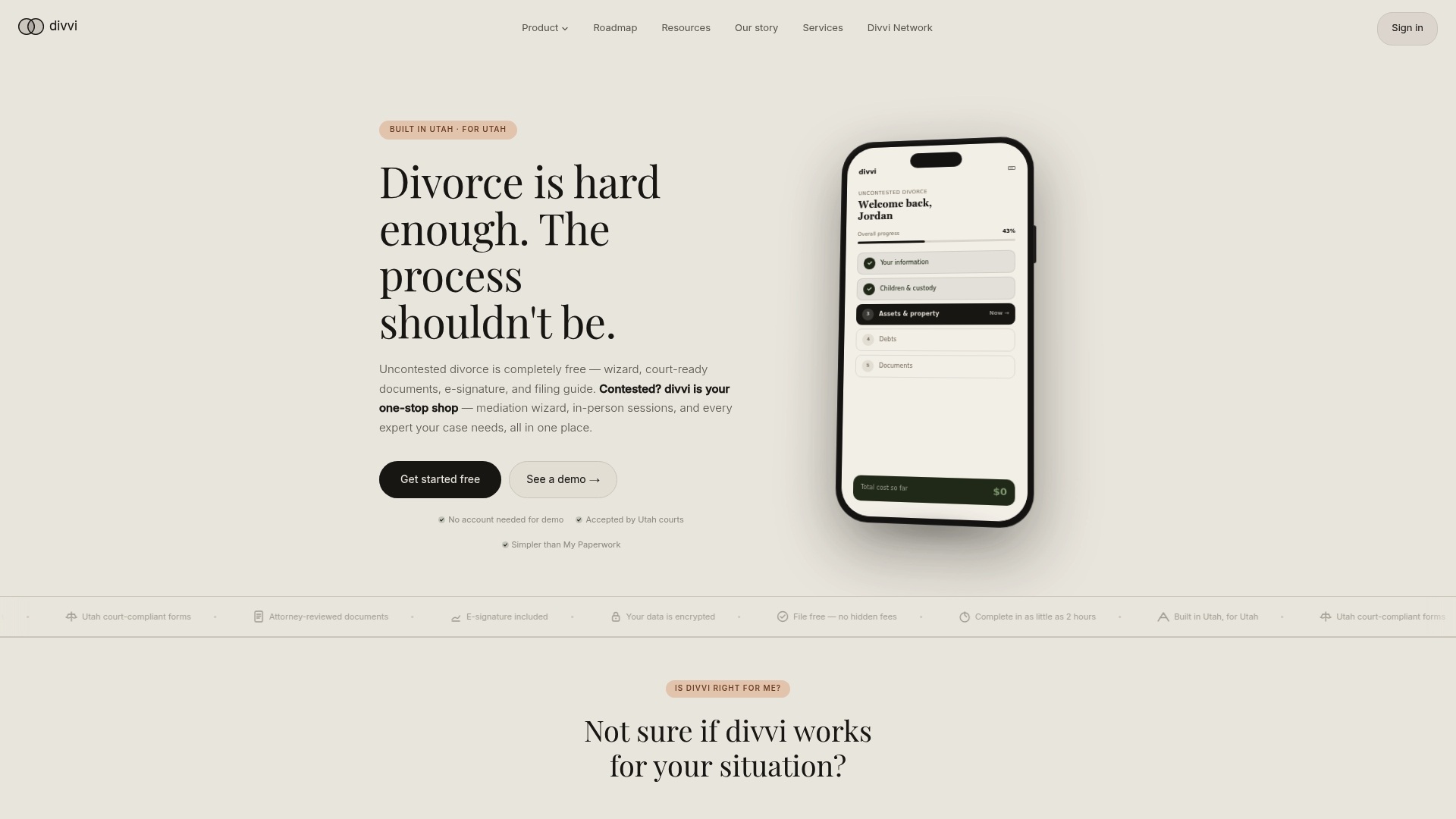
divvi's divorce platform walks you through every step of the process, from the initial petition to the final decree. The free uncontested divorce wizard takes about 40 minutes and generates documents designed for filing. See the full calendar on the Utah divorce timeline. The uncontested path is free. A contested divorce takes longer, and mediation is available when you want a live session.
FAQ
What is the minimum time for a divorce in Utah?
Timing varies by court and by case. Utah law generally doesn't let a judge enter a divorce decree until 30 days after the petition is filed (Utah Code § 81-4-402(3)(a)). The court can waive that wait only in extraordinary circumstances. After that, the time depends on serving your spouse, when the final papers are submitted, and the court's processing and the judge's review. Many uncontested divorces typically finish in about 6 weeks to 4 months from filing, but that isn't a promise. Contested divorces usually take longer.
Can the 30-day waiting period be waived in Utah?
A court may waive the 30-day waiting period only after finding extraordinary circumstances (Utah Code § 81-4-402(3)(a)). The statute does not give examples. The judge's review and signature still come after that wait, unless it is waived.
How long does a contested divorce take in Utah?
A contested divorce takes longer than an uncontested one. How much longer depends on the disagreement, the court's calendar, and whether the open issues settle. divvi does not publish a duration for contested cases.
Do both parents have to take parenting classes in Utah?
If you have a minor child, both parents generally complete the required courses and file proof with the court before the decree is entered. Couples with no minor children are not required to take them.
What is the biggest cause of delays in Utah divorces?
Incomplete financial disclosures and failure to complete mandatory parenting classes on time cause more delays than any other factor. Filing accurate, complete documents from the start is the most effective way to shorten your divorce finalization timeline.