Guardian ad Litem in Utah: The Attorney for Your Child
Written and reviewed by the divvi team. How we research and check this.

If your Utah custody or abuse/neglect case involves a child's welfare, the court can appoint a Guardian ad Litem (GAL) to represent that child's best interests independently of both parents. Here is what that means for your case right now.
A GAL in Utah is a licensed attorney whose sole client is the child, not you or the other parent. Courts appoint them in three main situations:
- Custody and parent-time disputes where the court needs an independent assessment of what arrangement serves the child
- Abuse, neglect, or dependency proceedings in juvenile court, typically triggered by a Child Protective Services report
- Protective order matters in district court where allegations of abuse or domestic violence affect a child's safety
Your first call should be to the court clerk's office or the Utah Office of Guardian ad Litem to confirm which program applies to your case. If you are also managing custody filings or contested-divorce paperwork, Divvi can help you prepare documents designed for filing and connect you with attorney review.
Table of Contents
- What is a guardian ad litem in Utah, and what law creates the role?
- When do Utah courts appoint a GAL?
- State Office GAL vs. Private GAL (PGAL): which one applies to your case?
- What a GAL actually does in Utah courts — and what they cannot do
- Who can serve as a GAL or PGAL in Utah?
- How GAL fees work in Utah: who pays and what to expect
- How GAL involvement changes custody hearings and likely outcomes
- Official Utah resources, forms, and contacts
- Key Takeaways
- What parents consistently get wrong about GALs in Utah
- Divvi helps Utah families handle the paperwork side of custody cases
- Useful sources
What is a guardian ad litem in Utah, and what law creates the role?
Utah law formally defines two types: an attorney guardian ad litem and a private attorney guardian ad litem (PGAL). Both are licensed attorneys. The difference is who employs them and in which court they practice.
The statutory foundation is the District Court Guardian Ad Litem Act, codified at Utah Code §§ 78A-2-701 through 78A-2-705. Part 7 sets out definitions, appointment authority, duties, fee allocation, and the conditions under which a GAL's appointment ends. It is the primary legal authority for all district court GAL work in Utah.
Key statutory language: Under the District Court Guardian Ad Litem Act, a GAL's mandate is to represent the best interests of the child — an independent standard that is separate from what either parent wants and separate from what Child Protective Services recommends.
That independence is not incidental. The GAL is not a mediator, not a second attorney for one parent, and not an extension of CPS. When a child is old enough to express preferences, the GAL may present both the child's stated wishes and the GAL's own objective recommendation to the court — and those two positions do not have to match.
For juvenile court cases (abuse, neglect, dependency), the state-funded Utah Office of Guardian ad Litem provides staff attorneys directly. For district court custody disputes, the court draws from the PGAL roster of privately certified attorneys. Knowing which court your case is in tells you immediately which program you are dealing with.
When do Utah courts appoint a GAL?
Appointment is either mandatory under statute or discretionary based on the judge's assessment of the child's situation. The triggers differ by court type.
Common case types that lead to appointment:
- Juvenile court abuse, neglect, or dependency petitions filed after a CPS investigation
- High-conflict custody or parent-time disputes in district court where the child's welfare is genuinely at issue
- Protective order proceedings in district court involving allegations of domestic violence or child abuse
- Relocation disputes where one parent seeks to move a child out of state or significantly far within Utah
- Cases where a child has special needs, a disability, or a medical condition that requires independent assessment
Under Utah Code § 78A-2-703, a district court may appoint an attorney guardian ad litem when there are allegations of abuse or neglect, when a protective order is sought, or when the court finds that the child's interests require independent representation. The statute sets the outer boundary; judges have discretion within it.
Discretionary triggers are worth understanding. A judge may appoint a GAL even without a CPS report if the litigation is unusually contentious, if the child has been drawn into the conflict, or if prior orders have been repeatedly violated. Relocation requests frequently prompt appointment because the stakes for the child's relationship with one parent are high and the competing claims are hard to evaluate without an independent voice.
A practical example: two parents disputing a move from Salt Lake City to Denver, each with plausible arguments about schooling and family support, is exactly the kind of case where a judge will want a GAL's report before ruling on temporary or permanent parent-time changes.
Parent-time is Utah's statutory term for what most people call the custody schedule or visitation schedule; the words mean the same thing.
State Office GAL vs. Private GAL (PGAL): which one applies to your case?
The table below maps the key differences. Your court type is the deciding factor.
| Dimension | State Office of GAL | Private GAL (PGAL) |
|---|---|---|
| Court type | Juvenile court (abuse/neglect/dependency) | District court (custody, parent-time, protective orders) |
| Who appoints | Court; Office assigns a staff attorney | Court appoints from certified PGAL roster; parties may stipulate |
| Who pays | State-funded; no direct cost to parties | Fees allocated by court order between parties |
| Scope of role | Full representation in juvenile proceedings; coordinates with CASA volunteers | Investigates, reports, and advocates in district court custody matters |
| Oversight | Office of GAL management and Guardian ad Litem Oversight Committee | Office of GAL certification, mandatory training, and UCJA rules |
| CASA involvement | CASA volunteers frequently support Office GAL attorneys | Less common; possible in complex cases |
| Availability | Statewide through the Office | Depends on PGAL roster availability in the judicial district |
The Utah Office of Guardian ad Litem PGAL program manages both tracks. For district court cases, the Office maintains a roster of certified private attorneys and triages assignments to avoid conflicts of interest. Parties can sometimes stipulate to a specific PGAL from the roster, but the court makes the final appointment.
One practical implication: if your case is in juvenile court, you will not be billed directly for the GAL. If it is in district court, expect a fee order. The court has authority under Part 7 to split costs between parties, set a retainer amount, or in appropriate circumstances require pro bono service.
CASA volunteers add a layer that is worth understanding. Utah CASA reported 645 volunteers advocating for 1,207 children and donating 29,369 hours in the most recently published period. CASA volunteers are community advocates, not attorneys. They gather observations, maintain consistent contact with the child, and report to the court. The GAL attorney handles the legal strategy and courtroom presentation. In juvenile court cases, that partnership gives the court significantly more information than either could provide alone.
What a GAL actually does in Utah courts — and what they cannot do
The GAL's job is investigative and advocacy-based. Here is what that looks like in practice.
Routine GAL tasks:
- Interviewing the child privately, often multiple times
- Reviewing school records, medical records, and mental health records
- Contacting teachers, counselors, pediatricians, and other professionals who know the child
- Conducting home observations at each parent's residence
- Reviewing CPS history, prior court orders, and police reports
- Identifying community resources (counseling, tutoring, medical specialists) the child may need
- Filing a written report with findings and recommendations
- Testifying at hearings and responding to cross-examination
The GAL's investigation is guided by the parent-time and custody factors courts use under Utah Code § 81-9-206, which include the child's relationship with each parent, each parent's ability to meet the child's needs, the child's adjustment to home and school, and the distance between households.
What a GAL cannot do:
- Serve as a custody evaluator under UCJA Rule 4-903 (that is a separate, more formal process)
- Represent either parent's interests
- Make binding decisions — recommendations are persuasive, not determinative
- Override a judge's ruling
- Conduct a forensic psychological evaluation
The GAL report is not a verdict. Judges weigh it alongside other evidence, testimony, and the parties' arguments. A strong GAL recommendation carries real weight, but a parent who presents credible counter-evidence at a hearing can still prevail on specific issues.
Pro Tip: Before your first GAL interview, organize your records into a single folder: school report cards, medical visit summaries, a written timeline of key events, and a short list of witnesses who can speak to your parenting. Handing the GAL a clear, factual package signals cooperation and makes their job easier — which tends to reflect well on you.
Who can serve as a GAL or PGAL in Utah?
Not every attorney can take a GAL appointment. The Office of GAL sets minimum qualifications and runs a mandatory certification process for PGALs.
To join the PGAL roster, an attorney must complete a one-day mandatory training program administered by the Office of GAL, submit an application through the PGAL program page, and demonstrate that they meet the statutory and court-rule requirements under Part 7 and the UCJA. The Office then maintains the roster and assigns PGALs to cases, checking for conflicts before each appointment.
The Guardian ad Litem Oversight Committee supervises program standards for both the Office and the PGAL track. That committee reviews complaints, monitors compliance with training requirements, and can recommend removal of a PGAL from the roster.
The Office of GAL's own guidance states that a GAL must balance the child's expressed wishes against an objective best-interests assessment — meaning the GAL is not simply a mouthpiece for what the child says they want, but an independent legal advocate who weighs the child's preferences as one factor among many.
Staff attorneys in the Office of GAL handle juvenile court cases and are supervised by Office management. For anyone considering how to become a guardian ad litem in Utah, the PGAL application and training through the Office is the formal pathway for district court work. CASA volunteers follow a separate application and training process through Utah CASA and are not attorneys.
How GAL fees work in Utah: who pays and what to expect
Fee allocation for PGALs is set by court order under Part 7. There is no single flat rate, and costs vary by case complexity and the attorney's hourly rate.
How courts typically handle PGAL fees:
- Split the cost equally between both parties
- Allocate a larger share to the higher-earning party
- Set an initial retainer amount and require payment before the PGAL begins work
- Order pro bono service when both parties demonstrate financial hardship
- Revisit fee allocation at the final hearing based on each party's conduct and ability to pay
If your case is in juvenile court, the state-funded Office of GAL covers costs. The indigency consideration matters most in district court: if you cannot afford a PGAL fee, raise it at the first scheduling conference with a financial affidavit in hand. Courts have discretion to adjust the allocation, and judges generally prefer to have a GAL in a high-conflict case even when resources are tight.
Pro Tip: At your first status conference, ask the judge to include specific language in the appointment order about the fee cap, payment schedule, and what happens if one party fails to pay. Vague fee orders create disputes later. A sentence like "each party shall pay $X within 14 days of this order as an initial retainer" is far more enforceable than "fees to be split equally."
The Utah Courts Self-Help Contact page lists regional clerk contacts who can tell you whether a fee schedule or standard retainer amount is used in your judicial district.
How GAL involvement changes custody hearings and likely outcomes
A GAL report changes the information landscape at a hearing. Here is what that means practically.
Practical effects on your case:
- GAL reports often influence temporary custody and parent-time orders before a final hearing
- Judges may use GAL findings to prompt additional evidence collection (ordering a custody evaluation, requiring drug testing, or mandating counseling)
- A GAL's recommendation can shift the negotiating dynamic in mediation — parties tend to settle closer to what the GAL recommends when the report is credible
- In contested trials, the GAL testifies and is subject to cross-examination by both parties' attorneys
- A GAL who identifies safety concerns can trigger emergency motions for protective orders or supervised visitation
GAL recommendations are persuasive, not binding. A judge can accept them in full, accept them in part, or reject them entirely with findings on the record. In practice, judges give significant weight to a thorough, well-documented GAL report, particularly on fact-intensive questions like which parent handles medical appointments, school involvement, and day-to-day routines.
Pro Tip: Treat every interaction with the GAL as part of your case record. Respond to document requests within the timeframe given, keep communications respectful and factual, and never put the GAL in the middle of a dispute with the other parent. If the GAL's report contains a factual error, address it in writing with supporting documentation before the hearing — not for the first time on the witness stand.
If the GAL report leads toward mediation, Divvi's network of vetted mediators can help you find a qualified Utah mediator to work through the issues the GAL has identified.
Official Utah resources, forms, and contacts
| Resource | What it covers | Where to go |
|---|---|---|
| Utah Office of Guardian ad Litem | Program overview, mission, juvenile court GAL services | utcourts.gov/en/about/miscellaneous/gal |
| PGAL Application & Training | PGAL roster, mandatory training, application forms | utcourts.gov/en/about/miscellaneous/gal/pgal |
| Utah CASA | CASA volunteer application, program statistics, child advocacy | utahcasa.org |
| Child Protection Ombuds | Neutral family advocacy within 18 months of a child-welfare incident | dhhs.utah.gov |
| Utah Courts Self-Help | Court clerk contacts, procedural help, regional resources | utcourts.gov/selfhelp/contact |
| District Court GAL Act (Part 7) | Full statutory text: §§ 78A-2-701 through 78A-2-705 | le.utah.gov |
Key forms and pages to bookmark:
- Part 7 District Court Guardian Ad Litem Act
- Utah Office of Guardian ad Litem
- Utah Office of Guardian ad Litem - PGAL
- Child Protection Ombuds Services - Utah DHHS
- Utah CASA | Volunteer Today | Advocate for Children
- 78A-2-703 Appointment of attorney guardian ad litem in district court matters
- Utah Courts Self-Help Contact
- 81-9-206 Determination of parent-time schedule -- Parent-time factors
The Child Protection Ombuds at Utah DHHS is worth knowing about even if you already have a GAL. The Ombuds provides neutral assistance for families navigating child-welfare systems and can advocate on process-related concerns within an 18-month window from the incident. It is not a substitute for a GAL in court, but it is a practical resource for families who feel lost in the administrative side of a CPS case.
For procedural questions about filing, the Utah Courts Self-Help Contact page is the fastest first stop. Court clerks can tell you which forms your district uses, local filing deadlines, and whether a self-help center is available at your courthouse.
Key Takeaways
A Guardian ad Litem in Utah is a court-appointed attorney who represents the child's best interests exclusively, and understanding which program applies to your case determines who pays, who investigates, and how much influence the GAL's report will carry.
| Point | Details |
|---|---|
| GAL represents the child, not you | The GAL's duty is the child's best interests under Part 7 — not your preferred outcome. |
| Court type determines the program | Juvenile court cases use the state Office of GAL; district court custody cases use a certified PGAL. |
| Fees are set by court order in district court | Courts can split costs, set retainers, or order pro bono service; raise fee concerns at the first hearing. |
| You can request or object in writing | File a motion citing § 78A-2-703 before the appointment order is signed for the best chance of shaping the outcome. |
| Divvi supports contested-case filings | Divvi's platform prepares documents designed for filing and connects you with attorney review for GAL-impacted cases. |
What parents consistently get wrong about GALs in Utah
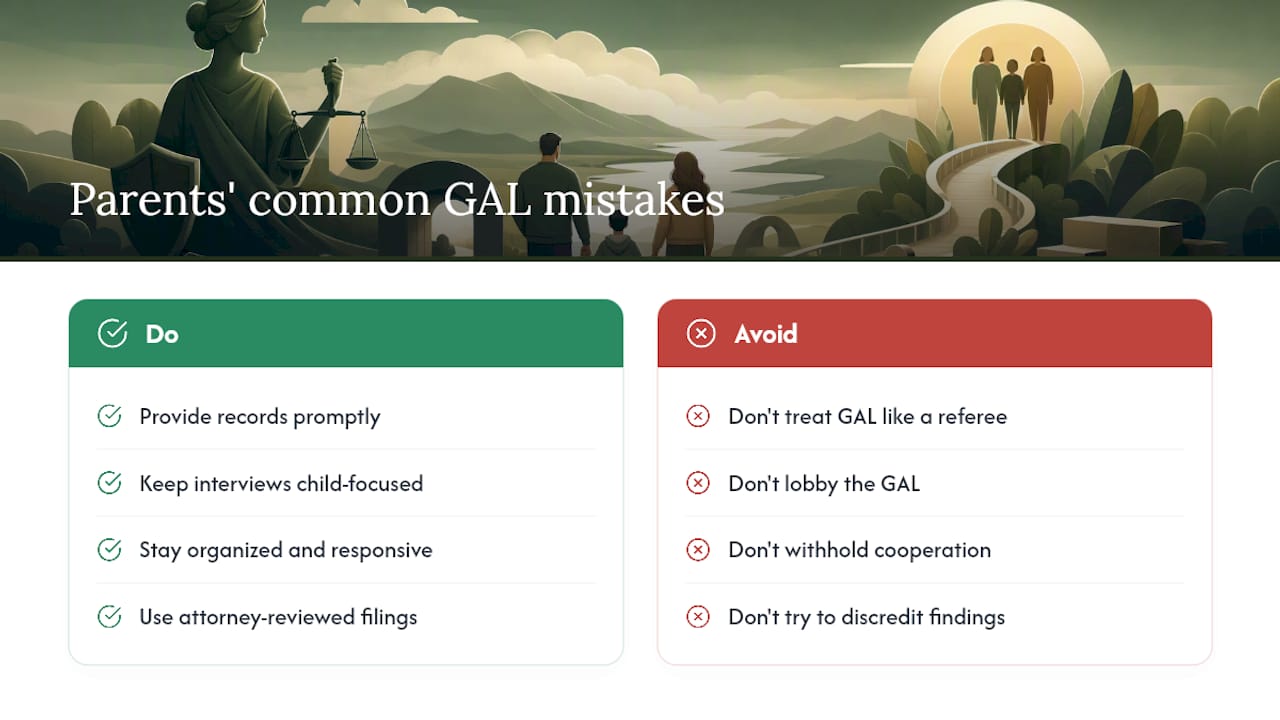
The most common mistake is treating the GAL like a referee who will eventually pick a side. That framing leads parents to lobby the GAL, withhold cooperation, or try to discredit the GAL's findings in ways that backfire badly at trial.
A GAL is not there to validate your position. They are there to tell the court what the child needs, and those two things sometimes align with what you want and sometimes do not. Parents who accept that distinction early tend to engage more constructively: they provide records promptly, they keep interviews focused on the child rather than grievances about the other parent, and they use the GAL's report as a realistic baseline for settlement talks rather than a declaration of war.
The second thing parents underestimate is timing. GAL investigations take time, and that time affects temporary orders. If the GAL has not filed a report before the temporary-order hearing, the judge may rule on limited information. Staying organized, responsive, and cooperative from day one shortens the GAL's timeline and gives you a better shot at a favorable temporary order.
One more thing worth saying plainly: a GAL recommendation is not the end of your case. Judges are not required to follow it. If the report contains factual errors or misses important context, you can address those at the hearing with documentary evidence and witness testimony. The divorce discovery checklist Divvi publishes is a practical starting point for organizing the records a GAL is likely to request.
If you are facing a contested custody case with a PGAL involved, this is not the moment to go it alone on paperwork. An attorney referral and a clear document strategy matter more than most parents realize until they are already in the hearing.
Divvi helps Utah families handle the paperwork side of custody cases
Contested custody cases with a GAL involved generate a lot of paperwork fast: motions, financial affidavits, proposed parenting plans, discovery requests, and eventually a response to the GAL's report. Getting those documents right matters.

Divvi is built for exactly this situation. The platform generates custody and divorce documents designed for filing through a step-by-step wizard, offers attorney referrals for contested cases, and connects you with Utah mediators when a GAL report opens the door to settlement. The base platform is free for uncontested cases; contested-case support, attorney referrals, and mediation matching are available as paid upgrades. You pay only for what your case actually needs.
If a PGAL has been appointed and your case is heading toward a contested hearing, start with Divvi's Utah divorce and custody platform to get your filings organized and reviewed before the next hearing date.
Useful sources
The sources below are the primary authorities for everything covered in this article. Verify current statutory text and program details directly with these pages before filing.
| Source | What it covers |
|---|---|
| District Court Guardian Ad Litem Act (Part 7) | Full statutory text: definitions, appointment, duties, fees, termination |
| Utah Office of Guardian ad Litem | State program overview, juvenile court GAL services, mission |
| PGAL Program Page | Application, mandatory training, roster, oversight |
| § 78A-2-703 Appointment Authority | Statutory triggers for district court GAL appointment |
| § 81-9-206 Parent-Time Factors | Custody and parent-time factors GALs reference in recommendations |
| Utah CASA | CASA volunteer program, statistics, application |
| Child Protection Ombuds | DHHS family advocacy, 18-month window for Ombuds services |
| Utah Courts Self-Help Contact | Court clerk contacts, procedural guidance, regional self-help |
This article is general legal information, not legal advice. Utah statutes and court rules change; confirm current requirements with the Utah Courts website, the Office of Guardian ad Litem, or a licensed Utah family law attorney before taking action in your case.