Does It Matter Who Files for Divorce First?
Written and reviewed by the divvi team. How we research and check this.

Filing first does not automatically win you a better custody arrangement, a larger share of the marital home, or higher support payments. In the vast majority of U.S. no-fault jurisdictions, courts decide those outcomes based on statutory rules, evidence, and the best interests of any children involved — not on which spouse signed the petition first.
That said, filing first is not meaningless. The petitioner gains real procedural tools:
- Control over the timeline. The waiting period clock starts when you file, not when your spouse agrees.
- Early access to temporary orders. You can ask the court to freeze assets, set interim child support, or secure housing before your spouse has a chance to respond.
- Venue selection in some cases, particularly when spouses live in different counties or states.
- Activation of automatic restraining orders (in states like California and Colorado) the moment service occurs.
Whether those advantages matter in your case depends on your state's rules, your specific facts, and whether there is any concrete risk — asset dissipation, a child being taken out of state, or a safety concern — that makes speed genuinely important. Read on for a state-by-state breakdown and a practical decision framework.
Table of Contents
- Does filing first actually change your legal outcome?
- What are the real advantages of filing first?
- What are the risks of filing first?
- When does state law make filing first matter more?
- What does filing actually involve, step by step?
- When is it better to wait, file jointly, or use mediation?
- How legal help or an online platform can support your decision
- Key Takeaways
- The filing-first decision is simpler than most people think
- Divvi helps Utah residents file with confidence
- Useful sources and further reading
Does filing first actually change your legal outcome?
The short answer is no, and the longer answer is: it changes the process, not the result.

Family courts in every U.S. state evaluate custody, property division, and spousal support on the merits. A judge in California, Texas, or Utah does not look at who filed the petition and award that person a procedural bonus. The legal outcome depends on evidence, statutory formulas, and in custody cases, what arrangement serves the child's best interests. A parent who files second has exactly the same standing to request primary custody as the one who filed first.
What filing first does change is your position at the start of the case. You set the initial timeline. You frame the opening document. In states with mandatory waiting periods, your clock starts earlier. Those are real differences — they just don't reach into the judge's ultimate findings on the big-ticket issues.
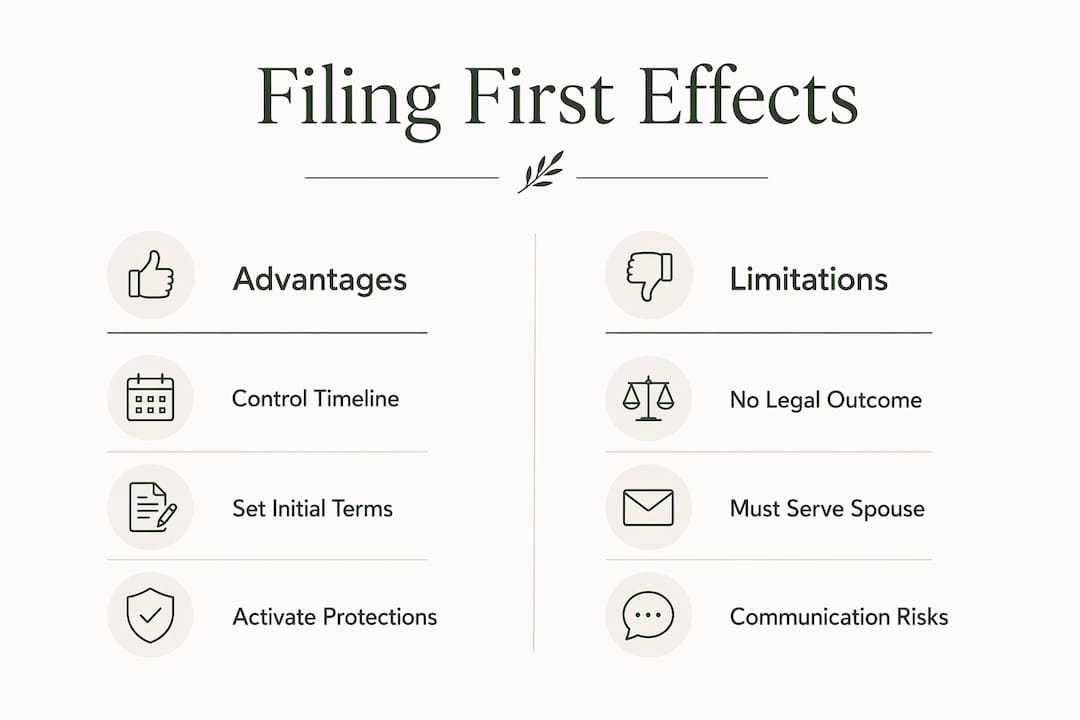
The scenarios where filing-first genuinely matters are specific: a spouse who may hide retirement accounts, a parent who might relocate with the children, or a situation where an automatic injunction would immediately protect shared assets. Outside those triggers, the effect of filing for divorce first is largely procedural.
What are the real advantages of filing first?
Filing first gives you a set of procedural levers. Whether those levers are worth pulling depends on your facts.
- Temporary orders, requested immediately. As the petitioner, you can ask the court for interim child support, exclusive use of the marital home, or a freeze on joint accounts before your spouse has filed a response. That window can be critical when finances are asymmetric.
- Automatic temporary restraining orders (ATROs). In California, ATROs bind the petitioner upon filing and the respondent upon service. They prohibit either party from transferring, encumbering, or disposing of property without consent. The moment your spouse is served, those protections snap into place.
- Waiting-period clock. Most states impose a mandatory waiting period before a divorce can be finalized. That clock runs from the date of filing or service, not from the date you reach an agreement. Filing first starts it sooner.
- Venue control. If you and your spouse live in different counties or different states, the petitioner generally picks the courthouse. When both spouses independently qualify to file in their respective states, the court where papers land first typically takes the case. For a spouse who would otherwise travel hours to every hearing, that is a meaningful edge.
- Document and financial preparation runway. Filing first usually means you have already gathered bank statements, tax returns, retirement account balances, and property records. That preparation advantage does not disappear once the case is open.
- Narrative framing. Your petition is the first document the court sees. It states your proposed custody arrangement, your view of the marital estate, and whether you are seeking support. That opening position shapes early negotiations, even if the respondent files a counter-petition.
- Default judgment protection. A spouse who is unprepared or avoidant may fail to respond within the statutory window. A default judgment can follow, and it tends to reflect the petitioner's requests closely.
Pro Tip: Serve your spouse promptly after filing. In states with ATROs or automatic injunctions, the protective reach of those orders does not extend to your spouse until service is complete. A delay in service is a gap in protection.
What are the risks of filing first?
Filing first is not always the right move, and the downsides are worth taking seriously before you pull the trigger.
- You show your hand immediately. The petition lays out your proposed custody arrangement, your view of the property split, and whether you want support. Your spouse reads that document and has weeks to build a counter-strategy. An aggressive opening position can harden the other side before settlement talks even begin.
- Increased conflict. The formal act of filing changes the emotional temperature of a separation. Experienced family law attorneys warn that filing can close paths to quiet settlement and push a manageable split into adversarial litigation.
- Upfront costs fall on you. Filing fees across the country range from roughly $70 to $435, and process-service costs typically add additional fees depending on the service provider. Because you initiated the case, you will likely retain an attorney for a longer stretch than your spouse. Those extra months of representation add up.
- Social and family dynamics shift. Being the one who formally ended the marriage changes how extended family and mutual friends perceive the split. In cases where reconciliation was still a remote possibility, filing closes that door in a way that is hard to undo.
- Presenting first at trial is a double-edged sword. In contested trials, many courts allow the petitioner to present first. That gives you the opening narrative, but it also means your spouse's attorney cross-examines your witnesses before you hear theirs. In a tightly contested evidentiary battle, that order matters — but it cuts both ways.
The practical way to minimize these downsides: if you must file, keep communication channels open, avoid inflammatory language in the petition, and consider whether a limited emergency motion (for a specific protective order) is sufficient rather than a full petition that triggers the entire adversarial process.
When does state law make filing first matter more?
The importance of filing first varies significantly by jurisdiction. Here is how the principal differences break down.

Community property vs. equitable distribution
Filing first does not change which property rule your state applies. California, Texas, Arizona, and a handful of others divide marital property roughly 50/50 under community property rules. The remaining states use equitable distribution, which means fair but not necessarily equal. Neither formula shifts based on who filed. What can shift is the timing of asset protection and the venue where those rules get applied.
State-specific examples
California: Filing activates ATROs that bind the petitioner immediately and the respondent upon service. California also imposes a six-month mandatory waiting period from the date of service, not filing, so prompt service matters as much as prompt filing. The substantive outcome on property and custody does not change based on filing order.
Colorado: An automatic temporary injunction applies under state statute when a petition is filed and served. Colorado treats divorce as no-fault and gives the petitioner modest tactical advantages on timing and venue, but no automatic preference in property division or parenting decisions.
Texas: Filing first does not change legal rights, but the filing spouse pays the initial county filing fee and can request temporary orders early. Texas county filing fees typically run a moderate fee typical for the region, and the petitioner's ability to set the early case posture through temporary orders is a practical, if not legal, advantage.
Utah: Residency requirements apply (at least 90 days in the state and 90 days in the county where you file). Filing first in Utah allows you to request temporary orders for child custody, support, and property preservation before the respondent has responded. For Utah readers, Divvi's pros and cons of filing first guide covers state-specific procedural nuances in detail.
| State | Property rule | Key filing-first effect | Waiting period |
|---|---|---|---|
| California | Community property | ATROs activate on service | 6 months from service |
| Colorado | Equitable distribution | Automatic temporary injunction | — |
| Texas | Community property | Petitioner sets early case posture | — |
| Utah | Equitable distribution | Temporary orders available immediately | 30 days (uncontested) |
| Nevada | Community property | Joint petition option available | No mandatory waiting period |
Pro Tip: Before you file, confirm the residency requirement for your county, not just your state. Some states require you to file in the county where you last lived together, or where the respondent currently lives. Filing in the wrong venue can delay your case significantly.
What does filing actually involve, step by step?
Understanding the mechanics helps you decide whether the procedural advantages of filing first are worth pursuing in your situation.
- Prepare the petition. The petition identifies both spouses, states the grounds for divorce (most people choose no-fault grounds), and outlines your requested terms for property division, custody, and support. For clarity on marital status details that courts consider, see Has Applicant Ever Been Married? Passport Question Explained. Many states also require a financial disclosure statement at or shortly after filing.
- File with the clerk of court. Submit the petition and any required accompanying forms to the appropriate county court. Pay the filing fee at this stage. Texas county fees typically run around $350; fees elsewhere range from roughly $70 to $435 depending on the county and state.
- Arrange service of process. Your spouse must be formally served with the petition and a summons. A process server or sheriff typically handles this for $50–$200. Service is the trigger for the respondent's response window and, in ATRO states, for the protective orders to bind both parties.
- Respondent's response window. Most states give the respondent 20–30 days to file an answer or counter-petition. If they do not respond, you may be able to request a default judgment.
- Request temporary orders. At or shortly after filing, you can ask the court for interim relief: exclusive use of the marital home, temporary child custody and support, a freeze on joint accounts, or a temporary restraining order if safety is a concern. These orders govern the household until the final decree.
- Attend initial hearings and scheduling conferences. Most courts schedule an early conference to set timelines, identify contested issues, and explore whether mediation is appropriate. This is also where temporary orders are often heard if contested.
For Utah readers working through an uncontested case, Divvi's step-by-step uncontested filing guide walks through each stage with Utah-specific form references and court requirements.
When is it better to wait, file jointly, or use mediation?
Filing first is a tool, not a default. There are clear scenarios where it is the wrong move.
- Both parties are aligned on terms. When you and your spouse agree on custody, property, and support, a joint or uncontested filing is almost always faster, cheaper, and less damaging to the co-parenting relationship. In Nevada, for example, a joint petition for divorce can be approved without either party appearing before a judge.
- Mediation is realistic. If the main disputes are financial rather than safety-related, mediation before filing often produces a settlement faster than litigation. Filing first in this context can harden positions and make the mediator's job harder.
- The relationship is still cooperative. Filing without warning when your spouse expects a negotiated separation is a trust-breaking move. If you want any chance of a low-conflict post-divorce relationship, especially with children involved, coordinating the filing timeline is worth considering.
- You need more time to prepare. Gathering financial documents, securing housing, and consulting an attorney before filing gives you a stronger position. Filing in a rush because you feel pressure to "go first" often backfires.
The safety exceptions are non-negotiable. If there is a risk of domestic violence, asset dissipation, or a parent removing children from the state, filing and serving quickly is the right call. In those situations, the protective orders that activate upon service are not a procedural nicety — they are a concrete shield.
Pro Tip: If you are concerned about asset concealment but are not ready to file a full petition, consult an attorney about whether a temporary protective order or a targeted discovery request can address the immediate risk without triggering the full adversarial process.
How legal help or an online platform can support your decision
Whether you file first, file jointly, or wait, the quality of your preparation determines how well the process goes.
- Attorney consultation. A family law attorney can assess whether filing first gives you a meaningful advantage in your specific county, identify asset or custody risks that make speed necessary, and draft temporary order requests that actually hold up in court. For contested cases, complex assets, or any safety concern, attorney involvement is not optional.
- Document preparation and review. Having an attorney check your petition reduces the risk of procedural errors that delay your case or weaken your initial position.
- Temporary order strategy. An experienced practitioner can tell you which temporary orders are worth requesting in your jurisdiction and how to frame them so the court takes them seriously.
- Venue and residency guidance. When multiple filing options exist, a practitioner familiar with local court culture can advise on which venue is more favorable for your type of case.
- Online platforms for uncontested cases. When both parties are in agreement, an online divorce platform can generate documents designed for filing, walk you through the filing checklist, and connect you with a mediator or attorney for specific questions, at a fraction of the cost of full representation.
Divvi serves Utah residents specifically. The platform handles uncontested filings with a free document wizard, refers you to an attorney for contested cases, and connects users with mediators, financial advisors, and real estate professionals when the divorce involves complex assets or property. If you are outside Utah, the general guidance in this article applies, but you will need a Utah-licensed attorney or a platform serving your state for jurisdiction-specific help. For complicated situations involving contested custody, significant assets, or any safety risk, speaking with a licensed attorney in your state is the right next step regardless of which platform you use.
Key Takeaways
Filing first creates procedural advantages, not legal ones. Courts in every U.S. no-fault state decide custody, property, and support on the merits, regardless of which spouse initiated the case.
| Point | Details |
|---|---|
| Legal outcome unchanged | Filing order does not affect how a judge divides property, sets support, or decides custody. |
| Procedural advantages are real | Filing first allows early temporary orders, starts the waiting-period clock, and can control venue when spouses live in different counties or states. |
| State rules vary significantly | California ATROs, Colorado automatic injunctions, and Texas timing rules mean the practical value of filing first differs by jurisdiction. |
| Safety triggers override strategy | Asset dissipation risk, child removal risk, or domestic violence make filing quickly a protective necessity, not just a tactic. |
| Divvi for Utah residents | Divvi's free uncontested wizard and contested-case support help Utah residents prepare and file correctly from the start. |
The filing-first decision is simpler than most people think
Most people asking whether filing first matters are really asking a different question: "Am I protected?" That is the right instinct, and the answer has nothing to do with who signs the petition first.
The procedural advantages of filing first are real but narrow. Venue control matters when spouses genuinely qualify in different states with meaningfully different property laws. Temporary orders matter when there is a concrete financial or custody risk. The waiting-period clock matters when you are in a state with a long mandatory period and you know the marriage is over. Outside those specific triggers, the importance of filing first is largely overstated.
What I see consistently is that people file first out of fear rather than strategy. They worry that waiting means losing ground. In most cases, the ground they think they are losing does not exist. A judge evaluating a custody arrangement six months into the case does not remember or care who filed the petition. What the judge sees is the evidence in front of them.
The one scenario where I would always recommend filing quickly: any situation where a protective order is the real goal. If you need the court's authority to freeze an account, secure housing, or prevent a child from being taken out of state, filing and serving promptly is the mechanism that makes those protections real. That is not about winning. It is about safety.
For Utah readers, Divvi's tools and attorney network exist precisely for this kind of decision. You should not have to guess whether your situation calls for immediate filing or a coordinated approach. That is what the platform's guided process and attorney connections are for.
Divvi helps Utah residents file with confidence
Filing for divorce in Utah does not have to mean choosing between an expensive attorney and a confusing stack of court forms. Divvi is built for exactly this situation: a platform that handles the paperwork, connects you with the right professionals, and lets you pay only for what you actually need.
For uncontested cases, Divvi's free divorce wizard generates documents designed for filing in as little as two hours. For contested cases or situations involving custody disputes, significant assets, or an uncooperative spouse, the platform connects you with attorney referrals and local legal professionals who know Utah's courts. Mediation is available through the platform when both parties want a lower-conflict path to resolution. If you are worried about asset protection or the timing of temporary orders, Divvi's full Utah divorce service walks you through what to request and when.
The base service is free. You pay only for the specific support your case requires. Start with the free wizard, and if your situation is more complex, the platform's attorney network and contested-case support are there when you need them.
Useful sources and further reading
- San Diego Family Law Facilitator FAQ: Who should file for divorce first? — Court-published guidance on the legal effect of filing order.
- Provinziano and Associates: Does it matter who files for divorce first? — California-specific explanation of ATROs and the six-month waiting period.
- Baker Law Group: Does it matter who files for divorce first in Colorado? — Colorado automatic temporary injunction rules and venue considerations.
- C.E. Borman Law: Who should file first for divorce in Texas? — Texas filing fees, timing rules, and temporary order strategy.
- Davis and Associates: Does it matter who files for divorce first? — Practitioner perspective on emotional and negotiation costs of filing first.
- RightLawyers: Should I file first? — Concrete risk scenarios (asset dissipation, child removal) that make early filing necessary.
- LegalClarity: Is it better to file first for divorce? — Comprehensive overview of procedural advantages and filing fee ranges.
- Nevada Self-Help Center: Overview of divorce — Joint petition option and residency requirements in Nevada.
- Divvi: Pros and cons of filing for divorce first — Utah-focused procedural guidance and platform tools.
- Divvi: How to file an uncontested divorce in Utah — Step-by-step guide for Utah uncontested filings.
This article provides general legal information, not legal advice. Laws and court procedures vary by state and county. Confirm current rules with your local court or a licensed family law attorney before making filing decisions in your specific situation.