Custody Evaluation in Utah: What the Evaluator Looks For
Written and reviewed by the divvi team. How we research and check this.

A custody evaluation in Utah is a court-ordered, formal assessment by a licensed mental-health professional whose job is to give the court an objective picture of what custody arrangement best serves your child. The evaluator works for the court, not for you or the other parent. That distinction matters more than most parents realize going in.
Three things to do right now:
- Organize your records early. School reports, medical records, communication logs, and any DCFS or police reports take time to gather. Start before the evaluator is even appointed.
- Verify the evaluator's credentials. Under Rule 4-903 of the Utah Code of Judicial Administration, evaluators must hold specific licensure. You have the right to review their CV before appointment.
- Be honest and child-focused. Evaluators are trained to spot parents who are performing rather than parenting. Credibility is your most valuable asset in this process.
The court must confirm that parties have a present ability to pay before appointing an evaluator. If cost is a concern, raise it at the earliest hearing so the court can address fee allocation before the process begins.
Pro Tip: Rule 4-903 requires a settlement conference after the evaluation. Many cases resolve at that stage without a full written report. Ask your attorney to prepare for that conference as seriously as for trial.
Table of Contents
- What is a custody evaluation in Utah and when does the court order one?
- What Utah statutes and court rules actually govern this process?
- Who qualifies to serve as a custody evaluator in Utah?
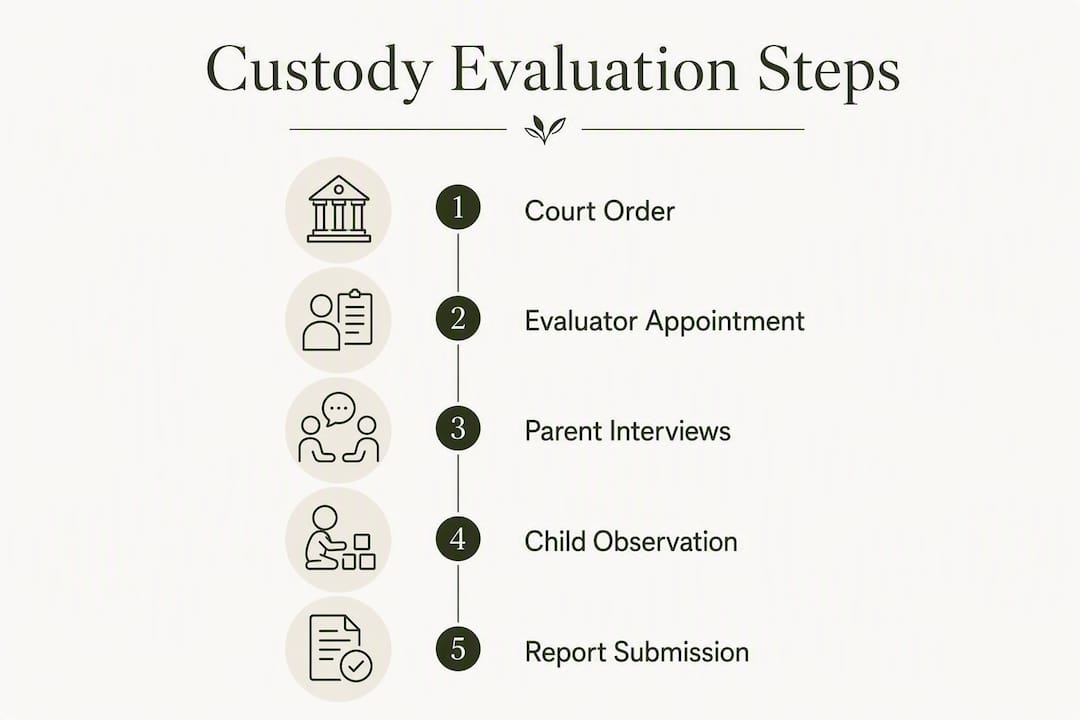
- What actually happens during a Utah custody evaluation, step by step?
- What factors does the evaluator actually weigh?
- How long does a custody evaluation take in Utah and who pays?
- How to prepare for your custody evaluation: a practical checklist
- How the evaluator's report affects the court's decision
- What to do if you think the evaluator got it wrong
- Attorneys, mediation, and alternatives to a full evaluation
- What the 2026 Utah changes mean for custody evaluations
- Key Takeaways
- What most parents underestimate about this process
- Divvi helps you prepare without the agency price tag
What is a custody evaluation in Utah and when does the court order one?
A custody evaluation is not a routine step in every Utah divorce or custody case. Courts treat it as a formal intervention, typically reserved for situations where standard proceedings cannot adequately surface what a child needs.
The Utah Courts self-help page on custody evaluations describes the evaluation as a structured process in which a licensed mental-health professional reviews records, conducts interviews, observes parent-child interactions, and contacts collateral sources such as teachers and therapists. The result is a professional opinion the court uses alongside all other evidence.
Common triggers for a court-ordered evaluation include:
- Allegations of abuse, neglect, or domestic violence
- High-conflict cases where parents cannot agree on basic parenting arrangements
- Concerns about a parent's mental health or substance use
- Relocation disputes where one parent wants to move with the child
- Situations where the child's stated preferences conflict sharply with one parent's position
Either party can file a motion requesting an evaluation. The court can also order one on its own motion if it finds extraordinary circumstances. Before appointing an evaluator, the court must confirm that both parties have the present ability to pay, per Rule 4-903.
The court does not order a custody evaluation simply because one parent asks for one. The requesting party typically must show the evaluation is necessary and that the cost is manageable for both parties.
What Utah statutes and court rules actually govern this process?
Three legal authorities shape every custody evaluation in Utah: Rule 4-903 of the Utah Code of Judicial Administration, Utah Code Section 81-9-204, and Utah Code Section 81-9-205.
Rule 4-903 is the procedural backbone. It defines who qualifies as an evaluator, what minimum steps the evaluation must include, and the timeline the court and parties must follow. A recent amendment shortened the window for requesting a written report from 45 days to 28 days after the custody evaluation conference. That deadline is easy to miss, and missing it can mean losing the right to a full written report.
Utah Code 81-9-204 and Utah Code 81-9-205 set out the best-interest factors the court weighs in any custody determination. Evaluators are expected to address these factors directly in their findings. The factors cover the child's relationship with each parent, the child's adjustment to home and school, each parent's ability to meet the child's physical and emotional needs, and the history of any abuse or coercive behavior.
Rule 4-903 also requires the evaluator to schedule a settlement conference after completing the assessment. This conference gives both parties a chance to hear the evaluator's verbal impressions and potentially resolve the case before a written report is ever filed.
The Utah Courts PDF version of Rule 4-903 is the most complete reference for procedural requirements, including continuing education expectations for evaluators and the specific steps for ordering and confirming the evaluation.
Who qualifies to serve as a custody evaluator in Utah?
Not everyone with a mental-health license can conduct a custody evaluation in Utah. Rule 4-903 specifies the acceptable licensure categories:
- Licensed psychologists
- Licensed clinical social workers (LCSWs)
- Licensed clinical mental health counselors (LCMHCs)
- Licensed marriage and family therapists (LMFTs)
- Psychiatrists
Beyond licensure, evaluators must have completed specialized training in child-custody topics and must maintain continuing education in the field. The rule was amended to add Licensed Clinical Mental Health Counselors to the approved list, reflecting the broader pool of qualified professionals now available in Utah.
Before an evaluator is appointed, you have the right to review their curriculum vitae. Look for direct experience conducting custody evaluations, training in domestic violence and trauma, and familiarity with the Utah statutory best-interest factors. An evaluator who primarily treats adults in private practice and has conducted only a handful of custody evaluations is a different proposition than one who does this work regularly.

Pro Tip: If you have concerns about an evaluator's qualifications or a potential conflict of interest, raise them before the appointment is finalized. Challenging an evaluator mid-evaluation is far harder and can look obstructive to the court. The Utah Division of Occupational and Professional Licensing lets you verify a license status online.
What actually happens during a Utah custody evaluation, step by step?
The process follows a predictable sequence, though the timeline varies by case complexity.
- Motion or stipulation. One party files a motion, or both parties agree, and the court enters an order appointing the evaluator and addressing fees.
- Fee order and ability-to-pay confirmation. The court confirms both parties can pay and typically allocates costs between them.
- Records gathering. The evaluator requests school records, medical and mental-health records, police reports, DCFS records, and any prior court orders. This stage is where delays most often occur.
- Individual parent interviews. Each parent meets separately with the evaluator, usually more than once.
- Child interviews. Children are interviewed in an age-appropriate way. Evaluators are trained to distinguish a child's genuine views from coached responses.
- Parent-child observations. The evaluator observes each parent interacting with the child, sometimes at home and sometimes in the evaluator's office.
- Collateral contacts. Teachers, therapists, pediatricians, and other relevant adults may be contacted for their observations.
- Psychological testing. Used selectively, not routinely. The evaluator decides whether standardized testing adds meaningful information.
- Settlement conference. The evaluator presents a verbal summary of findings. Parties can settle at this stage.
- Written report (if requested). Any party has 28 days after the conference to request a full written report. The report becomes part of the court record.
| Who is interviewed or observed | Why it matters |
|---|---|
| Each parent (individually) | Assesses parenting capacity, communication style, and understanding of the child's needs |
| Each child | Captures the child's perspective, adjustment, and relationship with each parent |
| Teachers and school staff | Provides independent view of the child's functioning and any changes in behavior |
| Therapists and pediatricians | Confirms mental and physical health history and any treatment concerns |
| Other collateral contacts | Grandparents, coaches, or childcare providers who observe regular parenting |
Common questions evaluators ask parents include: How do you handle disagreements with the other parent in front of your child? What does a typical school-night routine look like in your home? What are your child's current academic or social challenges? How do you support your child's relationship with the other parent?
What factors does the evaluator actually weigh?
The evaluator's job is to assess the statutory best-interest factors under Utah Code 81-9-204 and 81-9-205 and translate them into a professional recommendation. The core factors include:
- The child's bond with each parent and with siblings
- Each parent's ability to meet the child's physical, emotional, and developmental needs
- The child's adjustment to home, school, and community
- The child's own preferences, weighted by age and maturity
- Each parent's willingness to support the child's relationship with the other parent
- The mental and physical health of all parties
- Any history of abuse, domestic violence, or coercive control
- The distance between the parents' homes and the practicality of proposed arrangements
The 2026 updates to Utah law place particular weight on safety. Evaluators are now expected to be competent in identifying coercive control, which is a pattern of behavior rather than a single incident. A parent who controls finances, isolates the other parent from family, monitors communications, or uses the children as leverage may be engaging in coercive control even without physical violence.
Coercive control is harder to document than a single incident, but it leaves a pattern. Text message logs, financial records, witness accounts, and therapy notes can collectively tell a story that a one-time event cannot.
Documentation of these patterns matters more than ever. If you are in a high-conflict case with safety concerns, a discovery checklist can help you organize the evidence before the evaluator begins gathering records.
How long does a custody evaluation take in Utah and who pays?
Most routine custody evaluations in Utah take a period of a few months from appointment to settlement conference. Complex cases involving safety concerns, multiple children, or extensive records requests can run longer.
The most common sources of delay:
- Government records (DCFS, law enforcement) that take weeks to process
- Scheduling conflicts for child interviews, especially during school year
- Psychological testing that requires multiple sessions
- One party's failure to cooperate with records releases
On fees, the court's ability-to-pay finding at the outset shapes how costs are divided. Evaluators set their own rates, and a full evaluation including a written report can be a significant expense. The settlement conference stage, where the evaluator gives a verbal summary, often resolves cases before the written report is needed, which reduces total cost.
Pro Tip: Ask the evaluator at the first contact what their typical timeline looks like and when they plan to send records requests. Getting government records early is the single most controllable way to avoid delays. If you are concerned about costs, the Divvi divorce cost estimator can help you budget for evaluation fees alongside other case expenses.

How to prepare for your custody evaluation: a practical checklist
Preparation is not about performing for the evaluator. It is about making sure the evaluator has accurate, complete information about your parenting.
Documents to gather:
- School records (report cards, attendance, teacher communications, IEP or 504 plans)
- Medical and dental records for the child
- Mental-health treatment records for the child and, if relevant, for yourself
- DCFS records and any prior police reports
- Communication logs with the other parent (texts, emails)
- Calendars showing your parenting time and involvement in the child's activities
- Any prior court orders related to custody or protective orders
During interviews and observations:
- Be honest. Evaluators conduct multiple interviews and cross-reference information. Inconsistencies damage credibility far more than unflattering truths.
- Stay child-focused. Frame every answer around what your child needs, not what you want.
- Avoid criticizing the other parent gratuitously. Noting documented concerns is appropriate; venting is not.
- Do not coach your child before their interview. Evaluators are trained to identify coached responses, and coaching harms your credibility and your child.
- Maintain your normal routines during home visits. A suddenly spotless house and an unusually structured schedule can read as performance rather than reality.
When a child asks what the interview is about, a straightforward answer works best: "Someone is going to talk with you about our family so they can help the judge make good decisions for you." Keep it simple and reassuring, without suggesting what the child should say.
How the evaluator's report affects the court's decision
The evaluator's written report carries significant weight, but it is not a court order. The judge reviews it alongside all other evidence, including testimony, exhibits, and any other expert opinions.
The Utah Courts custody evaluation memo describes the settlement conference as a critical early stage where the evaluator's verbal impressions often allow parties to reach agreement without the cost and delay of a full written report. Many cases settle at this stage.
If the case proceeds to a written report, the evaluator typically addresses:
- Recommended legal custody arrangement (sole or joint)
- Recommended physical custody and parenting-time schedule
- Any conditions attached to parenting time (supervised exchanges, therapeutic contact, drug testing)
- Reunification steps if a parent-child relationship has been damaged
- Referrals for therapy, parenting classes, or other services
The evaluator's recommendations are influential, but the judge is not bound by them. Courts have overruled evaluator recommendations when other evidence at trial painted a different picture. The report is a powerful piece of evidence, not a verdict.
What to do if you think the evaluator got it wrong
Disagreeing with an evaluator's conclusions is not unusual. Acting on that disagreement effectively requires a clear sequence.
- Talk to your attorney first. Before filing anything, get a legal opinion on whether the concern is procedural (the evaluator skipped required steps) or substantive (the evaluator reached a wrong conclusion on the facts).
- File a timely objection or motion. Procedural problems should be raised promptly. Waiting until trial to raise a qualification issue you knew about earlier weakens your position.
- Request clarification. If the report contains factual errors (a date, a misquoted statement, a missing interview), you can ask the evaluator to address the discrepancy in a supplemental communication.
- Cross-examine at trial. If the case goes to hearing, your attorney can examine the evaluator on methodology, missing evidence, and the basis for specific recommendations.
- Request a supplemental or new evaluation. In cases involving significant procedural failures or newly discovered evidence, the court can order a supplemental assessment.
Pro Tip: Keep a dated log of any procedural problems as they occur: missed interview appointments, records the evaluator never requested, or communications that were not acknowledged. A contemporaneous log is far more credible than a list assembled after the report is issued.
Substantive disagreements (you think the evaluator weighed the factors incorrectly) are harder to remedy than procedural ones. The court gives evaluators professional deference. Your strongest counter is a well-documented factual record, not an argument that the evaluator was unfair.
Attorneys, mediation, and alternatives to a full evaluation
A full custody evaluation is not always the right tool. Three main options exist, and the choice depends on the nature of the dispute, the level of conflict, and the resources available.
- Mediation: Faster and less expensive than a full evaluation. Works well when both parents can negotiate in good faith and the primary dispute is about scheduling rather than safety. Mediators do not make recommendations to the court. Divvi offers both AI-assisted and human mediation options for parents who want a structured but lower-cost path.
- Limited or focused assessment: A narrower evaluation targeting a specific issue (a child's therapeutic needs, a parent's substance use) rather than a full custody picture. Less time-consuming and less expensive, but carries less evidentiary weight than a comprehensive evaluation.
- Full court-ordered evaluation under Rule 4-903: The most thorough option and the most expensive. Appropriate when safety is at issue, when the parties' accounts of parenting are dramatically different, or when the court needs an independent professional opinion to resolve a genuinely contested factual dispute.
Attorneys play a critical role at every stage: vetting evaluator credentials before appointment, preparing records packages, advising on settlement conference strategy, and cross-examining the evaluator if the case goes to trial. For parents navigating a contested case, Divvi's contested divorce support services connect you with attorneys who know the Utah custody process.
Never agree to a court-ordered evaluative or treatment program without attorney review, especially in cases involving domestic violence or coercive control. Some programs are not trauma-informed and can inadvertently harm a protective parent's position.
What the 2026 Utah changes mean for custody evaluations
Utah's 2026 legislative session brought meaningful changes to how custody evaluations are conducted and reviewed. H.B. 303 and the provisions sometimes called Om's Law shifted the statutory framework toward a safety-first model, with explicit attention to coercive control and domestic violence in custody proceedings.
The 2026 updates require evaluators to demonstrate competency in assessing domestic violence and coercive control. An evaluator who lacks that training is now more vulnerable to a qualification challenge than they would have been under prior law.
Practical implications for parents in active cases:
- Evaluators are expected to screen for coercive control patterns, not just documented physical abuse incidents.
- Courts are applying heightened scrutiny to reunification programs, particularly those that pressure a child to resume contact with a parent who has a history of abusive behavior.
- Trauma-informed expertise is now a meaningful credential to look for when reviewing an evaluator's CV.
Steps to take in light of these updates:
- Document patterns of controlling behavior with dates, screenshots, and witness names, not just isolated incidents.
- If your case involves domestic violence, ask your attorney whether the proposed evaluator has specific training in trauma-informed assessment.
- Review the 2026 Utah divorce law updates to understand how the broader statutory changes affect your case strategy.
- Consult an attorney early if you believe coercive control is a factor. The evidentiary bar for establishing a pattern is higher than for a single incident, and preparation matters.
For a detailed breakdown of what H.B. 303 changed and how courts are applying the new safety-first framework, this 2026 custody evaluation guide from Coil Law is a useful reference.
Key Takeaways
A Utah custody evaluation is a court-ordered, neutral assessment governed by Rule 4-903 and the best-interest factors in Utah Code 81-9-204 and 81-9-205, and parents who prepare early, document carefully, and stay child-focused are best positioned for a fair outcome.
| Point | Details |
|---|---|
| Verify evaluator credentials | Confirm licensure and domestic-violence training before appointment using the Utah DOPL license lookup. |
| Request records early | Government records (DCFS, police) take the longest; start requests as soon as the evaluation is ordered. |
| Use the settlement conference | The Rule 4-903 conference is a real opportunity to resolve the case before a written report is filed. |
| Document coercive control patterns | Under 2026 Utah law, patterns of controlling behavior carry more weight than isolated incidents. |
| Divvi for document prep | Divvi's free tools, document wizards, and attorney-review options help parents organize records and prepare documents designed for filing. |
What most parents underestimate about this process
The custody evaluation is not a test you pass by being the better parent on the day of the interview. Evaluators are looking at the whole picture: your child's adjustment, the consistency of your involvement over time, and how you talk about the other parent when the stakes are high.
The parents who fare worst in evaluations are usually not the ones with complicated histories. They are the ones who walk in treating the evaluator like a judge to persuade. They over-prepare their children, bring binders of evidence designed to bury the other parent, and answer every question with a rehearsed talking point. Evaluators see this constantly, and it reads as a parent who is more focused on winning than on the child.
The 2026 safety-first reforms are genuinely significant, but they do not change the fundamental dynamic. A parent with real safety concerns needs to document them clearly and raise them through proper channels, not perform distress for the evaluator. A parent without safety concerns needs to demonstrate consistent, child-centered parenting, not a flawless performance.
The settlement conference is the most underused opportunity in the entire process. Most parents and even some attorneys treat it as a formality before the written report. It is not. The evaluator's verbal impressions at that conference often reflect where the recommendations are heading, and a skilled attorney can use that moment to negotiate a resolution that avoids the cost, delay, and uncertainty of a full written report and a contested hearing.
Prepare seriously. Be honest. Keep your child at the center of every answer. That is not a strategy. It is just what the process is designed to surface.
Divvi helps you prepare without the agency price tag
Facing a custody evaluation while managing court filings, records requests, and attorney coordination is a lot to handle at once. Divvi gives Utah parents a practical alternative to paying full attorney rates for every document and every step.

The platform's free document wizard generates documents designed for filing, and the family management plan tool helps you build a proposed parenting arrangement before the evaluator ever asks for one. If your case is contested, Divvi connects you to attorney review, mediation services, and contested-case support at a fraction of traditional law firm costs. You pay only for what you actually need.
Divvi is not a custody evaluator and does not provide clinical opinions. What it does is help you get organized, prepare accurate documents, and connect with the right professionals when your case requires them. For parents who need to assemble records, draft a parenting plan, or get an attorney to review their filings before a critical hearing, start with the Divvi platform and use the tools that fit your situation.
This article provides general legal information about Utah custody evaluations. It is not legal advice. Confirm current rules and procedures with a licensed Utah family law attorney or the Utah Courts directly.