Can You Cancel a Divorce After Filing in Utah?
Written and reviewed by the divvi team. How we research and check this.

You can cancel a divorce after filing in Utah as long as a judge has not yet signed the final decree. The formal term for this process is "voluntary dismissal," and the steps involved depend heavily on one factor: whether your spouse has already responded to the petition. Acting quickly gives you the most control. Wait too long, and what starts as a simple one-page filing becomes a court hearing requiring a judge's approval.
Can you cancel a divorce after filing in Utah?
Cancelling a divorce after filing is legally possible at any point before a judge signs the final decree. The process is most straightforward when the respondent has not yet filed an answer. In that window, you hold full control over the case.
The specific document you file is called a Notice of Voluntary Dismissal. You submit it to the same court where you filed the original divorce petition. No hearing or judge approval is required at this stage. The case closes automatically once the notice is filed correctly.
Two types of dismissal exist, and the difference matters:
- Without prejudice: The case closes, but you retain the right to refile later if needed. This is the standard outcome in most voluntary dismissals.
- With prejudice: The case closes permanently. Refiling on the same grounds is barred. Courts rarely impose this without a specific reason.
Timing is critical to keeping the process simple. Every day that passes after your spouse receives the petition is a day closer to losing your unilateral right to dismiss. Utah courts follow the same procedural logic as federal Rule 41(a): once the other party participates, the rules change.
Pro Tip: Check the Utah divorce timeline before you file a dismissal. Knowing exactly where your case stands in the court calendar helps you act before any scheduled hearings lock the process in.

How does a spouse's response change your dismissal options?
The moment your spouse files an answer or counter-petition, your unilateral right to dismiss disappears. You lose automatic dismissal rights the instant any substantive response enters the court record. From that point forward, stopping the divorce requires either written consent from your spouse or a court order.
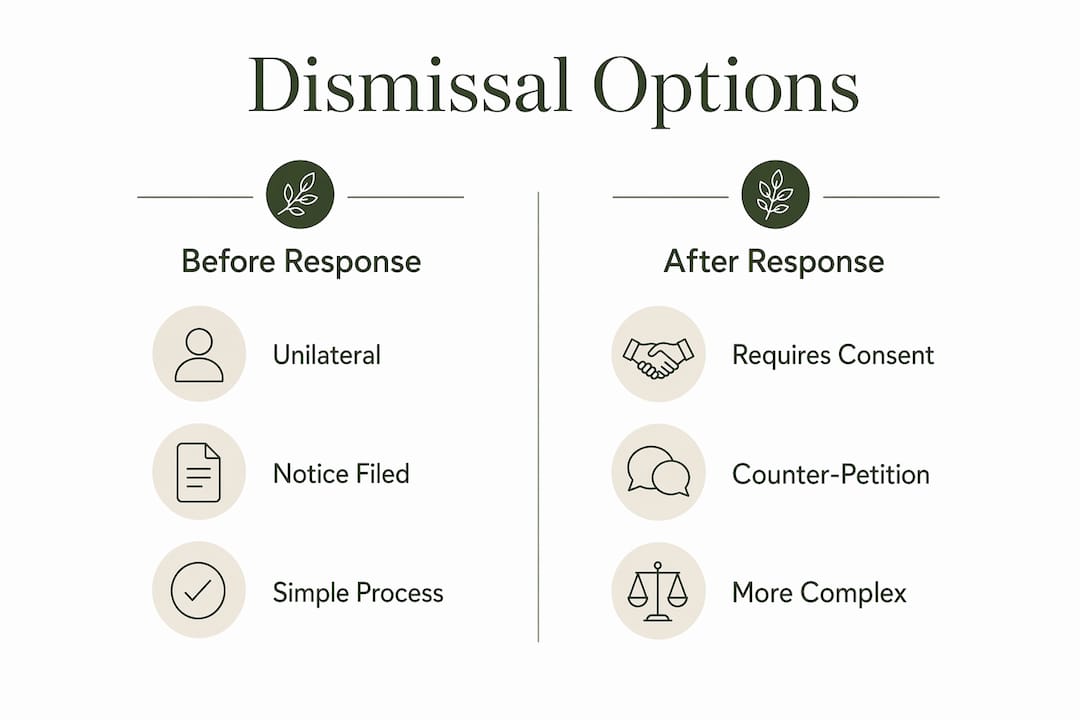
This shift matters more than most people realize. The court does not simply rubber-stamp a dismissal request after a response has been filed. A judge weighs several factors, with the primary one being prejudice to the other spouse. If your spouse has spent money on legal fees, gathered financial records, or made life decisions based on the pending divorce, the court may deny your motion to dismiss.
Here is what changes once your spouse responds:
- A joint motion or stipulation to dismiss becomes the cleanest path forward.
- An agreed dismissal avoids a hearing and keeps the process private.
- If your spouse refuses to agree, you must file a formal motion and attend a court hearing.
- The judge has full discretion to deny dismissal if it would unfairly harm your spouse.
One scenario catches many people off guard: a counter-petition. If your spouse filed their own petition for divorce, that counter-petition stays active even if you withdraw your original filing. Withdrawing your petition does not end the case. Your spouse's counter-petition continues moving forward, and the divorce can proceed without your original filing.
Pro Tip: Before assuming your spouse will agree to a joint dismissal, get that agreement in writing. Verbal agreements carry no legal weight in Utah family court. A signed stipulation protects both of you.
What happens to temporary orders when a divorce is dismissed?
Dismissing a divorce case does not automatically cancel temporary orders. This is one of the most overlooked consequences of withdrawing a divorce petition, and ignoring it creates real legal risk.
Temporary orders for child support, custody, or property restraints remain enforceable until a court explicitly vacates them. Failing to address temporary orders in your dismissal paperwork leaves them in legal limbo. You could find yourself bound by a child support payment schedule or a no-transfer order on property long after you believed the case was closed.
Follow these steps to close a dismissed case properly:
- List every active temporary order in your dismissal paperwork. Do not assume the court knows which orders exist.
- File a motion to vacate each temporary order alongside or immediately after your dismissal notice.
- Confirm the vacatur in writing. Request a signed court order confirming each temporary order is lifted.
- Verify the court record. Log into the Utah court's online case management system and confirm the case status shows "dismissed" with no pending orders.
- Keep copies of everything. Store the dismissal notice, vacatur orders, and case closure confirmation in a secure place.
The family management tools available through Divvi can help you track custody and support arrangements during this period, especially if children are involved and the situation remains unsettled.
Is it possible to cancel a divorce after the final decree is signed?
Once a judge signs the final decree, the marriage is legally over. A completed divorce cannot be cancelled through any standard dismissal filing. The parties' legal status changes to single, and every provision in the decree, covering property division, custody, and support, becomes an enforceable court order.
Limited legal remedies exist, but the bar is high. A motion to vacate a judgment must typically be filed within 30 days of the decree and requires proving fraud, mistake, or a serious procedural error. Courts do not reopen finalized divorces because the parties changed their minds. The legal system treats a signed decree as final.
If reconciliation happens after a final decree, the only path to resuming the marriage is remarriage. There is no legal mechanism to "undo" a dissolution. The couple must go through a new marriage ceremony and obtain a new marriage license.
| Situation | Dismissal possible? | What you need |
|---|---|---|
| Before spouse responds | Yes, unilaterally | Notice of Voluntary Dismissal |
| After spouse responds | Yes, with agreement | Joint stipulation or court order |
| After spouse files counter-petition | Partial only | Court order; counter-petition continues |
| After final decree is signed | No | Motion to vacate within 30 days (fraud/error only) |
| Reconciliation post-decree | No dismissal option | Remarriage required |
The pros and cons of filing first are worth reviewing if you are reconsidering your position before the decree is issued. Understanding your procedural standing at each stage helps you make decisions before options close.
Key Takeaways
Cancelling a divorce in Utah is fully possible before the final decree, but the window for simple, unilateral action is narrow and closes the moment your spouse responds.
| Point | Details |
|---|---|
| Act before spouse responds | Filing a Notice of Voluntary Dismissal before any response ends the case automatically. |
| Joint dismissal after response | Once your spouse responds, you need written consent or a court order to stop proceedings. |
| Counter-petitions survive withdrawal | Withdrawing your petition does not end a counter-petition filed by your spouse. |
| Vacate temporary orders explicitly | Temporary support and custody orders stay enforceable until a court formally vacates them. |
| Final decree is permanent | A signed final decree cannot be cancelled; reconciliation after that point requires remarriage. |
What waiting too long actually costs
The most common mistake is treating a divorce filing like a pause button. They file, things cool down at home, and they assume the case is just sitting there quietly. It is not. Courts schedule hearings, clerks send notices, and spouses consult attorneys. By the time someone decides they want to stop the process, their spouse has already filed a response and the simple one-page dismissal is off the table.
The second mistake is assuming a verbal agreement with a spouse is enough. Couples shake hands on reconciliation, then one partner changes their mind three weeks later. Without a signed stipulation in the court record, that handshake means nothing. The divorce continues.
The third thing people get wrong is the temporary orders issue. Someone dismisses their case, moves back in with their spouse, and six months later gets served with a contempt motion because a child support order they forgot about was never vacated. Court clerks can provide dismissal forms but cannot advise you on the legal effect of what you are signing. That gap is where people get hurt.
My honest advice: if you are considering withdrawing a divorce petition, treat it with the same seriousness as filing it. Verify every order, get every agreement in writing, and confirm the case closure with the court directly. A dismissal is a full stop. If you later decide to divorce again, you start from scratch and refile entirely.
— Landon
How Divvi supports couples reconsidering their divorce
Changing course mid-divorce is more common than most people expect, and the paperwork involved can be just as confusing as the original filing.
Divvi handles the full range of Utah divorce situations, including case withdrawals, document preparation for joint stipulations, and temporary order management. The document audit service reviews your existing filings to flag any active orders that need to be addressed before dismissal. The base platform is free to use, and you only pay for the specific services your situation requires. Whether you are stopping a divorce, modifying existing orders, or simply need clarity on where your case stands, Divvi's step-by-step process gives you documents designed for filing without the confusion. Visit the Utah divorce resource center to see exactly where your case fits.
FAQ
Can you stop a divorce once you file in Utah?
Yes. You can stop a divorce in Utah at any point before the judge signs the final decree. The process is simplest before your spouse files a response.
What form do you file to cancel a divorce in Utah?
You file a Notice of Voluntary Dismissal with the court where you originally filed the petition. If your spouse has already responded, you need a joint stipulation or a court-approved motion instead.
Does cancelling a divorce cancel child support orders?
No. Temporary child support and custody orders remain enforceable after dismissal unless the court explicitly vacates them. You must request vacatur in your dismissal paperwork.
What happens if my spouse already filed a counter-petition?
Withdrawing your original petition does not end your spouse's counter-petition. That filing stays active, and the divorce can proceed on the counter-petition alone unless your spouse also agrees to dismiss.
Can you undo a divorce after the final decree is signed?
No. Once a judge signs the final decree, the divorce is legally complete and cannot be cancelled. The only option to resume the marriage is to remarry. A motion to vacate is available only within a strict timeframe and only for fraud, mistake, or procedural error.