Best Divorce Mediators Near Me: How to Pick One Fast
Written and reviewed by the divvi team. How we research and check this.

If you're in Utah, the clearest starting point is Divvi's vetted mediator network, which matches you to a local, qualified mediator and pairs that match with attorney-reviewed, documents designed for filing. If you're outside Utah, the checklist in the next section will walk you through verifying a qualified mediator in your state.
The short version:
- Utah residents: Use Divvi to get matched with a vetted local mediator and access mediation-ready document tools.
- Outside Utah: Search your state court's mediator roster, confirm the mediator is trained in family law, and verify neutrality before you pay anything.
- Everyone: Have a consulting attorney review the final settlement before you file, regardless of how smooth the process feels.
Mediation is the recognized alternative dispute resolution process for divorce, and the quality of your mediator shapes everything from how long it takes to whether the agreement holds up in court.
Table of Contents
- How do you find and verify a qualified divorce mediator near you?
- What does mediation cost, and how long does it take?
- When mediation is the wrong choice
- Divvi makes Utah mediation faster and less expensive
- Key Takeaways
How do you find and verify a qualified divorce mediator near you?
The phrase "near me" is intuitive but slightly misleading. Because family law is state-governed, the most important qualifier is state expertise, not physical proximity. An online mediator licensed and experienced in your state's law can be as effective as someone two miles away.

That said, here is how to build a solid candidate list and verify each one.
Where to look first
- Your state court's mediator roster. Many states publish official lists of court-rostered mediators. In Utah, the Utah Courts mediation roster filters by specialty, including divorce and family law. Being court-rostered means the mediator has met state-specific training and experience benchmarks, which is a meaningful baseline.
- State bar family law sections. Many state bars maintain referral lists of mediators with family law backgrounds.
- Local court clerk's office. Ask directly which mediators are approved for your county's family court.
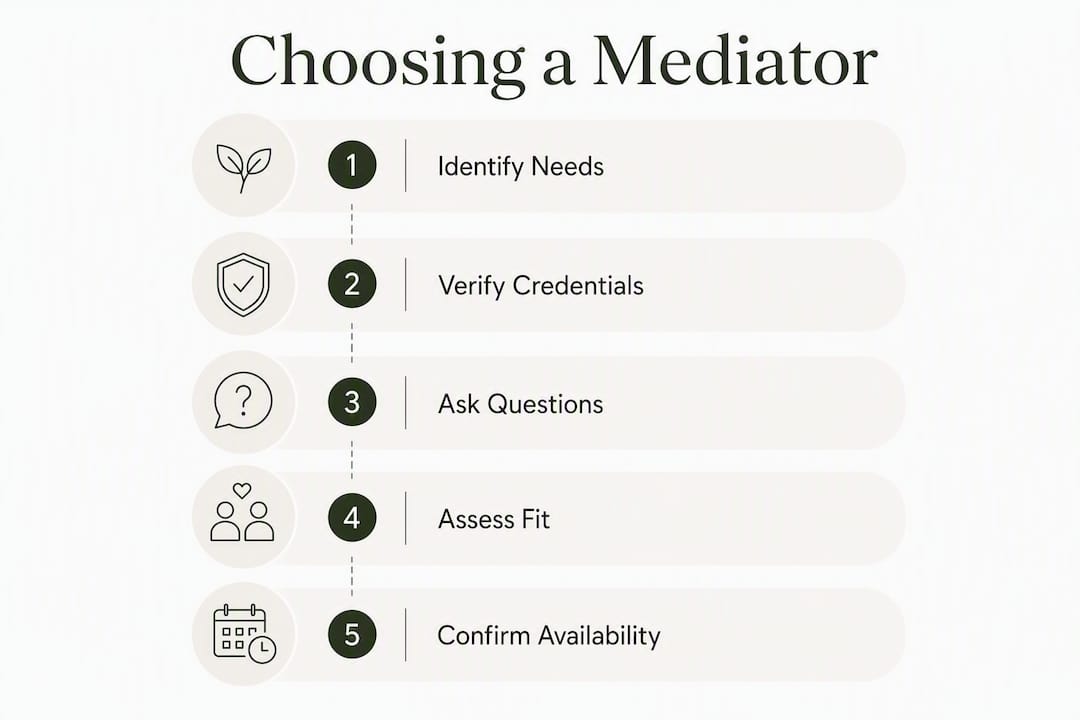
Verification checklist before you book
- Confirm the mediator is court-rostered or holds documented training hours in family law mediation.
- Ask for a written neutrality statement and conflict-of-interest disclosure.
- Request a sample engagement agreement before the first paid session.
- Compare at least two or three estimates on fees, session structure, and timeline.
- Ask specifically whether they have handled cases like yours: child custody disputes, high-asset division, or an uncooperative spouse.
What to ask at the initial meeting
- How do you structure sessions, and what is the typical number of sessions for a case like mine?
- How do you handle documentation, and do you coordinate with attorneys?
- What are your fees, and what is your cancellation policy?
- Have you handled cases involving [your specific issue: custody, business assets, interstate complications]?
Pro Tip: Ask the mediator directly whether they have experience with uncooperative spouses. A skilled mediator will describe a specific process for managing impasse, not just reassure you it rarely happens.
Preparing for sessions matters as much as choosing the right person. Communication tools like Meet Me Here can help you and your spouse organize your positions and reduce friction before you walk into a session.
What does mediation cost, and how long does it take?
Mediation costs vary significantly by complexity, state, and pricing model. The most commonly cited national range runs from $150 to $500 per hour, or roughly $2,000 to $8,000 total for a full divorce mediation. That spread is wide because a single-issue session (dividing one asset, resolving one parenting question) looks nothing like a contested case with children, a family business, and interstate complications.
Cost snapshot: Hourly rates of $150–$500 are typical nationally; flat-fee packages exist for simpler cases and can reduce total cost when the scope is well-defined.
Common pricing models:
- Hourly billing: Most common for complex or contested cases. You pay for time used, which rewards preparation.
- Flat-fee packages: Some providers offer fixed pricing for straightforward uncontested divorces. These work well when both parties are aligned on most issues.
- Single-issue sessions: A focused session on one disputed point, such as a parenting schedule or asset split, billed at a lower total cost.
Timeline by scenario:
- Simple, single-issue: One to two sessions, often resolved in a few weeks.
- Uncontested divorce with minor complexity: Three to five sessions over four to eight weeks.
- High-asset or contested cases: Multiple sessions over several months, sometimes longer if court filings require additional steps.
State rules add another layer. Utah, for example, has specific parenting-plan standards and child support formulas that a mediator unfamiliar with state law may not apply correctly. A mediator in California faces different disclosure requirements and community property rules. This is why state expertise matters more than zip code proximity.
When mediation is the wrong choice
Mediation's core limitation is structural: it requires voluntary participation and good-faith negotiation. A mediator must remain neutral and cannot represent either spouse. When one party refuses to engage honestly, the process breaks down, and court intervention becomes the realistic fallback.
Common failure scenarios:
- One spouse refuses to disclose assets or provides incomplete financial information.
- A history of domestic violence or coercion makes voluntary, equal negotiation impossible.
- A significant power imbalance leaves one party unable to advocate for their own interests.
- One party uses mediation sessions to delay proceedings rather than resolve them.
Red flags to watch for during intake:
- The mediator shows a preference for one party's position before both sides have been heard.
- No written conflict-of-interest check is offered.
- You feel pressure to sign a settlement agreement at the end of the first session.
- Fee terms are verbal only, with no written engagement agreement.
Avoid inflammatory language and threats during sessions; mediation works by focusing on interests and goals, not positions and grievances. If you find yourself preparing arguments rather than solutions, that is a signal to recalibrate before the session, not during it.
When domestic violence, hidden assets, or a genuinely uncooperative spouse is in the picture, consult a family law attorney before committing to mediation. An attorney can also review any settlement language before you file, which is standard practice regardless of how straightforward the case seemed.
Divvi makes Utah mediation faster and less expensive
For Utah residents, Divvi removes the two biggest friction points in mediation: finding a qualified mediator you can trust and producing documents designed for filing without a full litigation bill.
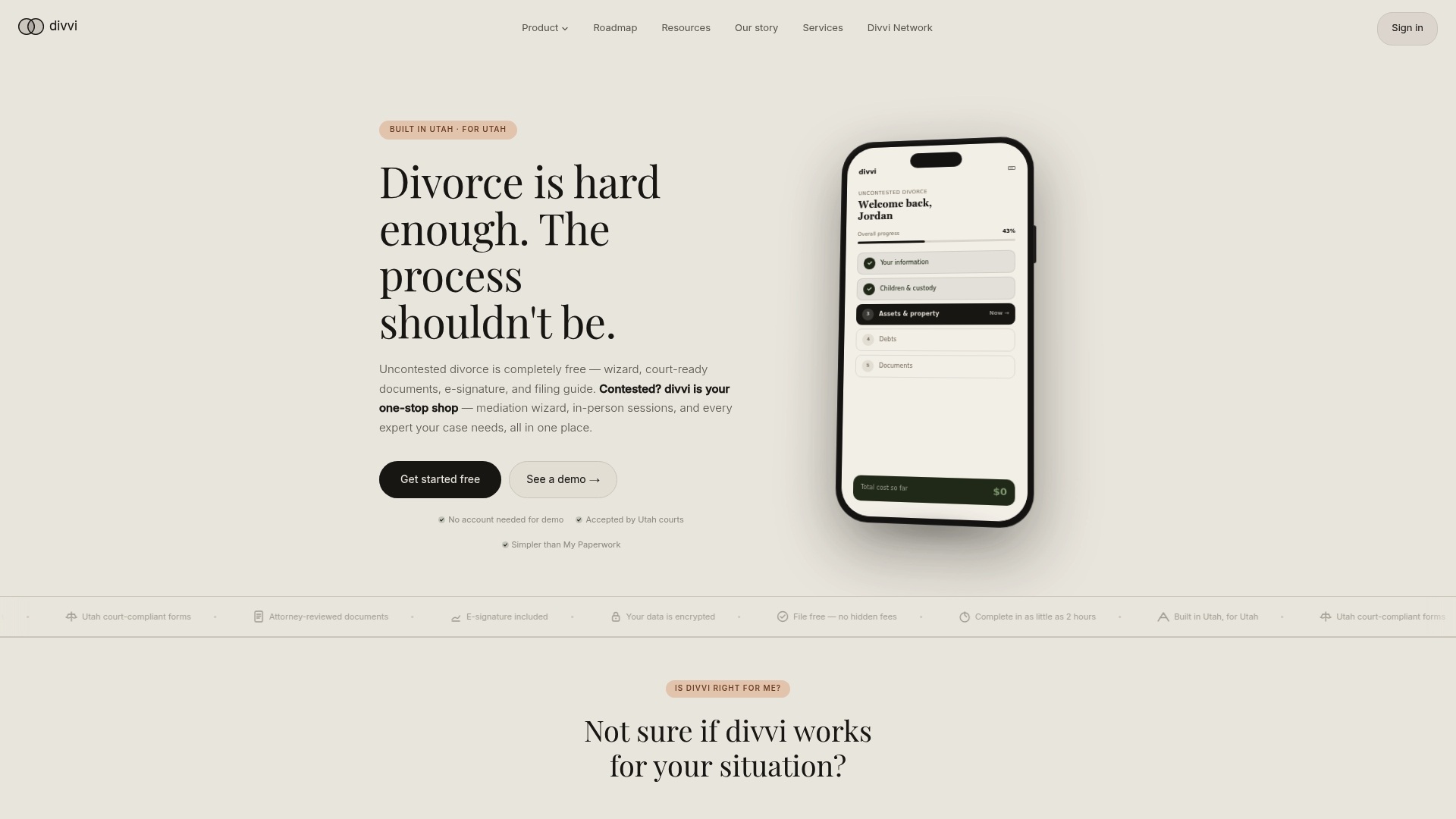
Divvi's vetted mediator network matches you to a local mediator based on your case type, whether that is a simple uncontested divorce, a custody dispute, or a case involving an uncooperative spouse. Every document generated through the platform is attorney-reviewed, so what you bring to mediation and what you file afterward meets Utah court standards. Uncontested cases can be completed in as little as two hours through the platform's step-by-step wizard, and the base service is free. You pay only for what your case actually needs: mediation support, attorney review, financial guidance, or post-decree modifications.
The Divvi mediation page walks you through the process from match to intake to final filing. If your situation changes after the decree, the platform also handles modifications. Start there, confirm your case type, and get matched.
Key Takeaways
The best divorce mediator near you is one who is court-rostered in your state, neutral, experienced in your specific case type, and willing to put fees and terms in writing before the first session.
| Point | Details |
|---|---|
| Utah residents: start with Divvi | Divvi matches you to a vetted local mediator with attorney-reviewed, documents designed for filing. |
| Verify court-rostered status | Court-rostered mediators have met state training and experience benchmarks; check your state's official roster. |
| Budget varies significantly | National divorcemediation costs are typically between $150 and $500 per hour, or $2,000 to $8,000 total; flat-fee packages are available for simpler cases. |
| Know when to stop mediating | Hidden assets, domestic violence, or a non-cooperative spouse are signals to consult a family law attorney instead. |
| Always get attorney review | Have a consulting attorney review the final settlement before filing, regardless of how smooth the process was. |
A note from Landon
Full disclosure: divvi publishes this guide, so this is what we offer, not an outside recommendation. For Utah readers that means a mediator network and a guided workflow, so you are not starting from scratch with a mediator you know nothing about.
For readers outside Utah, the verification checklist and cost ranges in this article give you a practical framework that works in any state. Prioritize state expertise, confirm court-rostered status, and never skip the attorney review before filing. Those three steps hold regardless of where you live.
Useful sources and where to go next
- Utah Courts — Court Roster of Mediators by Area of Expertise: Search Utah's official mediator roster by specialty, including divorce and family law.
- Utah Courts — Mediation Provider FAQ: Explains what court-rostered status means and how mediators qualify in Utah.
- JAMS ADR — Mediators and Ethics: Authoritative guidance on mediator neutrality and ethical obligations.
- Mediate.com — Good Faith in Mediation: Explains why good-faith participation is the foundation of any successful mediation.
- Divvi — Mediation Services: Start here if you're a Utah resident ready to begin the mediation process.
- Divvi — Vetted Mediator Network: See how Divvi matches Utah residents to qualified local mediators.
This article is general information, not legal advice. Confirm current rules and your specific options with a licensed family law attorney or your state's court resources.